



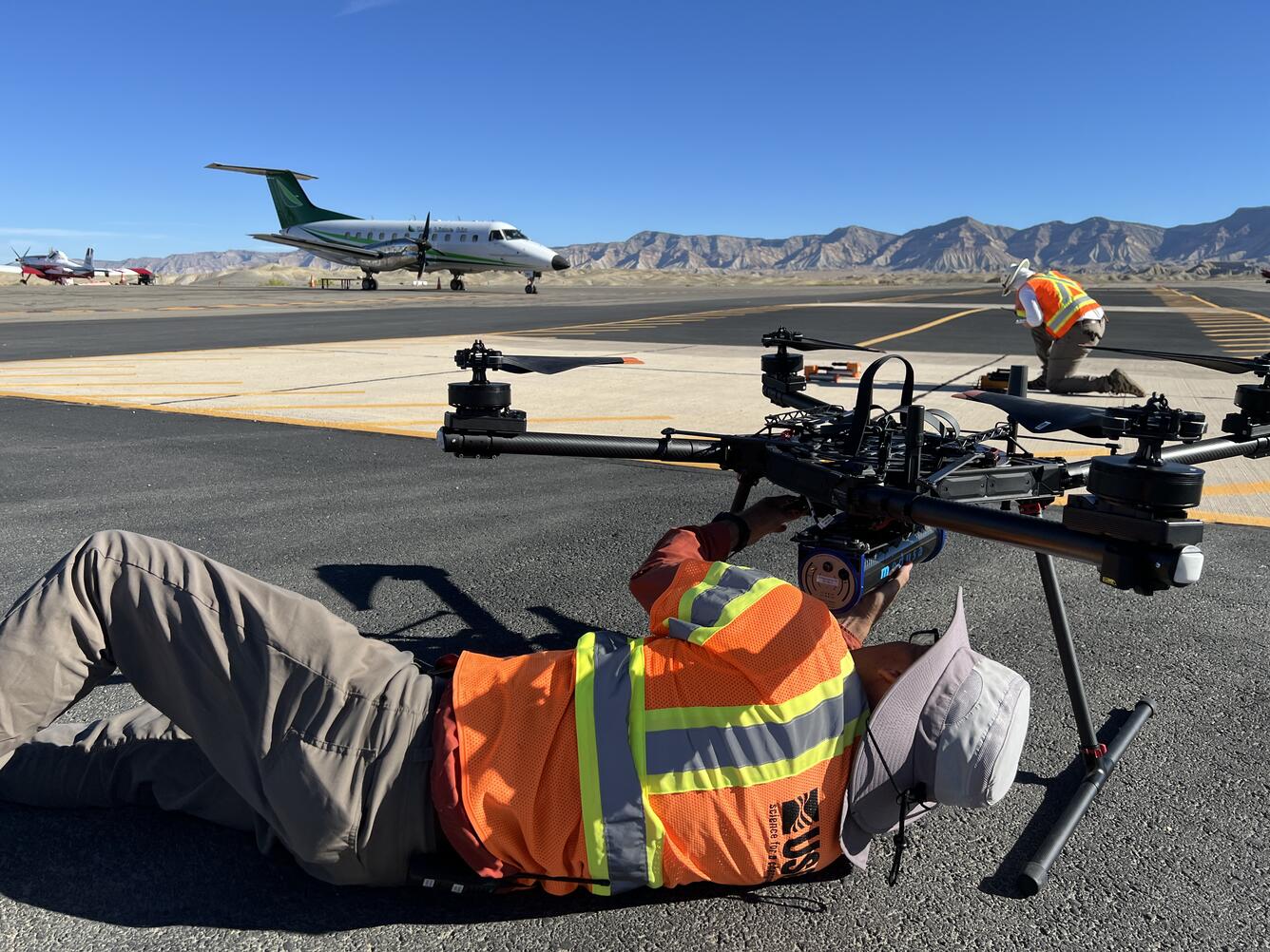
Securing sensors to UAS


Detailed Description
A USGS remote pilot secures a gamma ray spectrometer sensor onto an uncrewed aircraft system (UAS) at the Grand Junction Regional Airport (GJT) in Grand Junction, CO. Concrete pads built into the tarmac at GJT contain known concentrations of naturally occurring radioactive materials including Potassium, Thorium, and Uranium for radiometric calibration.
Sources/Usage
Public Domain.
Related

NUSO Research Missions
Research missions, often performed in cooperation with other DOI bureaus as well as non-DOI collaborators, serve as vital tools in the ongoing evaluation and integration activities that support the strategic implementation of UAS into the USGS and the DOI. * Any use of trade, firm, or product names is for descriptive purposes only and does not imply endorsement by the U.S. Government.

National Uncrewed Systems Office
The U.S. Geological Survey (USGS) National Uncrewed Systems Office (NUSO) leads the research activities needed to make Uncrewed Aircraft Systems (UAS) data collection an efficient, safe, and cost-effective remote sensing tool for Department of the Interior (DOI) and USGS scientists.
Related
NUSO Research Missions
Research missions, often performed in cooperation with other DOI bureaus as well as non-DOI collaborators, serve as vital tools in the ongoing evaluation and integration activities that support the strategic implementation of UAS into the USGS and the DOI. * Any use of trade, firm, or product names is for descriptive purposes only and does not imply endorsement by the U.S. Government.
National Uncrewed Systems Office
The U.S. Geological Survey (USGS) National Uncrewed Systems Office (NUSO) leads the research activities needed to make Uncrewed Aircraft Systems (UAS) data collection an efficient, safe, and cost-effective remote sensing tool for Department of the Interior (DOI) and USGS scientists.