



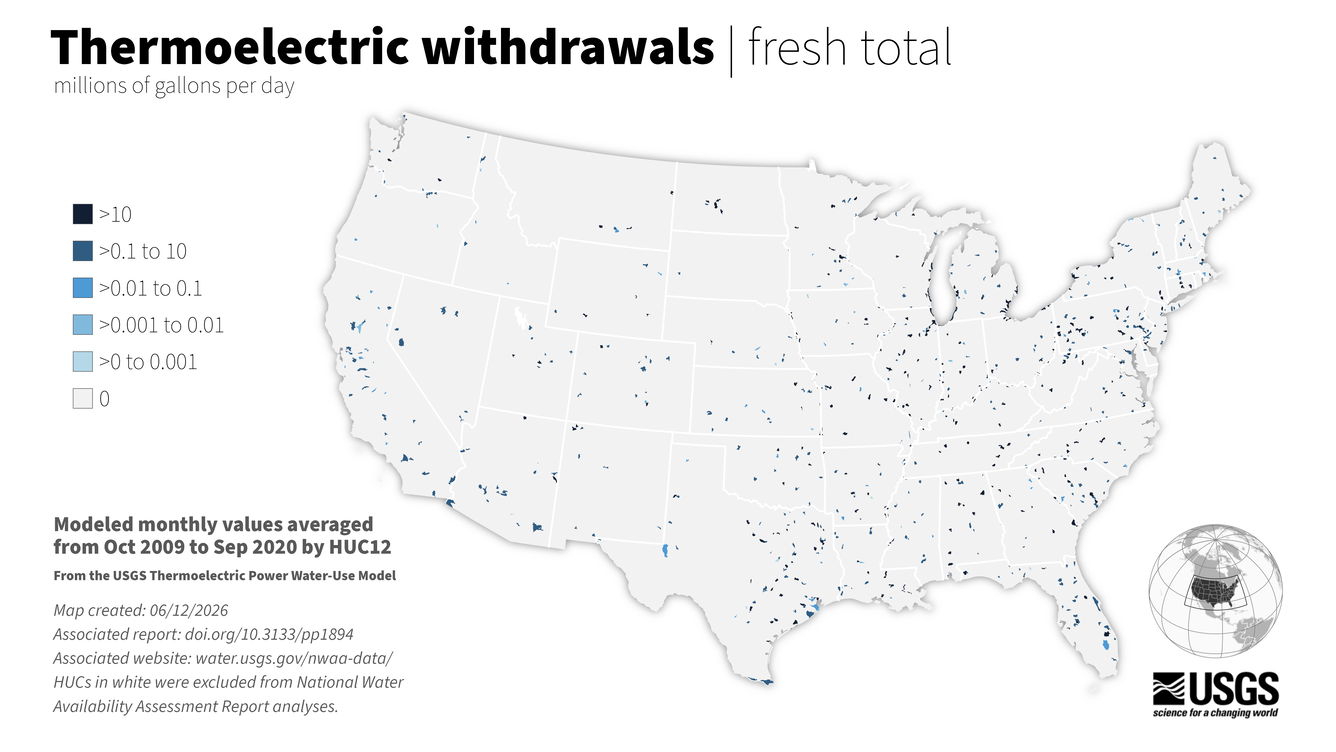
Thermoelectric Power Water Use map, monthly averages 2009-2020 by watershed


Detailed Description
This model computes the amount of water withdrawn and consumed by thermoelectric power plants each month over the period from 2008 to 2020 for all subwatersheds (12-digit Hydrologic Unit Codes or HUC12s) in the conterminous United States (CONUS).
Thermoelectric power plants withdraw more water than any other sector of water use in the United States and consume water at rates that can be significant especially in water-stressed regions. Water is primarily used for cooling purposes and is withdrawn from a source, routed through a plant’s condenser to cool the steam used to generate electricity, and consumed in a cooling system via evaporation. In this model, the amount of water that is withdrawn and consumed by thermoelectric power plants is computed based on linked heat-and-water budgets, accounting for power plant generation and cooling system technologies, the quantity of fuels consumed and electricity generated, and environmental factors such as air temperatures, water temperatures, wind speed, and elevation.
Published through the National Water Availability Assessment Data Companion.
Sources/Usage
Public Domain.
Related
Related science pages

Thermoelectric Power Water Use

Accessing Water Use Data

Water Use in the United States

National Water Availability Assessments
National Water Availability Assessment: Key Findings

National Water Availability Assessment Reports

National Water Availability Assessment Data Companion
Related
Related science pages
Thermoelectric Power Water Use
Accessing Water Use Data
Water Use in the United States
National Water Availability Assessments
National Water Availability Assessment: Key Findings
National Water Availability Assessment Reports