



National Fish Habitat Partnership (NFHP)
The National Fish Habitat Partnership (NFHP) is a collaborative effort working towards a common mission to protect, restore, and enhance the nation's fish and aquatic communities through partnerships that foster fish habitat conservation and improve the quality of life for the American people.
Under the NFHP program, federal, state, tribal, and privately raised funds are leveraged through regional Fish Habitat Partnerships to address the nation’s biggest fish habitat challenges. Fish Habitat Partnerships are the working units of NFHP. These local partnerships implement strategically identified fish habitat conservation projects in communities and on waterways across the country.
In 2020, the America's Conservation Enhancement Act formally recognized NFHP as federal law and identified the U.S. Geological Survey as a key partner as a science agency.
How NFHP Operates
- National Leadership: A governing board promotes, oversees and coordinates implementation of the Partnership, establishes national goals and priorities for fish habitat conservation, and recommends fish habitat conservation projects.
- Regional Partnerships: There are currently twenty recognized Fish Habitat Partnerships (FHPs) that promote cooperation and coordination to enhance fish populations and fish habitats. FHPs also build diverse support for fish habitat conservation and develop strategic plans and partnerships to help implement local and regional priority projects. Each FHP has unique geographic priorities and conservation goals.
- Science & Data Committee: Informs decisions and strategies within NFHP with best available science and data.
USGS Contributions
The U.S. Geological Survey (USGS) is a key partner in implementing NFHP, working alongside states, tribes, other federal agencies, conservation organizations, and industry. NFHP emphasizes an evidence-based decision-making strategy to ensure limited funding for fish habitat conservation is used effectively. This mission aligns closely with USGS’s science and data expertise.
Through shared scientific leadership across national and regional leadership, committees, and staff positions, USGS has helped shape NFHP’s direction and priorities. The primary role of USGS has centered on providing analytical and data management support, ensuring that conservation decisions are grounded in the best available science.
Key USGS Contributions
- Serving on national governance board and leading the science and data committee.
- Collaborating on assessments and modeling of fish habitat, fish distributions, and water quality/quantity.
- Advising on data systems, project information management, and integration.
- Supporting project design, implementation, and monitoring.
Benefits of USGS Involvement
- Maximizing Funding Integration: USGS helps coordinate the integration of local, regional, and national projects to maximize benefits of project resources and results.
- Stakeholder Engagement: USGS brings conservation communities together to identify local science needs, maximize impact of research tools, and expand collaborative networks.
- High-quality Science: USGS upholds and shares with the Partnership the highest levels of science quality, integrity, and transparency.
To learn more about NFHP and how to get involved please visit https://fishhabitat.org.
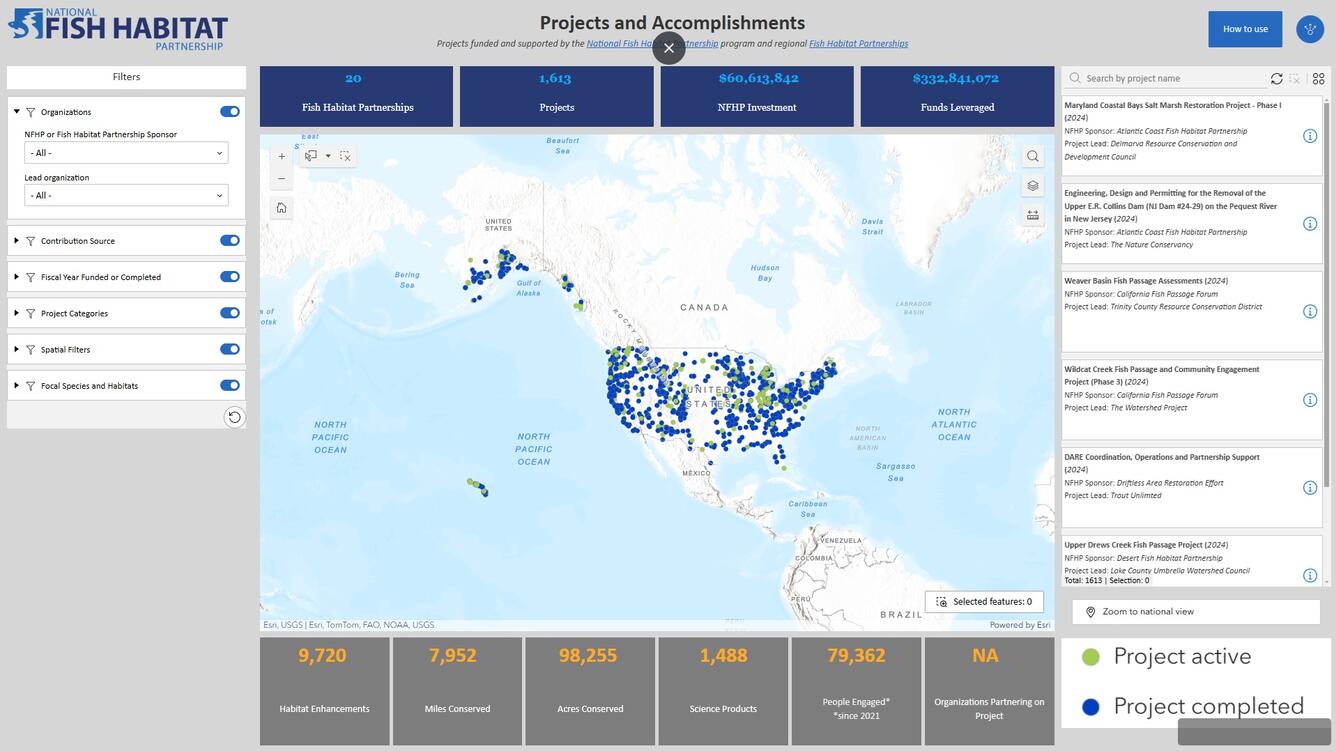

Enhancing Decision Support with Restoration Project Data Pipelines
The National Fish Habitat Partnership (NFHP) is a collaborative effort working towards a common mission to protect, restore, and enhance the nation's fish and aquatic communities through partnerships that foster fish habitat conservation and improve the quality of life for the American people.
Under the NFHP program, federal, state, tribal, and privately raised funds are leveraged through regional Fish Habitat Partnerships to address the nation’s biggest fish habitat challenges. Fish Habitat Partnerships are the working units of NFHP. These local partnerships implement strategically identified fish habitat conservation projects in communities and on waterways across the country.
In 2020, the America's Conservation Enhancement Act formally recognized NFHP as federal law and identified the U.S. Geological Survey as a key partner as a science agency.
How NFHP Operates
- National Leadership: A governing board promotes, oversees and coordinates implementation of the Partnership, establishes national goals and priorities for fish habitat conservation, and recommends fish habitat conservation projects.
- Regional Partnerships: There are currently twenty recognized Fish Habitat Partnerships (FHPs) that promote cooperation and coordination to enhance fish populations and fish habitats. FHPs also build diverse support for fish habitat conservation and develop strategic plans and partnerships to help implement local and regional priority projects. Each FHP has unique geographic priorities and conservation goals.
- Science & Data Committee: Informs decisions and strategies within NFHP with best available science and data.
USGS Contributions
The U.S. Geological Survey (USGS) is a key partner in implementing NFHP, working alongside states, tribes, other federal agencies, conservation organizations, and industry. NFHP emphasizes an evidence-based decision-making strategy to ensure limited funding for fish habitat conservation is used effectively. This mission aligns closely with USGS’s science and data expertise.
Through shared scientific leadership across national and regional leadership, committees, and staff positions, USGS has helped shape NFHP’s direction and priorities. The primary role of USGS has centered on providing analytical and data management support, ensuring that conservation decisions are grounded in the best available science.
Key USGS Contributions
- Serving on national governance board and leading the science and data committee.
- Collaborating on assessments and modeling of fish habitat, fish distributions, and water quality/quantity.
- Advising on data systems, project information management, and integration.
- Supporting project design, implementation, and monitoring.
Benefits of USGS Involvement
- Maximizing Funding Integration: USGS helps coordinate the integration of local, regional, and national projects to maximize benefits of project resources and results.
- Stakeholder Engagement: USGS brings conservation communities together to identify local science needs, maximize impact of research tools, and expand collaborative networks.
- High-quality Science: USGS upholds and shares with the Partnership the highest levels of science quality, integrity, and transparency.
To learn more about NFHP and how to get involved please visit https://fishhabitat.org.