



What a Super El Niño could mean for Alaska’s seabirds, salmon, and seas
NOAA has declared an El Niño in June 2026, with a "Super El Niño" expected to peak this winter. USGS researchers are tracking how warming waters threaten Alaska's ecosystems, from seabird die-offs and harmful algal blooms to heat-stressed salmon. USGS science helps reveal the connections between these climate events and the fish and wildlife that Alaskans and ecosystems depend on.
The National Oceanic and Atmospheric Administration (NOAA) has officially announced the formation of an El Niño in June 2026 and expect it to intensify to a “Super El Niño.” An El Niño is a climate phenomenon originating in the Pacific Ocean that can affect ocean temperatures and ocean currents with cascading effects on ecosystems worldwide. In the U.S., El Niños bring warmer conditions to northern states and wetter conditions to southern states. Peak El Niño is expected during winter 2026-2027, so effects on ecosystems might not fully emerge until 2027.
El Niños can co-occur alongside other climate events like marine and riverine heatwaves, which can result in an amplification of heat. Despite the differences in how these events originate or are defined, all can cause similar changes to Alaska’s aquatic ecosystems, such as warmer water temperatures and altered nutrient levels. USGS researchers study the effects of these kinds of climate events to understand the connections between the physical world and living resources of fish and wildlife.
El Niños, marine heatwaves, seabirds, and forage fish
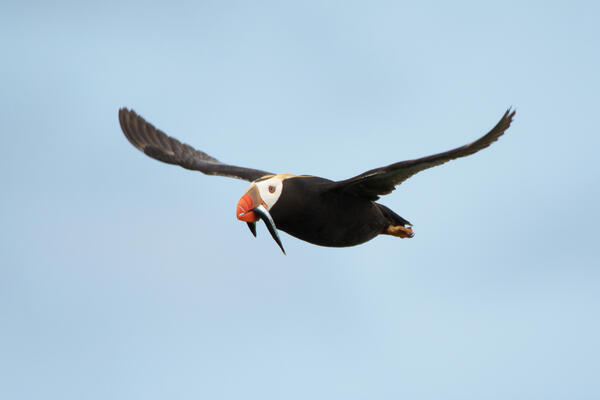
The USGS has been studying the impact of El Niños and marine heat waves on seabirds and forage fish, which have been obvious indicators of change in the marine environment, around Alaska over the past several decades. Alaska’s near- and offshore waters support the vast amounts of zooplankton and small “forage fish” necessary to feed millions of seabirds. However, when El Niños or marine heat waves occur, these important prey species can become reduced in size and fat or even die (von Biela et al. 2019, Arimitsu et al. 2021), resulting in less food energy available for seabirds. This can lead to seabird die-offs (Piatt et al. 1999, Piatt et al. 2020), persistent decreases in their population size and reproduction (Hatch et al. 1987, Schoen et al. 2024), and lower chick growth rates. In addition to diminished prey availability or quality, the mechanisms by which marine heat waves impact seabirds can also include top-down effects of avian predator disturbance resulting in failed or decreased reproduction.
Harmful algal blooms and seabirds
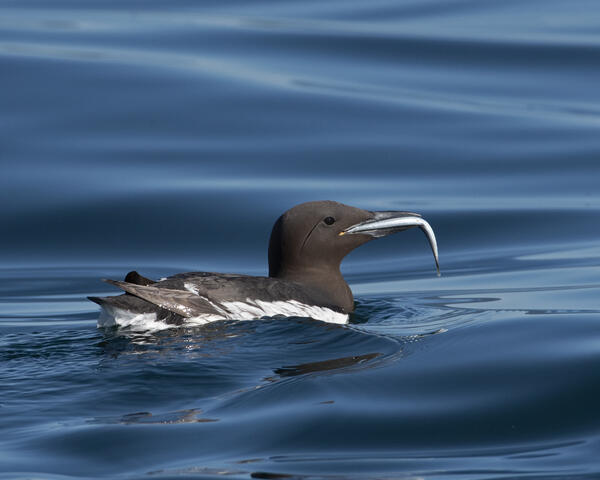
The elevated water temperatures that characterize El Niños and marine heatwaves can also lead to harmful algal blooms which pose health threats to seabirds, fishes, and even humans. The USGS has spent 10+ years studying harmful algal bloom toxins in Alaska and their impact on seabirds, including Common Murres killed on the heels of the Pacific marine heat wave (Piatt et al. 2020, Van Hemert et al. 2020), a multi-species seabird die-off during warm ocean temperatures in 2017, and Arctic Terns killed during another large marine heat wave in 2019. The tern die-off was linked to high concentrations of saxitoxin, a paralytic shellfish toxin produced by blooms of algae in the genus Alexandrium. More recently, the USGS investigated saxitoxin exposure throughout the marine food web during a die-off of seabirds, fish, and marine mammals in the Pribilof Islands of the Bering Sea in summer 2025. Some animals had saxitoxin concentrations many times higher than the regulatory limit for human consumption. Harmful algal bloom toxin results are closely monitored in Alaska because residents harvest and eat seafood, shellfish, and seabirds.
Pacific Salmon heat stress & die-offs
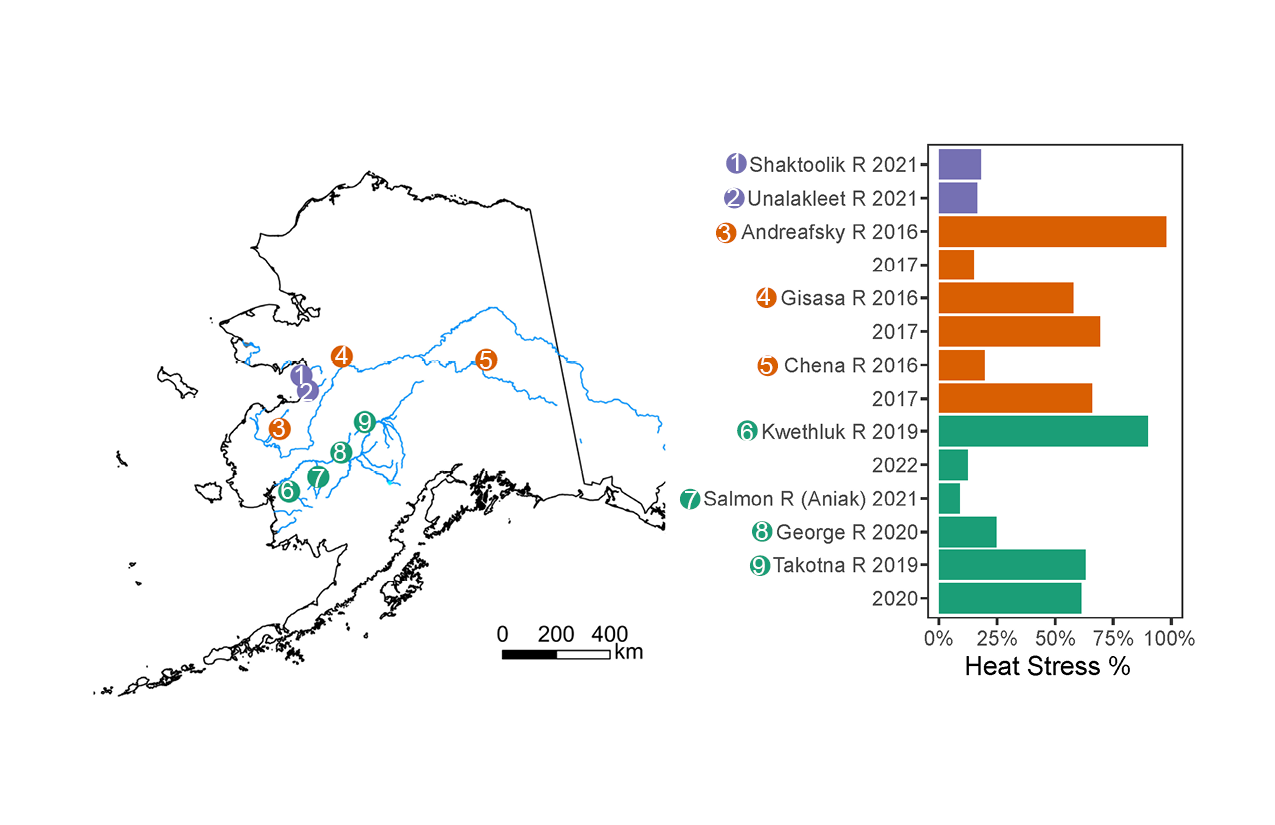
Yukon River Chinook salmon, which historically supported subsistence harvests for Alaskans and Canadians, as well as commercial and recreational fisheries have been in decline since the 1990s. The USGS began investigating heat stress in Chinook salmon a decade ago because subsistence fishermen on the Yukon River had water temperature records showing it was often more than 64°F/18°C and occasionally more than 70°F/21°C, water temperature that are known to stress cold-water salmon in other parts of their range. Using non-lethal muscle biopsies, the USGS found that greater than 50% of the Chinook salmon had evidence of heat stress in the Yukon River watershed during 2016-2017 and salmon parents that migrated during warm years tended to have fewer returning offspring.
When a riverine heatwave and drought event in 2019 coincided with the 2019 marine heat wave, there were widespread observations of Pacific salmon prematurely dying among all five species in Alaska (Chinook salmon, coho salmon, chum salmon, sockeye salmon, and pink salmon). This year, USGS published a paper comparing water temperatures and Chinook salmon heat stress rates across three regions of Alaska that included results from the 2019 riverine heatwave and after. Evidence suggested that warm temperatures and heat stress in Chinook salmon have been a long-term issue in the Yukon region (orange locations in figure), an emerging issue in the Kuskokwim region (green locations), and a future concern for the Norton Sound region (purple locations).
These efforts are responsive to the Department of the Interior’s management needs and science responsibilities established by the Migratory Bird Treaty Act and the Alaska National Interest Lands Conservation Act, which seeks to maintain rural subsistence fishing and hunting on federal lands and waters. The USGS collaborates with partners from other federal agencies, the State of Alaska, tribes, universities, and interested local organizations in the research examples noted above.
References
Arimitsu, M.L., Piatt, J.F., Hatch, S., Suryan, R.M., Batten, S., Bishop, M.A., Campbell, R.W., Coletti, H., Cushing, D., Gorman, K., Hopcroft, R.R., Kuletz, K.J., Marsteller, C., McKinstry, C., McGowan, D., Moran, J., Pegau, S., Schaefer, A., Schoen, S., Straley, J. and von Biela, V.R., 2021. Heatwave-induced synchrony within forage fish portfolio disrupts energy flow to top pelagic predators. Glob. Change Biol., 27: 1859-878. https://doi.org/10.1111/gcb.15556
Harding, A.M., Piatt, J.F. and Hamer, K.C., 2003. Breeding ecology of Horned Puffins (Fratercula corniculata) in Alaska: annual variation and effects of El Niño. Canadian Journal of Zoology, 81(6), pp.1004-1013.
Hatch, S.A., 1987. Did the 1982−1983 El Niño−Southern Oscillation affect seabirds in Alaska? Wilson Bull 99: 468−474.
Howard, K.G. and von Biela, V.R., 2023. Adult spawners: A critical period for subarctic Chinook salmon in a changing climate. Glob. Change Biol., 29: 1759-1773. https://doi.org/10.1111/gcb.16610
Marsteller, C.M., Arimitsu, M.L., Schoen, S.K., Stark, S.B., Piatt, J.F., 2024. Predator disturbance contributed to Common Murre Uria aalge breeding failures in Cook Inlet, Alaska, following the 2014-2016 Pacific marine heatwave. Marine Ornithology 52: 129-139.
Piatt, J.F., Drew, G.S., van Pelt, T.I., Abookire, A.A., Nielsen, A., Shultz, M.T., Kitaysky, A.S., 1999. Biological effects of the 1997/98 ENSO in Cook Inlet, Alaska. In: Freeland HJ, Peterson WT, Tyler A (eds) Proceedings of the 1998 Science Board Symposium on the Impacts of the 1997/98 El Niño Event on the North Pacific Ocean and its Marginal Seas. PICES Sci Rep 10. North Pacific Marine Science Organization, Sidney, p 82−86
Piatt, J.F., Parrish, J.K., Renner, H.M., Schoen, S.K., Jones, T.T., Arimitsu, M.L., Kuletz, K.J., Bodenstein, B., García-Reyes, M., Duerr, R.S. and Corcoran, R.M., 2020. Extreme mortality and reproductive failure of common murres resulting from the northeast Pacific marine heatwave of 2014-2016. PloS one, 15(1), p.e0226087.
Piatt J.F., Arimitsu M.L., Thompson S.A., Suryan R., Wilson R.P., Elliott K.H., Sydeman W.J., 2024. Mechanisms by which marine heatwaves affect seabirds. Mar Ecol Prog Ser 737:1-8 https://doi.org/10.3354/meps14625
Schoen S.K., Arimitsu M.L., Marsteller C.E., Piatt J.F., 2024. Lingering impacts of the 2014-2016 northeast Pacific marine heatwave on seabird demography in Cook Inlet, Alaska (USA). Mar Ecol Prog Ser 737:121-136 https://doi.org/10.3354/meps14177
U.S. Geological Survey (USGS) – Alaska Science Center – Harmful Algal Bloom Toxin Laboratory, 2022, Harmful algal bloom toxins in seabirds, forage fish, and marine invertebrates across Alaska (ver 6.0, September 2025; updated: 2026-02-19): U.S. Geological Survey data release, https://doi.org/10.5066/P9MLNP9H.
Van Hemert, C., Schoen, S.K., Litaker, R.W., Smith, M.M., Arimitsu, M.L., Piatt, J.F., Holland, W.C., Hardison, D.R. and Pearce, J.M., 2020. Algal toxins in Alaskan seabirds: Evaluating the role of saxitoxin and domoic acid in a large-scale die-off of Common Murres. Harmful Algae, 92, p.101730.
Van Hemert, C.R., Dusek, R.J., Smith, M.M., Kaler, R.A.S., Sheffield, G, Divine, L.M., Kuletz, K.J., Knowles, S., Lankton, J.S., Hardison, D.R., Litaker, R.W., Jones, T., Burgess, H.K., Parrish, J.K., 2021. Investigation of algal toxins in a multispecies seabird die-off in the Bering and Chukchi Seas. Journal of Wildlife Diseases 57(2):399-407. https://doi.org/10.7589/JWD-D-20-00057
Van Hemert, C., Harley, J.R., Baluss, G., Smith, M.M., Dusek, R.J., Lankton, J.S., Hardison, D.R., Schoen, S.K. and Kaler, R.S., 2022. Paralytic shellfish toxins associated with Arctic Tern mortalities in Alaska. Harmful algae, 117, p.102270.
von Biela, V.R., Arimitsu, M.L., Piatt, J.F., Heflin, B., Schoen, S.K., Trowbridge, J.L. and Clawson, C.M., 2019. Extreme reduction in nutritional value of a key forage fish during the Pacific marine heatwave of 2014-2016. Marine Ecology Progress Series, 613, pp.171-182.
von Biela, V.R., Bowen, L., McCormick, S.D., Carey, M.P., Donnelly, D.S., Waters, S., Regish, A.M., Laske, S.M., Brown, R.J., Larson, S. and Zuray, S., 2020. Evidence of prevalent heat stress in Yukon River Chinook salmon. Canadian Journal of Fisheries and Aquatic Sciences, 77(12), pp.1878-1892.
von Biela, V.R., C.J. Sergeant, M.P. Carey, Z. Liller, C. Russell, S. Quinn-Davidson, P. Rand, P.A.H. Westley, C.E. Zimmerman. 2022. Premature mortality observations among Alaska’s Pacific Salmon during record heat and drought in 2019. Fisheries. doi: 10.1002/fsh.10705
von Biela, V.R., Regish, A.M., McCormick, S.D., Spaeder, J., Whitworth, K., Leon, J., Gillikin, D., Liller, Z., Ivanoff, R., Bell, J. and Larson, S.D., 2026. Migration water temperature and heat stress assessments in western Alaska Chinook salmon overlapping the 2019 heatwave. Canadian Journal of Fisheries and Aquatic Sciences, 83, pp.1-14.