An official website of the United States government
Here's how you know
Official websites use .gov
A .gov website belongs to an official government organization in the United States.
Secure .gov websites use HTTPS
A lock () or https:// means you’ve safely connected to the .gov website. Share sensitive information only on official, secure websites.

Due to a lapse in appropriations, the majority of USGS websites may not be up to date and may not reflect current conditions. Websites displaying real-time data, such as Earthquake, Volcano, LANDSAT and Water information needed for public health and safety will be updated with limited support. Additionally, USGS will not be able to respond to inquiries until appropriations are enacted. For more information, please see www.doi.gov/shutdown.
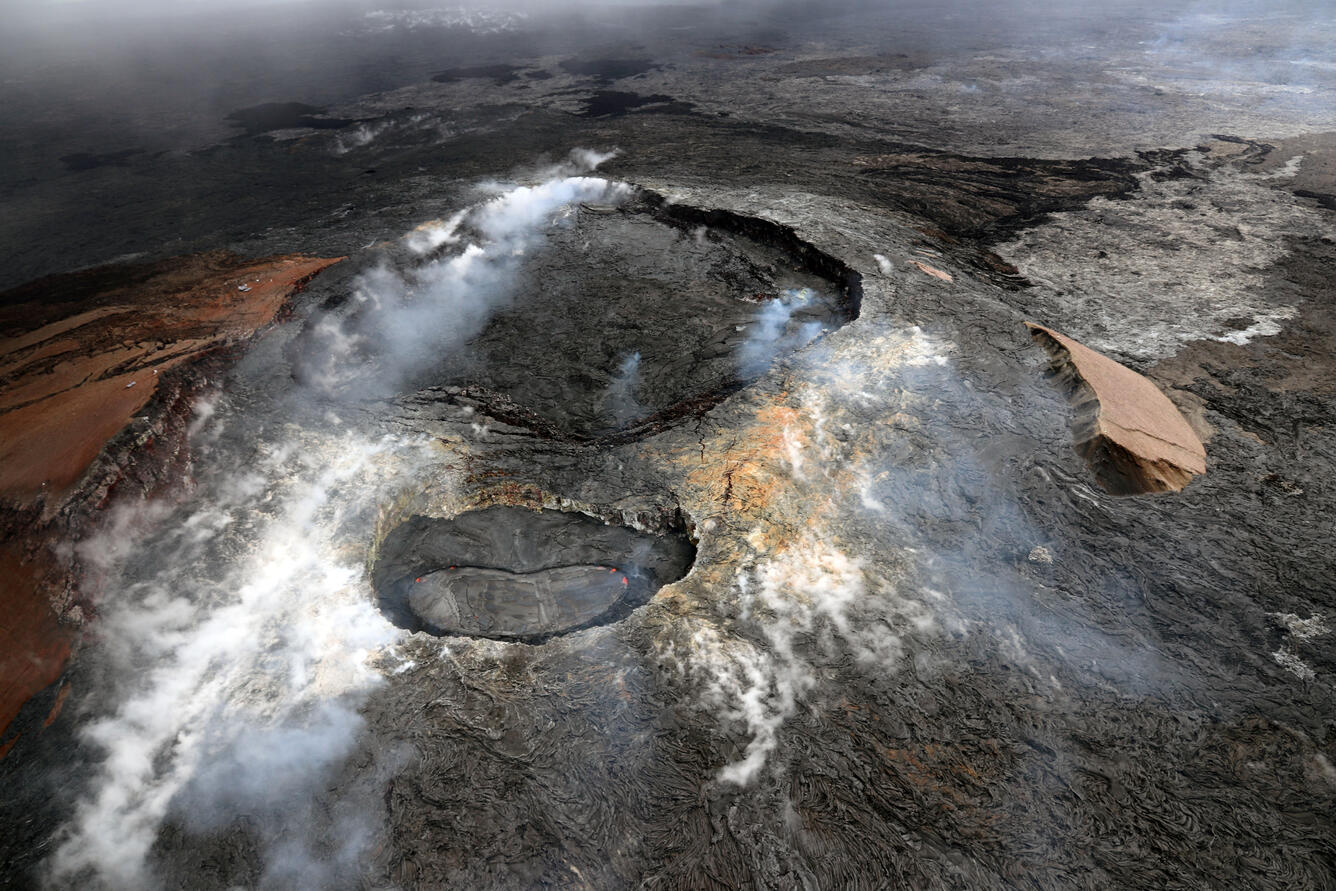
A brief break in the rain allowed for some clear views of Pu‘u ‘Ō‘ō on Kīlauea Volcano's East Rift Zone. Since mid-March, Pu‘u ‘Ō‘ō tiltmeters have been recording inflation, and uplift of the crater floor is visible in HVO webcams. The lava pond within the west pit (foreground) has also risen several meters (yards) and has overflowed onto the floor of the west pit numerous times.
Surface flows on the 61g flow field remain active. Most breakouts are within 2 km (1.2 miles) of the 61g vent on the flank of Pu‘u ‘Ō‘ō, but a few small surface flows are active on the upper flow field (above the pali) roughly 6 km (3.7 miles) from the vent.
This time-lapse image sequence taken by a time-lapse camera on the rim of Pu‘u ‘Ō‘ō's west pit, spans March 20 to April 18. The sequence, of approximately one image per day, shows the growth of the lava pond within the west pit as it developed into a perched lava pond. This sequence is looped 4 times.