An official website of the United States government
Here's how you know
Official websites use .gov
A .gov website belongs to an official government organization in the United States.
Secure .gov websites use HTTPS
A lock () or https:// means you’ve safely connected to the .gov website. Share sensitive information only on official, secure websites.
The two active flows (Kahauale‘a and Peace Day) are both fed from vents high on Pu‘u ‘Ō‘ō cone. This view (looking southwest) shows Pu‘u ‘Ō‘ō crater. In the foreground, a lava pond and small spots of orange glow mark the location of the vent for the Kahauale‘a flow. Near the north rim of the crater (right) a steep spatter cone (see other photo from today) was producing loud gas jetting sounds.
A closer look at the start of the lava tube on the Kahauale‘a flow, near the rim of Pu‘u ‘Ō‘ō crater. See photo above for aerial view. Unfortunately a direct view of the lava stream was not available here.
This steep spatter cone near the north rim of Pu‘u ‘Ō‘ō crater was making loud gas jetting sounds, presumably due to gas forced through the small glowing holes near the top of the cone.
The Kahauale‘a flow remains active, with the flow front today about 4.9 km (3 miles) northeast of Pu‘u ‘Ō‘ō. The flow is still on earlier Pu‘u ‘Ō‘ō flows, but has been slowly approaching the edge of the forest.
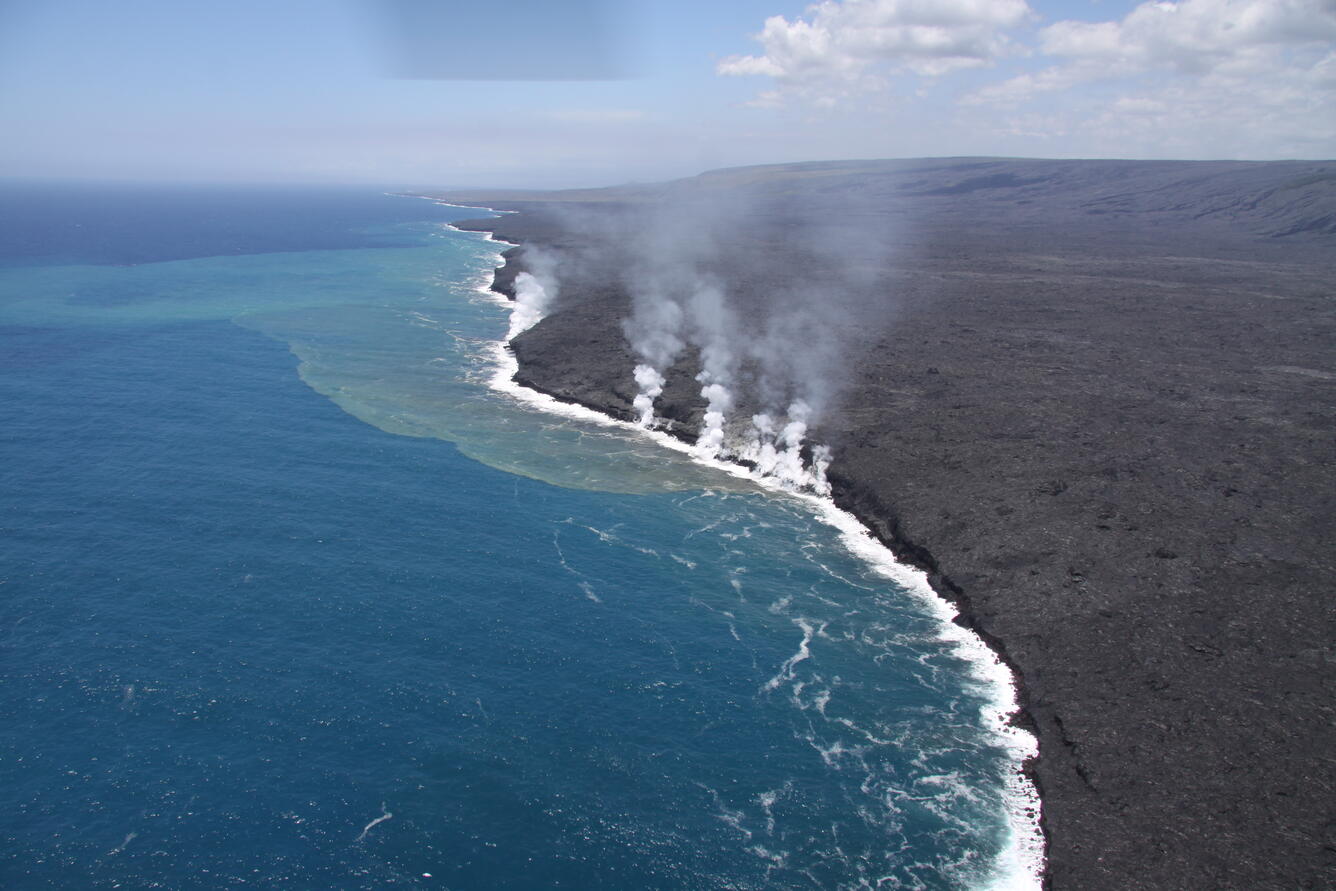
Another view of the ocean entry points and discolored water at Kupapa‘u. The thermal camera today showed that water surface temperatures were up 50 degrees Celsius (122 degrees Fahrenheit) a short distance out from the entry points. Just beyond the ocean entry, the light colored areas represent active breakouts. On the pali, fume marks the path of the lava tube. The bump on the horizon at the very left edge of the image is Pu‘u ‘Ō‘ō, the site of the vent for these flows.