An official website of the United States government
Here's how you know
Official websites use .gov
A .gov website belongs to an official government organization in the United States.
Secure .gov websites use HTTPS
A lock () or https:// means you’ve safely connected to the .gov website. Share sensitive information only on official, secure websites.
Calm after the storm—a beautiful day on Kīlauea Volcano's East Rift Zone. Rain from Hurricane Madeline had little impact on Pu‘u ‘Ō‘ō, shown here, or lava flow 61g.
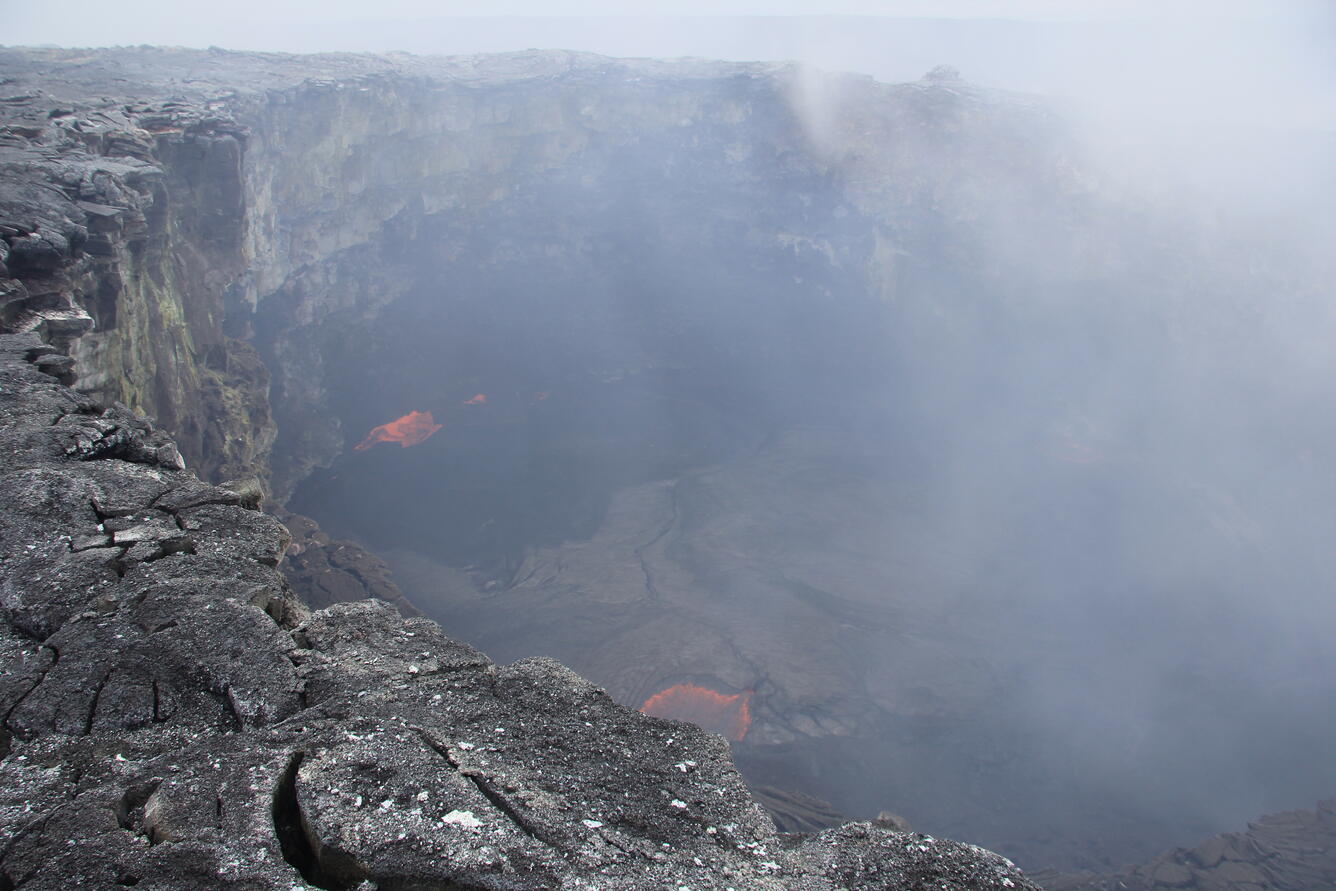
View of the lava pond within the Pu‘u ‘Ō‘ō west pit crater, which is about 50 m (164 ft) across. Weak spattering on the lava pond surface, about 23 m (75 ft) below the crater rim, is visible through the thick volcanic gas cloud.
An aerial view of a new breakout (light-colored flow at center of image) from the 61g tube. The breakout began with some vigor on the morning August 29, but today it was sluggish, with only a few scattered pāhoehoe toes still active on the margins of the flow.
View of the 61g flow field, from Pu‘u ‘Ō‘ō (visible on top, left horizon) to the westernmost ocean entry at the coast, where lava spills into the sea, creating a lava delta. Fume emanating from the flow field—on the coastal plain (above the ocean entry) and high on the pali (cliff) in the far distance—delineate part of the active tube system that carries lava from the Pu‘u ‘Ō‘ō vent to the sea.
A closer view of where lava is entering the sea along a 1.1-km- (0.7-mi-) wide section of the coastline. There is no evidence that high surf from Hurricane Madeline had any impact on the lava deltas that have formed, and continue to grow, at the ocean entries. Discoloration of the ocean water is caused by fragments of volcanic glass, which are produced when hot lava enters cool seawater and shatters into tiny pieces that are carried by currents along the shore.