



New study reveals the deep roots of early eruptions in the Clear Lake Volcanic Field
How do volcanic fields get their start? By looking at crystals in the oldest lavas in a field, geoscientists can tell a story about the rocks’ pathway from the mantle to the surface.
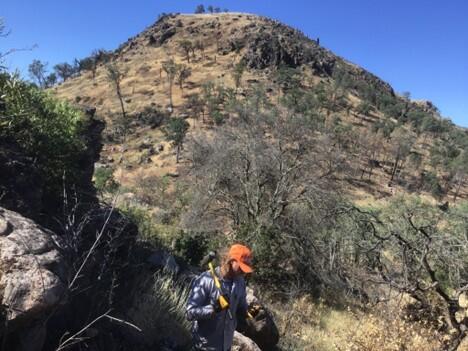
The Clear Lake Volcanic Field is the youngest (~0.008 to 2.2 million years) and northernmost volcanism in the California Coast Ranges. Located ~100 km north of the San Francisco Bay Area, it began erupting around 2.2 million years ago and may have last erupted about 8,000 years ago. This volcanic field was mapped in the 1980s https://pubs.usgs.gov/imap/2362/, but its oldest lava flows weren’t studied in detail. As part of an effort to understand the eruption history and hazards in the Clear Lake field, CalVO geologists Dawnika Blatter and Seth Burgess mapped, sampled, and analyzed these early lava flows (first image) to understand when and where they erupted and how they made their way from the Earth’s interior to the surface. A newly published paper (https://doi.org/10.1093/petrology/egaf077) documents the “primitive” nature of these old lavas, meaning they came directly from the mantle without spending much time in the crust. The chemical compositions of these lavas give clues about the composition, temperature, and depth of the mantle that the melts came from. The compositions of their early-forming crystals, like olivine and chromium spinel (second image) also tell the temperatures that they crystallized at as the magma ascended.
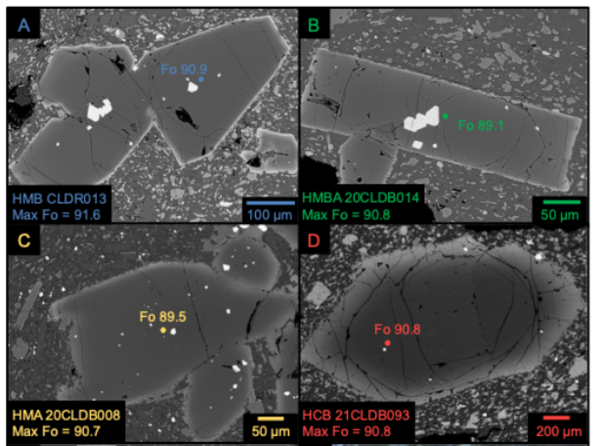
These clues led to the conclusions that these primitive magmas came from two different types of mantle: Hot, upwelling upper mantle (asthenosphere), and cooler, water-rich lithospheric mantle. The parts of the mantle the lavas came from were as hot as 1330 °C (~2430°F) at depths of up to 53 km (33 miles). From this information, CalVO scientists were able to determine the amount of heat delivered to the crust early in the formation of the Clear Lake Volcanic Field. Over the next million years, this heat created a crustal magmatic system that generated the silica-rich volcanic rocks of Cobb Mountain and the Geysers Plutonic Complex (which hosts The Geysers geothermal field).