



Tiny zircon crystals tell a big eruption story in the Coso Volcanic Field
How do CalVO scientists create a timeline of eruptions from radioactive elements stored in tiny crystals? The Coso volcanic field is one place where a special technique is hard at work.
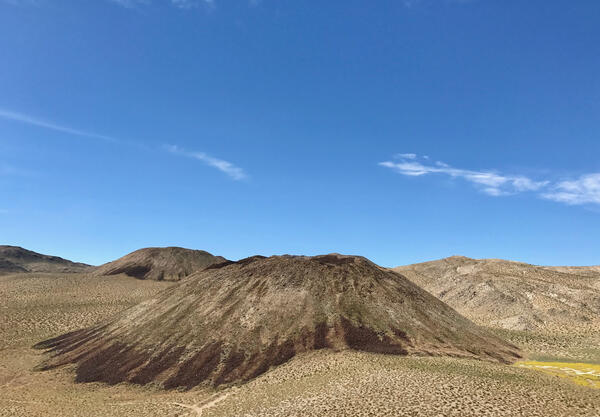
Located primarily within the Naval Air Weapons Station, China Lake, roughly 100 miles northeast of Bakersfield, California, the Coso field is full of steep-sided volcanic domes rich in silica (see photo), and cinder cones and lava flows rich in iron. The Coso field is classified as “moderate” threat by the USGS because of its long history of volcanism, evidence for eruptions in the past ~50 thousand years, and its ongoing earthquake and hydrothermal activity. Similar to the Clear Lake volcanic field in Northern California, the Coso volcanic field is also used for geothermal power: four interconnected power plants produce enough power to supply over 100 thousand homes.
Understanding past volcanic activity in the Coso area is critical to predicting what the volcanic system might do in the future. To better constrain the timing and frequency of past eruptions that produced silica-rich, sticky lavas - which can lead to explosive activity - CalVO geologist Seth Burgess searches for tiny pieces of the mineral zircon in the rock. He collects gallons of lava from the Coso domes and crushes it down to sand-sized pieces, looking for crystals of zircon, which contain the radioactive element Uranium. This uranium can be used as a radiometric chronometer, or a kind of clock based on radioactive decay, which allows Seth to determine when the lava erupted. He uses the USGS/Stanford SHRIMP (Sensitive High-Resolution Ion Microprobe, https://shrimprg.stanford.edu/) to measure the products of the radioactive decay in zircons and build a timeline of eruptions in the Coso volcanic field. The more lava domes and flows dated with this method, the better the timeline, and the better CalVO geologists' ability to figure out patterns of eruption and forecast future activity.
The photo shows several silica-rich volcanic domes, the closest of which erupted onto the desert floor around 80,000 years ago. The lack of thick vegetation in the desert environment is ideal for geologists interested in locating and collecting pristine samples of these domes.