



The value of volcano eruption photographs
Photographs can be a huge help in interpreting the mechanics and timelines of volcanic eruptions. For example, he 1914–1917 eruptions of Lassen Peak were one of the first to be extensively photographed by local observers. Details about the large eruption on the late evening of May 19, 1915, was limited by a lack of direct observations, since it happened mostly in darkness.
The prevailing hypothesis of scientists at the time was that a tongue of lava filled the crater at the summit of Lassen Peak and spilled over the lip onto a thick blanket of snow. The hot lava melted the snow, which caused the lava flow to break up and avalanche down the flank of Lassen Peak as a great debris- and mudflow. The mudflow took out a half mile-wide strip of trees on the lower flanks of Lassen Peak to create the Devastated Area, and proceeded 11 miles (18 kilometers) down Lost Creek to Old Station where it was finally observed by residents.
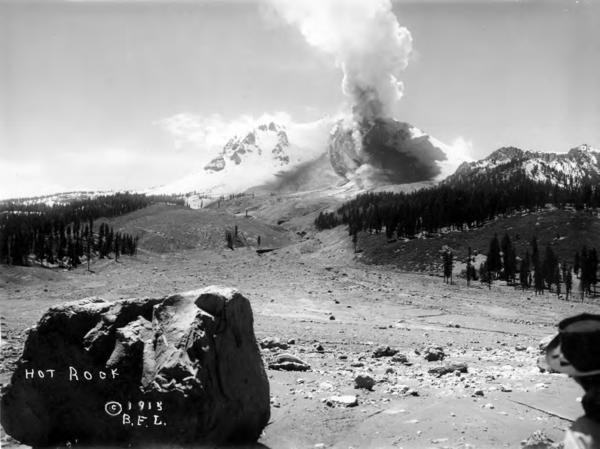
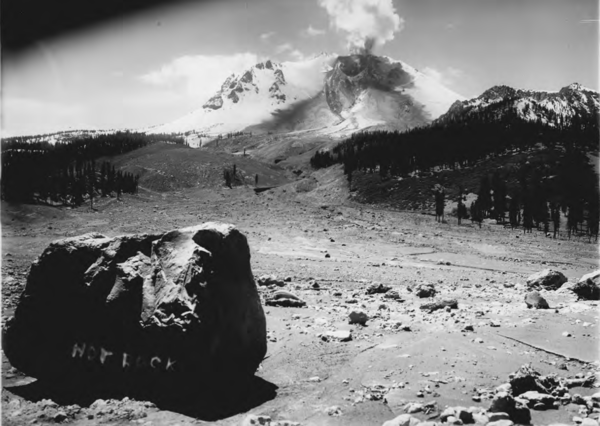
However, photographs by Benjamin Franklin Loomis, a local businessman and amateur photographer, prove this scenario wrong. Loomis visited the Devastated Area on the morning of May 22, 1915, and took the 2 photographs later published in his book, Pictorial History of the Lassen Volcano. The first, included here, shows the summit of Lassen Peak emitting a cloud of steam. The steam cloud casts a shadow over the summit so it is not clearly visible. In the second photograph, the steam has temporarily dissipated, and a lava flow is clearly visible on the upper flank of Lassen Peak. Hence, the breakup of the flow could not have been the source of the great mudflow on May 19. This photograph was either not available or ignored by the early volcanologists interpreting May 19 eruption.
Fortunately for him, and the survival of his photographs, Loomis left the area before the big eruption at 4:00 PM on May 22. Modern field work on the 1914-1917 eruptions has given us a different story: Late on the evening of May 19, a large explosion shattered the dacite dome, creating a new crater at the summit of Lassen Peak. No new magma was ejected in this explosion, but glowing blocks of hot lava from the dome fell on the summit and the deeply snow-covered upper flanks of Lassen Peak. These falling blocks of hot rock were what created the avalanche and mudflow; later that night, a new dacite lava flow welled up into and filled the crater created by the explosion. Scientists at the time saw this flow and assumed it had come before the avalanche, rather than after.
Stories like these reinforce the importance of revisiting the records of old eruptions. Even something as simple as a photograph can add important context to events modern scientists weren’t there to see!
To read more about the Lassen Peak eruptions of 1914-1917, check out the fact sheet at https://pubs.usgs.gov/fs/2014/3119/downloads/fs2014-3119.pdf.