



Why is there a volcano in California's Central Valley?
Is it a really overdone fried egg? A pancake? A flower? Nope, it's a volcano!
The California Volcano Monitor is a weekly column written by scientists and collaborators of the California Volcano Observatory. This week's contribution is from Jessica Ball, physical volcanologist with the U.S. Geological Survey.
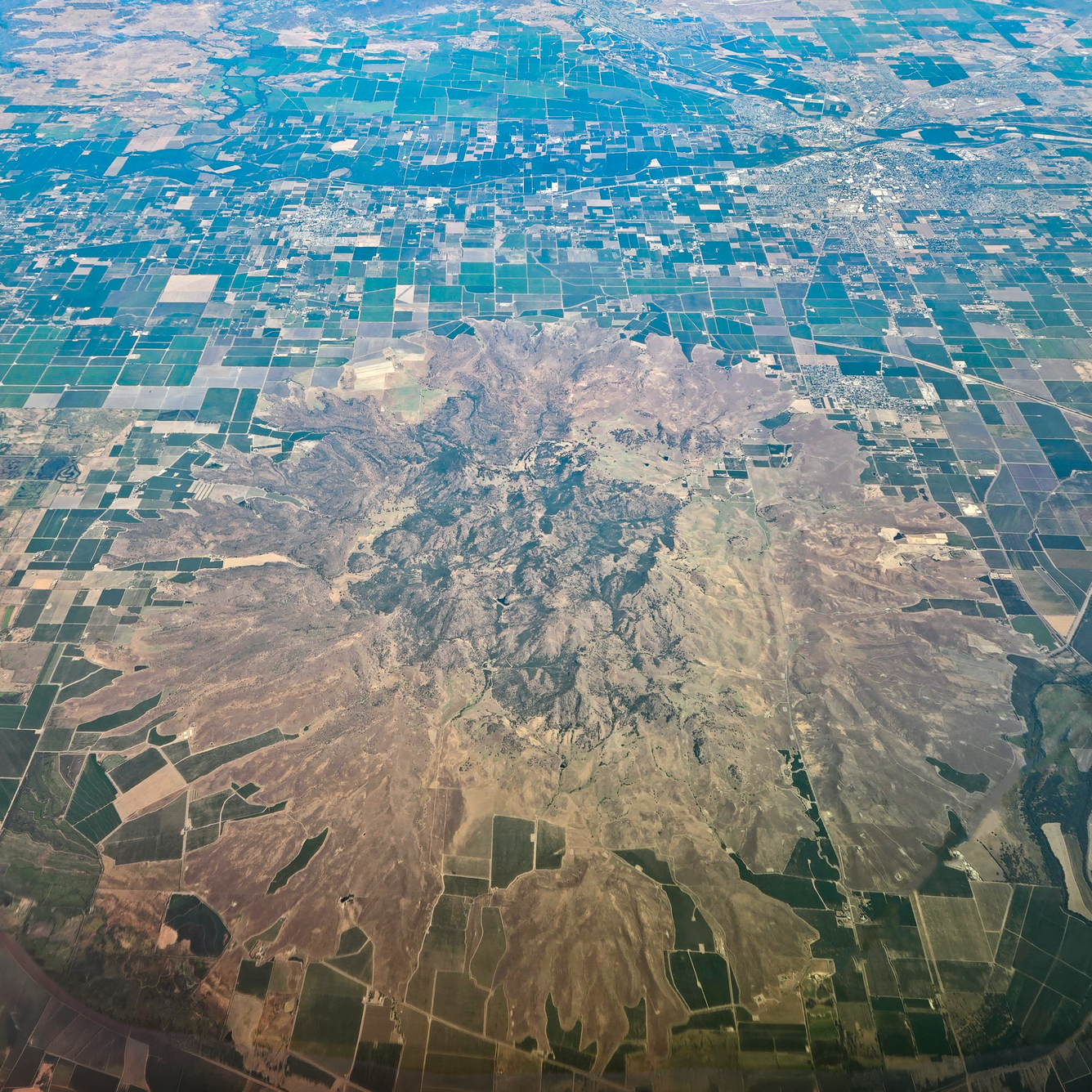
Sutter Buttes is the only volcano in California's Central Valley. Rising over 2,000 feet (610 m) over the valley floor, this enigmatic edifice was formed between 1.6 and 1.4 million years ago. Geologist James Dana described the cluster of hills as "an island in a vast prairie of millpond smoothness" when he first encountered Sutter Buttes in 1841, and the impression is certainly accurate. But what is a volcano doing so far away from any other volcanoes in California?
Instead of being part of the Cascade volcanic arc, like Lassen Peak and Mount Shasta, Sutter Buttes are related to the same Coast Range volcanic activity which formed the Clear Lake volcanic field. They may be related to a buried, inactive fault that separates the granitic and metamorphic rocks of the Sierra Nevada to the east, and the oceanic rocks of the Coast Range to the west. As shown by geophysical surveys, other faults intersect this deep, north-south-oriented crustal fault, possibly creating pathways for magma to ascend through the thick sedimentary rocks of the Central Valley.
The eruptions that formed Sutter Buttes must have been a sight to see. The first magma to push through the sediments was sticky rhyolite, which formed thick, pasty domes and pyroclastic flows when explosions released trapped gas. After 30,000 years or so, bigger eruptions of andesite and dacite lava through multiple vents in the core of the volcano created even larger lava domes. They also warped the surrounding sedimentary rocks so much that their original horizontal layers became vertical or even overturned! During these eruptions, explosions and collapses formed pyroclastic flows, which flowed downslope and made a thick apron of debris all around the central domes.
Though spectacular in appearance, Sutter Buttes isn't active anymore, and seems unlikely to ever be active again. It's simply a picturesque - and intriguing! - feature in California's Central Valley.
Visit "Sutter Buttes: The lone volcano in California's Great Valley" to learn more about Sutter Buttes!