



By Hawaiian Volcano Observatory
May 23, 2025
Episode 23 precursory activity at the summit of Kīlauea over the past several days has been characterized by low-level spattering and flames within the vents. The V3cam, recently installed last week, provided shaky views of this activity. On May 22, USGS scientists adjusted the livestream camera to stabilize the view.
Media
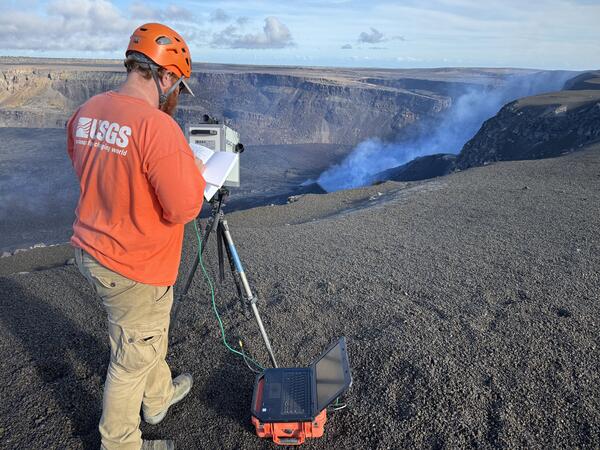
A USGS Hawaiian Volcano Observatory geologist uses an FTIR (Fourier transform infrared spectrometer) to measure the chemical composition of volcanic gas during cycles of spattering and seismic tremor at the active vent at Kīlauea summit on May 22, 2025. USGS photo by M. Patrick.
Sources/Usage: Public Domain. View Media Details
Media
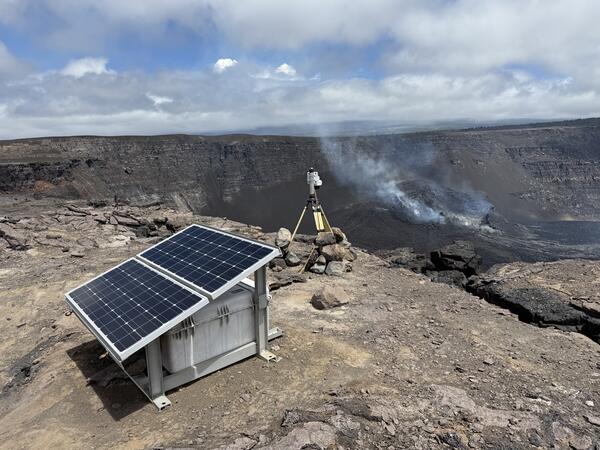
A view of the V3cam site located on the south rim of Halemaʻumaʻu crater and Kaluapele. The camera, which was installed with permission from Hawaiʻi Volcanoes National Park, is one of three that provide livestream views of the ongoing episodic eruption at the summit of Kīlauea. USGS photo by M. Warren.
Sources/Usage: Public Domain. View Media Details
Media
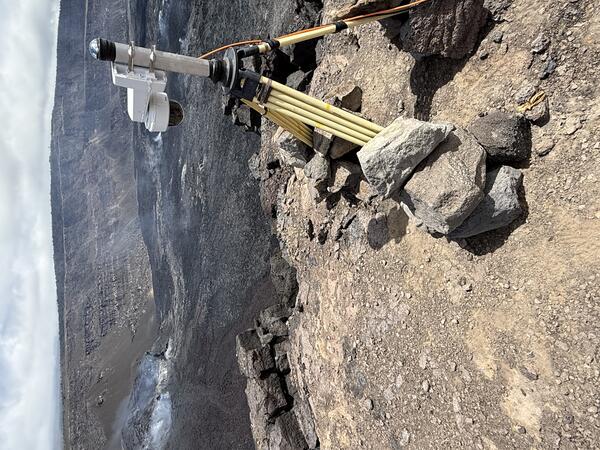
This photograph shows the new V3cam, installed by the USGS Hawaiian Volcano Observatory (HVO) in mid-May 2025. The V3cam, like all of the HVO monitoring cameras that start with "V," is a pan-tilt-zoom model that can be controlled remotely. This capability is useful in evaluating the ongoing episodic eruptive activity within Halemaʻumaʻu, and the associated hazards. USGS photo by M. Warren.
Sources/Usage: Public Domain. View Media Details
Media
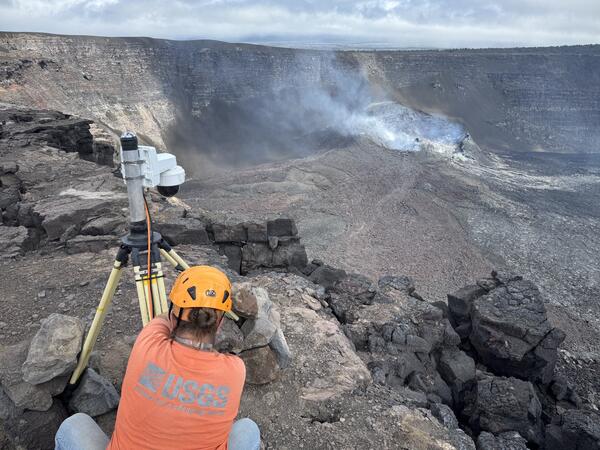
On May 22, 2025, USGS Hawaiian Volcano Observatory (HVO) staff stabilized the new V3cam livestream camera. The camera was installed just last week and views since then were shaky due to the strong winds which are common in the caldera. The camera was moved from a tall mast to a more stable tripod setup. As HVO staff conducted this work, loud episodes of gas and ash jetting were happening every 6 minutes at the south vent within Halema‘uma‘u. USGS photo by M. Patrick.
Sources/Usage: Public Domain. View Media Details