



The 2024 YVO annual report has just exploded from the presses!
In 2024, Yellowstone experienced a year of contrasts. Hydrothermal explosions dominated the headlines, but in terms of seismicity and ground deformation it was a quiet year.
Yellowstone Caldera Chronicles is a weekly column written by scientists and collaborators of the Yellowstone Volcano Observatory. This week's contribution is from Michael Poland, geophysicist with the U.S. Geological Survey and Scientist-in-Charge of the Yellowstone Volcano Observatory.
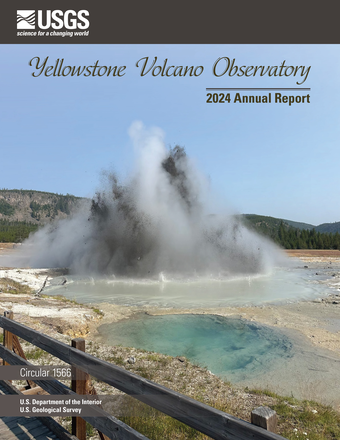
The year 2024 will probably be remembered as the year of the hydrothermal explosion, with one event that was unwitnessed but detected by geophysical sensors at Norris Geyser Basin in April, and another that was experienced by numerous people in Biscuit Basin in July. But there was a lot more to the year than just those explosions, and all of the details are in the 2024 Yellowstone Volcano Observatory annual report—just published and freely available at https://doi.org/10.3133/cir1566!
The July 23, 2024, explosion of Black Diamond Pool in Biscuit Basin was the best documented hydrothermal explosion in the history of Yellowstone National Park thanks to numerous visitor videos, photographs, and descriptions. Despite the violence of the event, which hurled mud, rocks, and debris up to 120–180 meters (400–600 feet) into the air, there were fortunately no injuries. Geologists responded immediately, mapping about 1,500 rocks with a long dimension of at least 40 centimeters (16 inches) that were emplaced as a result of the explosion. These rocks were composed of sandstones, siltstones, and glacial debris that are present in the upper ~50 meters (175 feet) of the surface; none of the debris was composed of the rhyolite bedrock found beneath that depth, indicating that the explosion had a very shallow source. Some of the rocks were coated in impermeable silica and represent the interior of the hot water plumbing system beneath the pool. Sealing of the water conduits by mineral deposits probably caused pressure to build and led to the explosion.
The other explosion of 2024 occurred on April 15 and was completely unobserved because it happened during a seasonal closure of Yellowstone National Park. The event took place on Porcelain Terrace in Norris Geyser Basin, and it created a small crater about 3 meters (10 feet) across along with a larger area of disrupted ground. That region had been very active for several years, with thermal water pouring into a nearby lake, raising the water levels and changing the lake’s color from green to milky blue. Following the explosion, activity diminished markedly, water stopped flowing into the lake, and the lake’s level and color returned to normal. A number of trees around the lake’s shore, however, were killed due to being inundated by the silica-rich water.
The April 15, 2024, explosion has the distinction of being the first in Yellowstone National Park to be detected by geophysical monitoring. Acoustic sensors that were installed just a few months prior to the event recorded the passage of the explosion’s sound waves, while seismic sensors detected the shaking caused by the interaction of the sound waves with the ground. The joint seismic-acoustic monitoring approach used in Norris Geyser Basin will eventually be deployed to other areas of the park, as described in the Yellowstone Volcano Observatory’s monitoring plan.
Aside from the two explosions, Yellowstone National Park was mostly quiet in a geological sense. There were only 1,173 located earthquakes in the region during 2024, the largest of which was magnitude 3.3. This is at the low end of the typical range of seismicity. There were also no changes in ground deformation during the year. The caldera continued to subside at a rate of about 2–3 centimeters (~1 inch) per year, which has been ongoing since 2015–2016, and there was no significant deformation in the area of Norris Geyser Basin, to the north of the caldera (although that condition changed in mid-2025!).
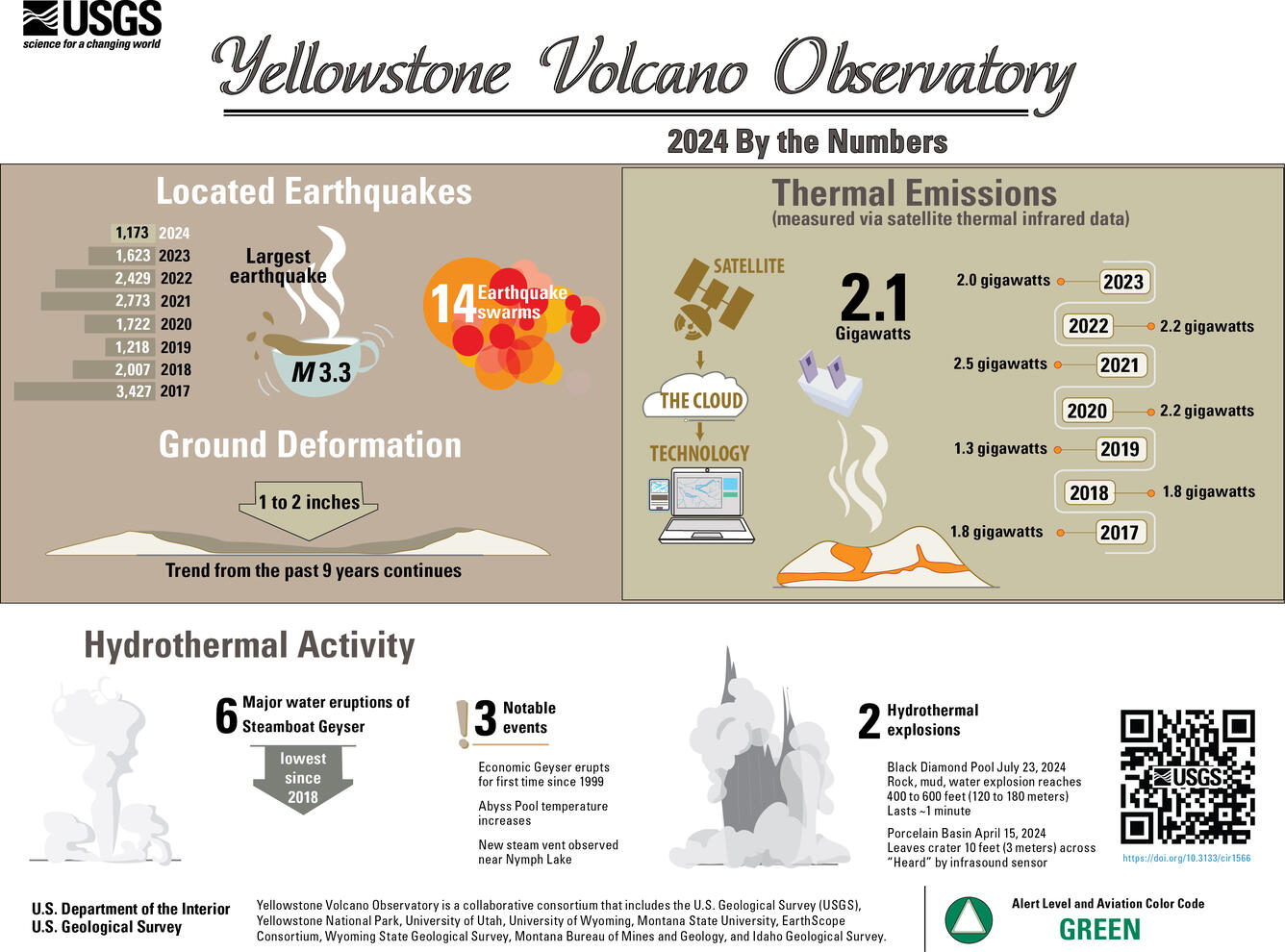
Steamboat Geyser in Norris Geyser Basin continued to erupt, although much less frequently than in the past few years. There were 6 major eruptions in 2024, which was the fourth straight year of decline following a peak of 48 eruptions each in 2019 and 2020. Not all geysers and hot springs in Yellowstone National Park calmed down, though. Abyss Pool, in West Thumb Geyser Basin, increased in temperature over the course of the summer, and a new steam vent formed near Nymph Lake, north of Norris Geyser Basin, in early August. Despite these changes, overall thermal output from the Yellowstone region remained consistent with previous years, as measured by both river chemistry and thermal satellite data.
Interested in all the details? Then check out the Yellowstone Volcano Observatory’s 2024 annual report, available at a web browser near you— https://doi.org/10.3133/cir1566!