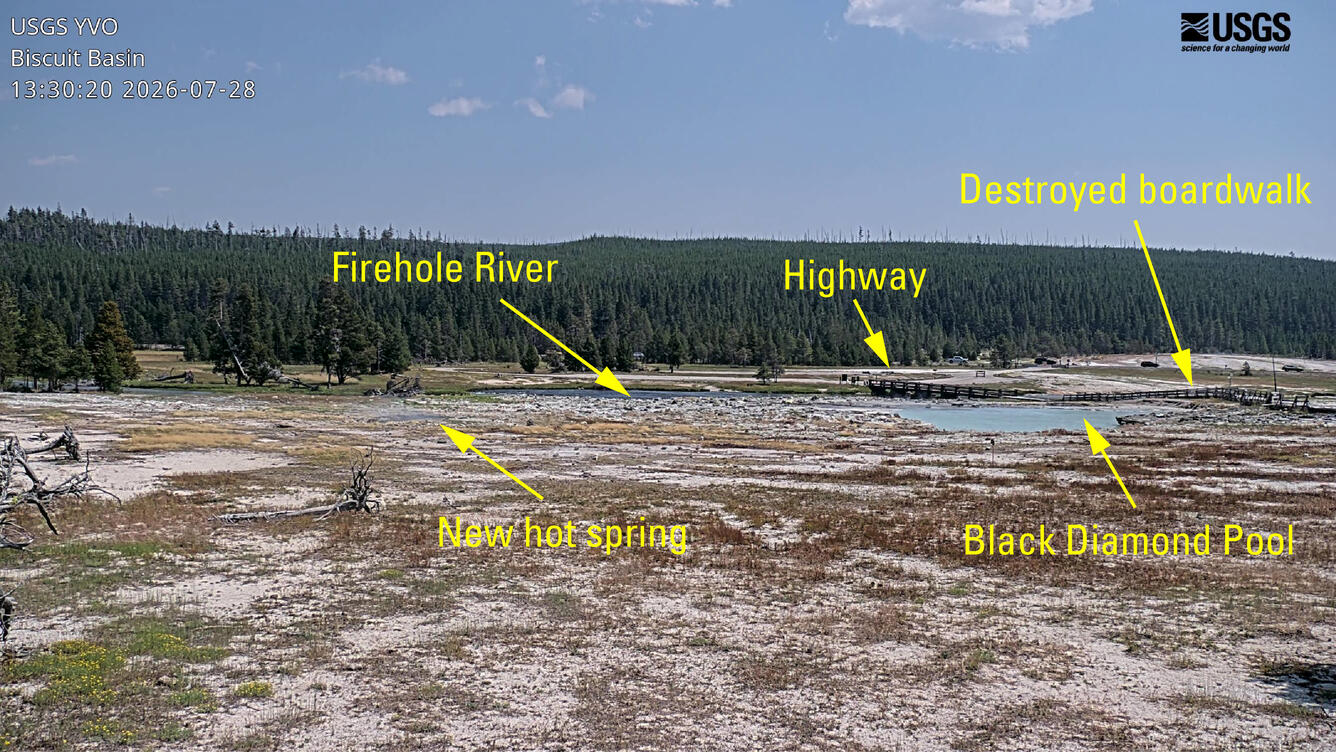
A new camera is now observing activity in Biscuit Basin
In response to the June 13, 2026, hydrothermal explosion at Biscuit Basin, a new camera was installed to track activity over a broader area than had previously been possible.
Yellowstone Caldera Chronicles is a weekly column written by scientists and collaborators of the Yellowstone Volcano Observatory. This week's contribution is from Michael Poland, geophysicist with the U.S. Geological Survey and Scientist-in-Charge of the Yellowstone Volcano Observatory.
Biscuit Basin has been the site of numerous hydrothermal explosions dating back more than 100 years—especially from the area of Black Diamond Pool. That history was on display on July 23, 2024, when a hydrothermal explosion occurred just before 10 a.m. local time, sending people nearby scrambling for safety as liquid water, rock, steam, and mud were thrown hundreds of feet into the air. The explosion did not cause any injuries but destroyed a section of boardwalk adjacent to the pool. Biscuit Basin has been closed to visitors ever since.
After the 2024 explosion, smaller eruptions continued to occur from the pool, although they were difficult to identify due to a lack of continuous on-site monitoring. That changed in May 2025, when a camera was installed on a section of boardwalk adjacent to Black Diamond Pool. As soon it was set up, the camera began recording a diversity of previously unknown activity. This included eruptions of hot water and mud that ranged in size from just a couple of feet (less than a meter) in height to about 30 feet (9 meters). In addition, sloshing and water-level changes were observed, possibly due to bubbles that did not reach the surface but instead imploded at the base of the pool. Collapse of shorelines was also seen on several occasions. All of these observations were corroborated by a new seismic, infrasound (a form of low-frequency acoustic energy), and GPS station that was installed in July 2025. That monitoring site is about 330 feet (100 meters) northwest of Black Diamond Pool.
On June 13, 2026, another hydrothermal explosion occurred at Biscuit Basin, this time to the north of Black Diamond Pool. The explosion was captured by the camera, but much of the activity was obscured behind the steam plume from the pool. Clearly another view was needed.
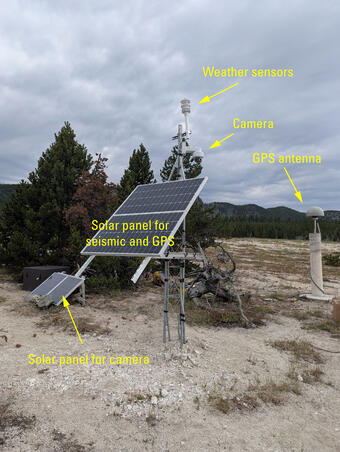
On July 22, 2026, Yellowstone Volcano Observatory scientists and field engineers from the University of Utah, Yellowstone National Park, and USGS collaborated to install a new camera in Biscuit Basin. The camera is on the tower that serves as a mast for solar power, weather sensors, and communications for the seismic/infrasound/GPS station in Biscuit Basin. Looking from that location to the east-southeast, the camera has an expansive view of both Black Diamond Pool and the area of the June 13, 2026, explosion.
The camera is connected to the local cellular network and captures an image every 15 minutes. That image is available at https://www.usgs.gov/media/webcams/biscuit-basin-webcam-0. The camera also records video, so if any anomalous activity occurs the video can be remotely downloaded. In addition, the pan-tilt-zoom capability of the camera allows the view to be changed to look at other features in Biscuit Basin, like Sapphire Pool or Jewel Geyser.
The work was done under a research permit (YELL-2026-SCI-5842) that was granted to the Yellowstone Volcano Observatory by Yellowstone National Park to monitor specific areas with cameras. Plans are in the works for another camera hopefully later in 2026! For many years, the observatory operated a camera on a cellular tower near Lake Village with a view of Yellowstone Lake. That camera failed in 2024, and efforts to replace the equipment have been stymied by weather and other factors.
But for now, we hope everyone enjoys the new view of Biscuit Basin, and we look forward to sharing insights from that camera soon. Doubtless it will capture some interesting activity…