



Beyond the bathroom: Top visitor questions in Yellowstone’s thermal areas
With the arrival of Memorial Day and the unofficial start of the summer travel season, we take a look at the most common questions that visitors to Yellowstone’s thermal basins ask the park’s interpretive rangers.
Yellowstone Caldera Chronicles is a weekly column written by scientists and collaborators of the Yellowstone Volcano Observatory. This week's contribution is from Michael Poland, geophysicist with the U.S. Geological Survey and Scientist-in-Charge of the Yellowstone Volcano Observatory, and Mindy Dottellis, interpretive ranger with Yellowstone National Park in 2025.
When in a place as otherworldly as Yellowstone, it’s only natural to find yourself brimming with questions at each turn of the trail. What is this scat I’m seeing? How does a geyser erupt, anyway? What makes Yellowstone so special?
Where’s the bathroom?
Fear not, for all inquiries are welcome. You may come across a ranger during your travels who would be more than happy to answer your burning questions, but in case you don’t, we’ve compiled the top questions according to the Yellowstone rangers themselves!
And yes, the location of the nearest “comfort station” is the most asked question across the park. You might even say it’s the number 1 question. With that out of the way…
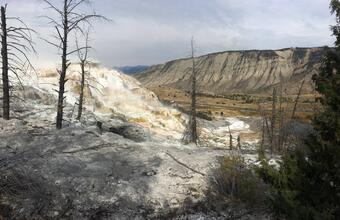
The most common questions across all of the park’s thermal basins are about the temperature and acidity of the water. This varies tremendously between areas. All geysers are boiling, but water in hot springs can range from just a few degrees below boiling to barely warm to the touch. Norris Geyser Basin is the hottest thermal area in the park. Research drilling in the 1960s found a temperature of 237 °C (459 °F) about 330 meters (1,087 feet) beneath the surface! Mammoth Hot Springs is one of the coolest because the water travels quite a distance from the heat source beneath Yellowstone Caldera—there are no geysers, and the maximum water temperature is about 73 °C (163 °F). The answer to the question, “when does Mammoth erupt?” is “never.”
The acidity also varies. Most thermal basins are either mostly acidic or mostly neutral. Areas with lots of geysers and colorful hot springs are mostly neutral, while areas with mud pots and gassy vents that smell like rotten eggs are mostly acidic. Norris Geyser Basin is an outlier, with both neutral and acidic features, often in close proximity. Steamboat Geyser is the tallest geyser in the world and has a neutral pH, whereas nearby Echinus Geyser is the largest acidic geyser in the world. The acid concentration is relatively low—akin to orange juice—so the acidity doesn’t cause burns on contact. The water temperature is a far bigger hazard.
Visitors also commonly ask how the boardwalks are built. Designing infrastructure that can be safely installed and stand up to Yellowstone’s unforgiving environment is challenging. Geologists map out safe areas for boardwalks based on thermal surveys, but the paths sometimes must be moved because of changes in hydrothermal activity.

And what about the animals? Based on the footprints and poop, animals clearly love thermal ground. Do they get burned? While they mostly avoid the hottest water, animals occasionally make mistakes and fall into thermal pools. Most animals avoid drinking thermal water, which can be toxic, but they still eat plants that have high amounts of silica and other compounds derived from thermal water. This can contribute to unhealthy teeth, and animals that live mostly in thermal areas tend to have shorter lifespans than those that live outside thermal areas.
At Norris Geyser Basin, a common question is “Where is Norris Geyser?” In fact, there isn’t any such feature. The basin is named for the second superintendent of Yellowstone National Park, Philetus W. Norris. Visitors also ask about the characteristic blue color of the water, which in most cases is due to high silica content.
In the Old Faithful area, visitors often wonder about how predictions are made. Geyser timing often depends on the preceding eruption. At Old Faithful Geyser specifically, a briefer-than-usual 90 second to 2 minute 45 second eruption means that the next eruption may occur after about 72 minutes, whereas the more common 3 minute 30 second to 4 minute 30 second long eruptions are followed by a quiet interval of about 103 minutes, give or take about 15 minutes. More precise timing of the duration of an eruption allows for more accurate predictions, give or take only 12 minutes during the 2026 season. Because of this, it is not possible to forecast eruption times more than one eruption in advance.

At Mammoth Hot Springs, visitors are curious about the travertine terraces. This material forms because hot water interacts with ancient marine sediments beneath the ground and brings calcium carbonate to the surface. As the water degases carbon dioxide, the travertine precipitates out, resulting in the characteristic formations.
For an area that has been studied for more than 150 years, Yellowstone is still full of mysteries, and research in every field, from archaeology to zoology, is ongoing. So stay curious out there and ask away! There are truly no dumb questions when in Yellowstone National Park.
And as CCR explained in their hit song, there’s a bathroom on the right.
ACKNOWLEDGEMENT: Many thanks to the Yellowstone National Park interpretive rangers who contributed their perspectives for this article, and especially Ian Hall and Sarah Gleeson.