



An expanded understanding of the Lava Creek Tuff eruption
Supereruptions are often imaged to be massive instantaneous events. New geological evidence from Yellowstone, however, shows that these eruptions are more complex and might involve numerous smaller pulses spread over years.
Yellowstone Caldera Chronicles is a weekly column written by scientists and collaborators of the Yellowstone Volcano Observatory. This week's contribution is from Dr. Madison Myers, Associate Professor with the Department of Earth Sciences at Montana State University.
When most people come across the term “supereruption,” they might imagine a single, catastrophic blast: one enormous magma chamber erupting all at once in an event of unimaginable scale. While Yellowstone has certainly produced huge eruptions, new research suggests the reality may be far more complex—and far more interesting. Instead of one giant explosion, Yellowstone’s “supereruptions” may include a sequence of closely spaced smaller eruptions fed by multiple magma bodies and occurring over weeks to decades to centuries. So put on your boots and don’t forget your hand lens! To explore the evidence for this eruptive complexity, we’ll have to take a challenging journey over deadfall and through swampland ripe with mosquitoes to reach deep into the Sour Creek dome.
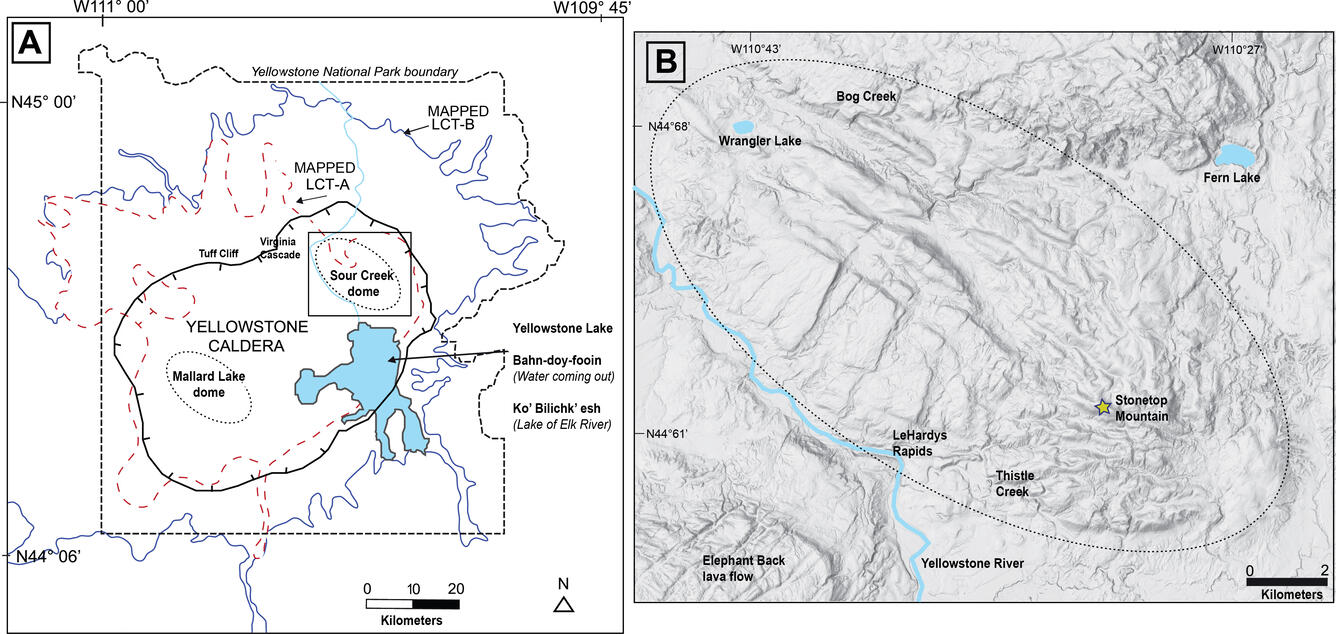
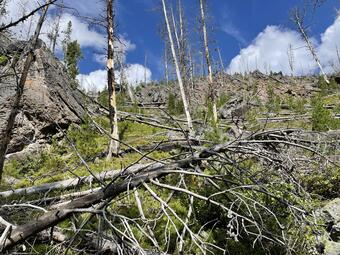
The Sour Creek dome, located just north of Yellowstone Lake, is referred to as a resurgent dome—a feature that formed by magma injection at shallow depths and thought to be driven by repressurization of the magma body that erupted the Lava Creek Tuff and formed Yellowstone Caldera soon after that eruption occurred roughly 631,000 years ago. The dome was initially mapped as including rocks that were older than Yellowstone Caldera that that had been uplifted above the caldera floor. However, a few years ago these rocks were studied using argon dating methods and were found to be younger—the same age as Yellowstone Caldera, in fact. Over the past 5 years, a group of intrepid field geologists have been walking over and around endless lodgepole pine to remap the rocks within the Sour Creek dome. What started as a simple field verification turned out to be anything but.
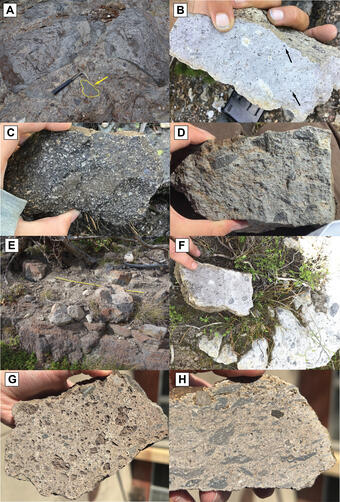
The rocks in the Sour Creek dome tell a complex story. Several contain fragments of earlier erupted material that had already cooled and solidified before being torn up and re-erupted—but both the fragments and the host rock are about the same age as the Lava Creek Tuff! This observation provides a key insight into this eruption: there was enough time between eruptive pulses for deposits to cool, fracture, and become incorporated into subsequent eruptions. In other words, Yellowstone’s “supereruption” was not just one event—it was a sequence. While the timing of these pulses cannot yet be resolved precisely, field relations clearly show that some deposits erupted one after another, forming a complex set of layers rather than a single blanket of volcanic material. Given that the Lava Creek Tuff eruption has previously been interpreted as just two main pulses, known as members A and B, this discovery completely rewrites our understanding of Yellowstone’s youngest supereruption. Further complicating the picture, field evidence suggests that all these events building the Sour Creek dome took place AFTER the main Lava Creek Tuff event!
The common presence of recycled rock fragments challenges another previous assumption: the size of the Yellowstone Caldera. The texture of the rocks suggests that many of the Sour Creek dome deposits erupted from a source that was no more than a few kilometers (a couple of miles) away, which means they can’t have come from the ring fracture for the mapped caldera boundary 10 miles (16 milometers) to the east. The dominance of recycled volcanic material and the absence of older surrounding rocks further indicates that these eruptions primarily reworked earlier deposits rather than excavating deep into the crust, implying that these eruptions occurred from a feature roughly aligned with the modern Yellowstone River between Yellowstone Lake and Canyon Village. That interpretation suggests that Yellowstone Caldera might be smaller and more circular than previously thought, with a boundary closer to where the Yellowstone River is today.
Reassessment of the faults along the Sour Creek dome using high resolution lidar data provides additional insights. Long considered a resurgent dome formed by uplift shortly after caldera collapse, evidence suggests that the Sour Creek dome may instead be a constructional feature—a broad accumulation of volcanic material that built up over successive eruptions. This is because the faults that cut the dome are much younger (by nearly half a million years) than the eruptions themselves, suggesting that the dome’s shape is not a result of structural uplift.
Finally, there’s the story told by the minerals within these newly mapped units in the Sour Creek dome area. The mineral sanidine not only provides a way to determine the eruption age but can also track the chemical history of the magma in which the crystals grew. In Sour Creek dome, these crystals show distinct compositional signatures for all the newly mapped deposits, indicating that at least four separate magma bodies contributed to the eruption sequence. Rather than one large reservoir, the subsurface consisted of multiple pockets of magma—each evolving, recharging, and erupting somewhat independently. For instance, some of these magma bodies experienced injections of hotter material shortly before eruption, while others show evidence of longer, quieter evolution.
Together, these findings reshape how we think about supereruptions, and the one that formed Yellowstone Caldera specifically. Rather than single, catastrophic explosions from a giant magma chamber, they may involve multiple magma bodies, multiple vents, and multiple eruptive pulses separated by days, weeks, months, or even years to decades. These findings are similar to those gained from studies of the Huckleberry Ridge Tuff supereruption (which occurred in the Yellowstone area about 2.1 million years ago), as well as from some of the lava flows that erupted after the formation of Yellowstone Caldera. In addition, this observation of smaller melt lenses beneath the ground is also observed today through geophysical imaging methods.
Curious to read more about these new geological insights? The paper describing these results is out (https://doi.org/10.1130/GES02939.1) and freely available.