



The many types of fluids that flow in Yellowstone
The are many types of fluids that flow between the deep mantle underlying Yellowstone National Park and the atmosphere above it. These fluids drive volcanic and geyser eruptions and transport the significant amount of heat from Earth’s deep interior that fuels Yellowstone’s numerous thermal features.
Yellowstone Caldera Chronicles is a weekly column written by scientists and collaborators of the Yellowstone Volcano Observatory. This week's contribution is from Shaul Hurwitz, Research Hydrologist with the U.S. Geological Survey, and Michael Manga, Professor of Earth and Planetary Science at the University of California, Berkeley.
A fluid is a material that deforms (flows) continuously in response to an applied force. This definition is intuitive for liquids and gases and distinguishes these substances from cold solids. The field of study of how materials deform when forces are applied is called rheology.
Viscosity is the property of a fluid that measures its resistance to change in shape and its ability to flow. Viscosity can be measured with instruments called viscometers or rheometers, and the common units of viscosity are Pascal-seconds (Pa·s). The range of fluid viscosities on Earth spans at least 26 orders of magnitude, from 10-5 (gas) to more than 1021 Pa·s (Earth’s mantle). The viscosity of liquids generally decreases with increasing temperature (hotter liquids flow more easily than cooler liquids), while conversely the viscosity of gases generally increases with temperature (cooler gases flow more easily than hotter gases).
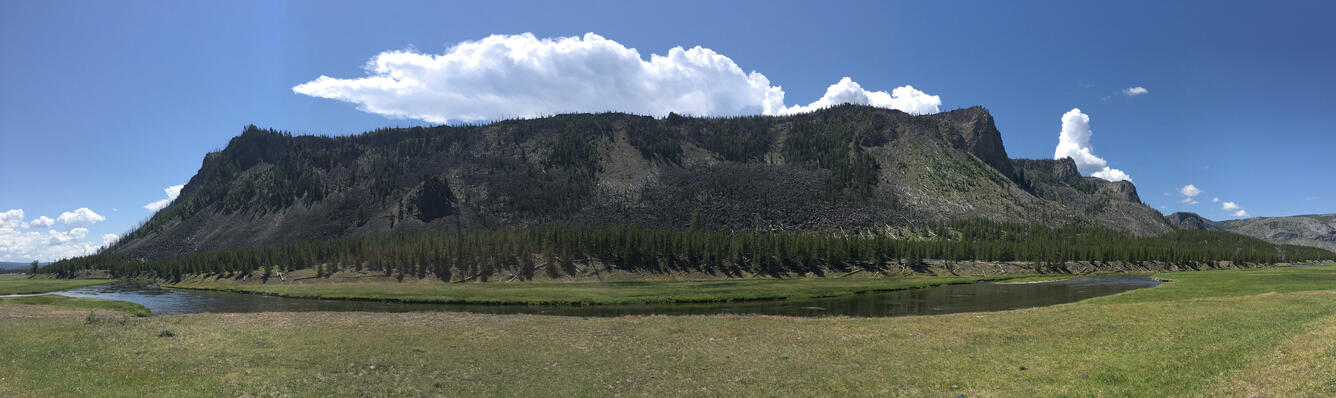
Let’s examine the range of fluid viscosities in Yellowstone, starting with the mantle underlying the volcanic field. On human timescales the mantle would be considered a solid (and therefore, not a fluid), but over timescales of thousands to millions of years, flow in the mantle at speeds of centimeters per year is the engine that drives plate tectonics and Yellowstone’s “hotspot” volcanism. Going shallower into the crust that overlies the mantle, magnetotellurics and seismic images show that both rhyolite and basalt magma reside at depths ranging from about 4 kilometers (2.5 miles) to as deep as about 50 kilometers (30 miles) below the surface. Rhyolite magmas are characterized by relatively high viscosity (similar to asphalt), while basalt has low viscosity (similar to syrup).
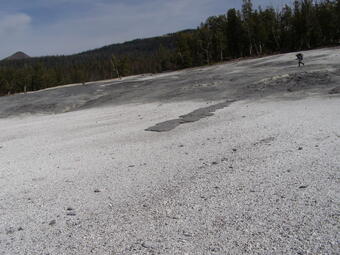
The high silica content of rhyolite makes it viscous and prevents gases from escaping easily, which can lead to explosive eruptions like the one that formed the Lava Creek Tuff and resulted in the collapse of Yellowstone caldera. Not all rhyolitic eruptions in Yellowstone were explosive, though; Yellowstone caldera is mostly filled by very thick (up to about 350 meters or 1150 feet) rhyolite lava flows. Because rhyolite is so viscous, these lavas probably took months to years to be emplaced and cool. Yellowstone rhyolite has characteristic textures that record how the lava flow developed. Basaltic lavas are found only outside the Yellowstone caldera, many of them in the north part of the park near Mammoth Hot Springs. Basaltic lavas are also common in the Snake River Plain and Craters of the Moon to the west of Yellowstone National Park in Idaho. Basalt has lower silica content than rhyolite and, therefore, is less viscous. Basaltic lava flows can travel hundreds of kilometers from their sources under certain conditions.
Until about 14,000 years ago Yellowstone was covered by glaciers for many thousands of years. Like the mantle, the ice making up those glaciers seems to be solid on human timescales, but on longer timescales ice can flow. When the glaciers receded and the ice (solid water) melted, large volumes of low-viscosity liquid water formed.
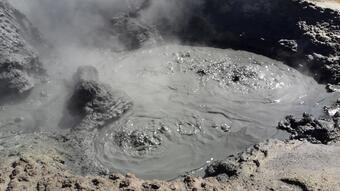
The viscosity of water decreases with increasing temperature. At 93 degrees Celsius (200 degrees Fahrenheit), which is the approximate boiling temperature of pure water at the elevation of Yellowstone, water is almost six times less viscous compared to temperatures just above freezing (zero degrees Celsius or 32 Fahrenheit), although the viscosity increases when there is material in the water, as is the case with mud pots. Steam that forms when water boils at hot springs has a viscosity about 25 times lower than liquid water at the same temperature, meaning that the steam emitted from geysers has far less resistance to flow compared to the accompanying liquid water.
One of the many unusual phenomena in Yellowstone are molten sulfur flows, such as those at Brimstone Basin near the eastern shore of Yellowstone Lake. The sulfur flow likely formed when native sulfur deposits were ignited during a forest fire at a temperature of at least 113 degrees Celsius (235 Fahrenheit), the boiling temperature of pure sulfur. Molten sulfur has a viscosity only about 10 times greater than water; however, tree remnants and other debris within the flow would make it somewhat more viscous.
Yellowstone is no doubt one of the most dynamic places on Earth. The many types of fluids that flow between the mantle and the atmosphere generate explosive volcanic and geyser eruptions, create lava flows, bubbling mud pots, and very rare sulfur flows, and they span nearly the full range of possible material viscosities. These fluids transport a lot of heat and mass from deep within the Earth and ultimately into the atmosphere, helping to make Yellowstone’s numerous thermal features and the life within them a natural wonder.