



With new thermal features popping up frequently and old ones experiencing periods of activity and quiescence, have you ever wondered how Yellowstone National Park keeps it all straight? Sometimes it’s tricky!
Yellowstone Caldera Chronicles is a weekly column written by scientists and collaborators of the Yellowstone Volcano Observatory. This week’s contribution is from Phillip Kondracki and Lauren Harrison in the Warner College of Natural Resources at Colorado State University.
Biscuit Basin has been in the media spotlight recently due to a hydrothermal explosion that occurred in July 2024 at Black Diamond Pool and smaller events that have occurred since. Unlike geysers, which release pressure through open, though constricted, vents, hydrothermal explosions occur when superheated water suddenly flashes to steam, shattering the confining rock. The result is abrupt and destructive, leaving craters, ejecta, and scars on the landscape.
Some of these events are well-documented in scientific literature and visitor records, like the explosion at Porkchop Geyser in 1989. Other events are lesser known, but records still exist in Yellowstone National Park’s archives, which is the case for the August 1925 hydrothermal explosion in Biscuit Basin. Though modest in scale compared to Yellowstone’s great explosion craters like Mary Bay, it represents an early recorded hydrothermal explosion near Black Diamond Pool and a reminder that even small disturbances can alter both the landscape and the human stories attached to them.
The 1925 blast was not witnessed at the time it took place. It occurred near the Firehole River, tearing open the fragile sinter crust and likely established or enlarged a new thermal pool near Black Diamond Pool.
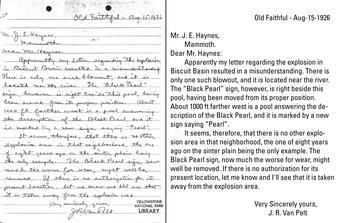
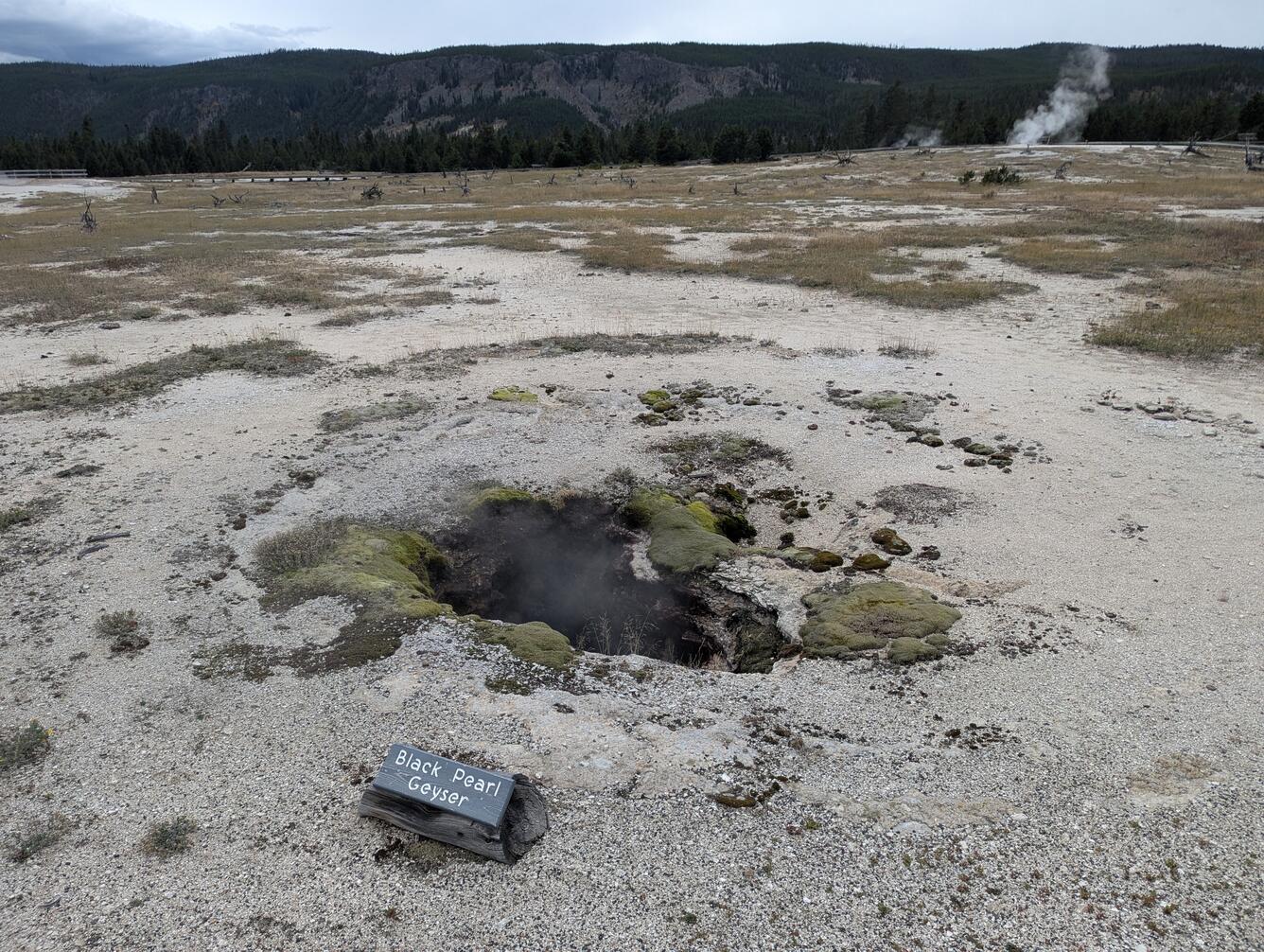
In the years that followed, confusion arose about what exactly had happened and where. Visitors encountered a weathered sign labeled “Black Pearl” near the blast zone, yet the feature it supposedly named was nowhere to be found. The true Black Pearl Geyser, which is studded with dark, pearl-like sinter spheres, lay roughly 1,000 feet (300 meters) to the west. The pools near Black Diamond Pool are named Wall Pool to the west and Black Opal Pool to the east. This is an example of early, informal names changing as duplications and conflicts were noticed!
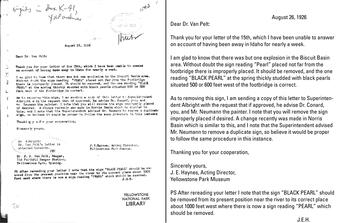
A flurry of correspondence in 1926 sought to untangle the mix-up. J. R. Van Pelt, a ranger at Old Faithful, clarified in a letter that only one explosion had occurred in Biscuit Basin, and that the “Black Pearl” sign had been mistakenly moved. Acting Yellowstone Park Museum Director J. E. Haynes confirmed the error, noting that the misplaced sign should be removed and the authentic Black Pearl Geyser restored to its proper name. The bureaucratic exchange, complete with references to superintendents, painters, and precedents from Norris Geyser Basin, reads today like a small episode of scientific housekeeping.
But beneath the clerical details lies something deeper. In the early twentieth century, documenting Yellowstone’s hydrothermal activity was as much an exercise in precision as it was in persistence. With telephones only just becoming common and letters serving as the primary means of communication, even small ambiguities in description or location could create lasting confusion. Observations travelled slowly, often filtered through fuzzy memory, unclear handwriting, and individual interpretation. In this environment, details that seemed clear in person could easily shift once retold, leaving room for misplacement, contradiction, or error. The historical record that survives from this period, therefore, reflects not only what people witnessed, but also the fragility of communication itself.
The sign confusion reminds us that stories of geologic change can easily be twisted by human error. A mislabeled pool risks hiding the memory of a much larger event. The explosion in 1925 shows the raw, unpredictable power beneath Yellowstone’s surface. Nearly a century later, and with a more recent Biscuit Basin blast refreshing memories, this area remains a case study in both natural danger and cultural response: nature reshapes the land instantly, and people scramble afterward to describe, classify, and effectively communicate changes to those who did not witness events.
Today, the Yellowstone Volcano Observatory has installed monitoring equipment in Biscuit Basin that will provide a record of any future explosions—hopefully preventing future explosion mix-ups like that which occurred after the 1925 event!