



Pennsylvania Waters - Winter 2026 - Issue 15
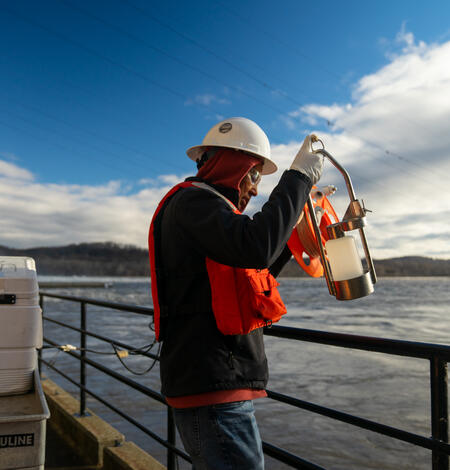
Informing Chesapeake Bay Watershed Management by Monitoring Trends in River Nutrient and Sediment Loads
The USGS has computed nutrient and suspended-sediment loads and trends through water year 2023 in Chesapeake Bay rivers. These monitoring-based estimates help federal, state, and local managers evaluate and plan water-quality restoration strategies.

Drought Watch Expanded to 40 Pennsylvania Counties
USGS groundwater and surface water monitoring data contributed to the Pennsylvania Department of Environmental Protection's (PaDEP) January 8, 2026, expansion of drought watches to three additional counties. A total of 40 counties are now under drought watch, and one county under a warning.
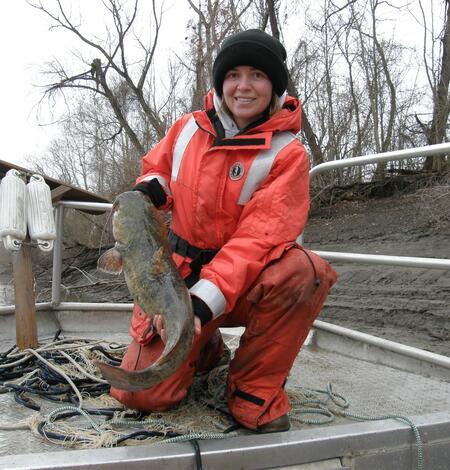
Invasive flathead catfish now top predators in Susquehanna River in Pennsylvania
New study suggests that smallmouth bass and channel catfish are changing what they eat to avoid having to compete with or being eaten by the invader
Three Rivers Water Quality, Pittsburgh
USGS, in cooperation with the Allegheny County Sanitary Authority (ALCOSAN), is monitoring water quality changes related to wastewater infrastructure improvements

Using a time-of-travel sampling approach to quantify per- and polyfluoroalkyl substances (PFAS) stream loading and source inputs in a mixed-source, urban catchment
Understanding per- and polyfluoroalkyl substances (PFAS) mass distribution in surface and groundwater systems can support source prioritization, load reduction, and water management. Thirteen sites within an urban catchment were sampled utilizing a time-of-travel sampling approach to minimize the influence of subdaily fluctuations in mass from PFAS point sources and to quantify PFAS and...
Municipal and industrial wastewater treatment plant effluent contributions to per- and polyfluoroalkyl substances in the Potomac River: A basin-scale measuring and modeling approach
Managing per- and polyfluoroalkyl substances (PFAS) in water resources requires a basin-scale approach. Predicted environmental concentrations (PEC) and stream-vulnerability scores for PFAS were determined for the Potomac River watershed in the eastern United States. Approximately 15% of stream reaches contained municipal and/or industrial wastewater treatment plant (WWTP) discharges...
Tree swallows as indicators of per- and polyfluoroalkyl substance exposure and effects at select Department of Defense sites along the East Coast and at sites with different sources in the Upper Midwest, United States
Questions remain about the distribution of per- and polyfluoroalkyl substances (PFAS) in the environment, the sources and movement within and between ecosystems, and whether there are effects from such exposure. Information from the Upper Midwest and the mid-Atlantic regions of the United States, which have different PFAS sources, were investigated. Concentrations of Total40 (sum of 40...
Regional high-frequency monitoring revealed chloride concentrations in exceedance of ecological benchmarks in urban streams across the Delaware River Basin, USA
Rising chloride concentrations pose critical risks to freshwater stream ecosystems in temperate regions like the Delaware River Basin (DRB), USA, where winter deicer applications (i.e., road salt) are common. Increasing chloride concentrations have been documented in the region, but the extent to which chloride exceeds regulatory benchmarks remains unclear because detection of...
A geospatial analysis of water-quality threats from orphan wells in principal and secondary aquifers of the United States
Throughout the history of oil and gas production in the United States, millions of wells have been drilled for exploration and energy production. Hundreds of thousands of unplugged wells are no longer actively producing and are currently under orphan status, with no responsible party obligated for plugging. Orphan wells can pose threats to water resources by providing pathways for...
Tracking status and trends in seven key indicators of river and stream condition in the Chesapeake Bay watershed
Freshwater streams and rivers are recognized as vital habitats within the Chesapeake Bay watershed, which has been undergoing extensive restoration efforts for more than 30 years. Resource managers need to understand stream and river condition and how these conditions are changing over time to determine whether regional long-term restoration and conservation goals are being met. The...