



Pachyprosopis cornuta, Horned Naked Bee, collected in Australia by Laurence PackerHere we have a representative of a subfamily of bees found only in Australia and nearby islands, although at least one has been introduced to a different continent (Africa) where it persisted long enough for bee collectors to find some.
All Multimedia
Access all multimedia to include images, video, audio, webcams, before-after imagery, and more. Filter and explore with filtering options to refine search.
Filter Total Items: 24926

Pachyprosopis cornuta, f, australia, back
Pachyprosopis cornuta, Horned Naked Bee, collected in Australia by Laurence PackerHere we have a representative of a subfamily of bees found only in Australia and nearby islands, although at least one has been introduced to a different continent (Africa) where it persisted long enough for bee collectors to find some.

Pachyprosopis cornuta, f, australia, face
Pachyprosopis cornuta, f, australia, face
Pachyprosopis cornuta, f, australia, face

Pachyprosopis cornuta, f, australia, side
Pachyprosopis cornuta, f, australia, side
Pachyprosopis cornuta, f, australia, side

Packera aurea, Golden ragwort 2, Howard County, Md,
Packera aurea, Golden ragwort 2, Howard County, Md,Golden Ragwort, Packera aurea. Common in Appalachia...and spotty on the coastal plains. Favored by Andrena gardineri...who feed their young only pollen from this plant. A nice ground cover plant for gardens, particularly shaded ones....Photo and specimens from Helen Lowe Metzman.
Packera aurea, Golden ragwort 2, Howard County, Md,
Packera aurea, Golden ragwort 2, Howard County, Md,Golden Ragwort, Packera aurea. Common in Appalachia...and spotty on the coastal plains. Favored by Andrena gardineri...who feed their young only pollen from this plant. A nice ground cover plant for gardens, particularly shaded ones....Photo and specimens from Helen Lowe Metzman.

Packera aurea, Golden ragwort, Howard County, Md,
Golden Ragwort, Packera aurea. Common in Appalachia...and spotty on the coastal plains. Favored by Andrena gardineri...who feed their young only pollen from this plant. A nice ground cover plant for gardens, particularly shaded ones....Photo and specimens from Helen Lowe Metzman.
Golden Ragwort, Packera aurea. Common in Appalachia...and spotty on the coastal plains. Favored by Andrena gardineri...who feed their young only pollen from this plant. A nice ground cover plant for gardens, particularly shaded ones....Photo and specimens from Helen Lowe Metzman.

Packera aurea, syn. Senecio aureus 2, involucres golden ragwort
Packera aurea, syn. Senecio aureus 2, involucres golden ragwortGolden ragwort, one of several species, now given the genus name of Packera...but formerly Senecio. Those taxonomists... This group hangs out in wet areas or moist roadsides, particularly in the Appalachians.
Packera aurea, syn. Senecio aureus 2, involucres golden ragwort
Packera aurea, syn. Senecio aureus 2, involucres golden ragwortGolden ragwort, one of several species, now given the genus name of Packera...but formerly Senecio. Those taxonomists... This group hangs out in wet areas or moist roadsides, particularly in the Appalachians.

Packera aurea, syn. Senecio aureus, golden ragwort
Packera aurea, syn. Senecio aureus, golden ragwortGolden ragwort, one of several species, now given the genus name of Packera...but formerly Senecio. Those taxonomists... This group hangs out in wet areas or moist roadsides, particularly in the Appalachians.
Packera aurea, syn. Senecio aureus, golden ragwort
Packera aurea, syn. Senecio aureus, golden ragwortGolden ragwort, one of several species, now given the genus name of Packera...but formerly Senecio. Those taxonomists... This group hangs out in wet areas or moist roadsides, particularly in the Appalachians.

Palaeorhiza species, f, Papau New Guinea, back
Palaeorhiza species, Badass Masked Bee, specimen collected in Papua New GuineaThin, relatively hairless, dangerous looking Masked Bees are waspish in aspect since they carry their pollen and nectar internally rather than trapped in external hairs.
Palaeorhiza species, Badass Masked Bee, specimen collected in Papua New GuineaThin, relatively hairless, dangerous looking Masked Bees are waspish in aspect since they carry their pollen and nectar internally rather than trapped in external hairs.

Palaeorhiza species, f, Papau New Guinea, face
Palaeorhiza species, Badass Masked Bee, specimen collected in Papua New GuineaThin, relatively hairless, dangerous looking Masked Bees are waspish in aspect since they carry their pollen and nectar internally rather than trapped in external hairs.
Palaeorhiza species, Badass Masked Bee, specimen collected in Papua New GuineaThin, relatively hairless, dangerous looking Masked Bees are waspish in aspect since they carry their pollen and nectar internally rather than trapped in external hairs.

Palaeorhiza species, f, Papau New Guinea, side
Palaeorhiza species, Badass Masked Bee, specimen collected in Papua New GuineaThin, relatively hairless, dangerous looking Masked Bees are waspish in aspect since they carry their pollen and nectar internally rather than trapped in external hairs.
Palaeorhiza species, Badass Masked Bee, specimen collected in Papua New GuineaThin, relatively hairless, dangerous looking Masked Bees are waspish in aspect since they carry their pollen and nectar internally rather than trapped in external hairs.

Panax trifolius, Dwarf Ginseng, Howard County, Md, Helen Lowe Metzman
Panax trifolius, Dwarf Ginseng, Howard County, Md, Helen Lowe MetzmanTiny. One would want this in your woodland rock garden. Dwarf Ginseng, Panax trifolius. Specimen and picture by Helen Lowe Metzman. Photography Information: Canon Mark II 5D, Zerene Stacker, Stackshot Sled, 65mm Canon MP-E 1-5X macro lens, Twin Macro Flash in Styrofoam Cooler, F5.0, ISO 100, Shutter Speed 200.
Panax trifolius, Dwarf Ginseng, Howard County, Md, Helen Lowe Metzman
Panax trifolius, Dwarf Ginseng, Howard County, Md, Helen Lowe MetzmanTiny. One would want this in your woodland rock garden. Dwarf Ginseng, Panax trifolius. Specimen and picture by Helen Lowe Metzman. Photography Information: Canon Mark II 5D, Zerene Stacker, Stackshot Sled, 65mm Canon MP-E 1-5X macro lens, Twin Macro Flash in Styrofoam Cooler, F5.0, ISO 100, Shutter Speed 200.

Panurginus atramontensis, f, back, Prince George's Co, MD
Panurginus atramontensis, f, back, Prince George's Co, MDAn Uncommon (or is it?) Deerberry specialist. If you don't collect bees on Deerberry (Vaccinium staminium) you will never see this bee (Panurginus atramontensis). It only gathers pollen and probably almost all of its nectar from this plant.
Panurginus atramontensis, f, back, Prince George's Co, MD
Panurginus atramontensis, f, back, Prince George's Co, MDAn Uncommon (or is it?) Deerberry specialist. If you don't collect bees on Deerberry (Vaccinium staminium) you will never see this bee (Panurginus atramontensis). It only gathers pollen and probably almost all of its nectar from this plant.

Panurginus atramontensis, f, face, Prince George's Co, MD
Panurginus atramontensis, f, face, Prince George's Co, MDAn Uncommon (or is it?) Deerberry specialist. If you don't collect bees on Deerberry (Vaccinium staminium) you will never see this bee (Panurginus atramontensis). It only gathers pollen and probably almost all of its nectar from this plant.
Panurginus atramontensis, f, face, Prince George's Co, MD
Panurginus atramontensis, f, face, Prince George's Co, MDAn Uncommon (or is it?) Deerberry specialist. If you don't collect bees on Deerberry (Vaccinium staminium) you will never see this bee (Panurginus atramontensis). It only gathers pollen and probably almost all of its nectar from this plant.

Panurginus atramontensis, f, right, Prince George's Co, MD
Panurginus atramontensis, f, right, Prince George's Co, MDAn Uncommon (or is it?) Deerberry specialist. If you don't collect bees on Deerberry (Vaccinium staminium) you will never see this bee (Panurginus atramontensis). It only gathers pollen and probably almost all of its nectar from this plant.
Panurginus atramontensis, f, right, Prince George's Co, MD
Panurginus atramontensis, f, right, Prince George's Co, MDAn Uncommon (or is it?) Deerberry specialist. If you don't collect bees on Deerberry (Vaccinium staminium) you will never see this bee (Panurginus atramontensis). It only gathers pollen and probably almost all of its nectar from this plant.
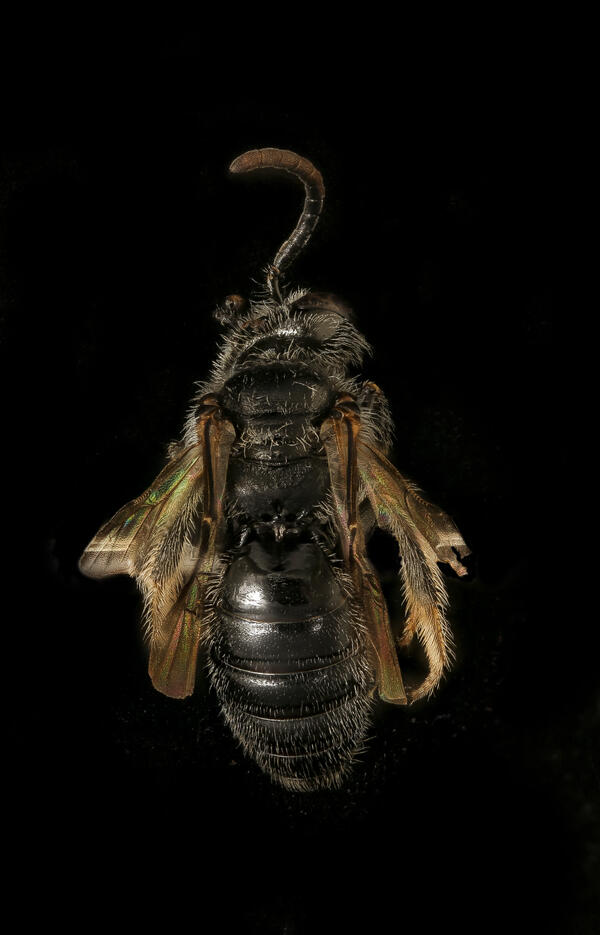
Panurginus atramontensis, m, back, Prince George's Co, MD
Panurginus atramontensis, m, back, Prince George's Co, MDAn Uncommon (or is it?) Deerberry specialist. If you don't collect bees on Deerberry (Vaccinium staminium) you will never see this bee (Panurginus atramontensis). It only gathers pollen and probably almost all of its nectar from this plant.
Panurginus atramontensis, m, back, Prince George's Co, MD
Panurginus atramontensis, m, back, Prince George's Co, MDAn Uncommon (or is it?) Deerberry specialist. If you don't collect bees on Deerberry (Vaccinium staminium) you will never see this bee (Panurginus atramontensis). It only gathers pollen and probably almost all of its nectar from this plant.

Panurginus atramontensis, m, face, Prince George's Co, MD
Panurginus atramontensis, m, face, Prince George's Co, MDAn Uncommon (or is it?) Deerberry specialist. If you don't collect bees on Deerberry (Vaccinium staminium) you will never see this bee (Panurginus atramontensis). It only gathers pollen and probably almost all of its nectar from this plant.
Panurginus atramontensis, m, face, Prince George's Co, MD
Panurginus atramontensis, m, face, Prince George's Co, MDAn Uncommon (or is it?) Deerberry specialist. If you don't collect bees on Deerberry (Vaccinium staminium) you will never see this bee (Panurginus atramontensis). It only gathers pollen and probably almost all of its nectar from this plant.

Panurginus atramontensis, m, left, Prince George's Co, MD
Panurginus atramontensis, m, left, Prince George's Co, MDAn Uncommon (or is it?) Deerberry specialist. If you don't collect bees on Deerberry (Vaccinium staminium) you will never see this bee (Panurginus atramontensis). It only gathers pollen and probably almost all of its nectar from this plant.
Panurginus atramontensis, m, left, Prince George's Co, MD
Panurginus atramontensis, m, left, Prince George's Co, MDAn Uncommon (or is it?) Deerberry specialist. If you don't collect bees on Deerberry (Vaccinium staminium) you will never see this bee (Panurginus atramontensis). It only gathers pollen and probably almost all of its nectar from this plant.

Panurginus calcaratus, f, facd, Norway
From the northern hemisphere comes ... Panurginus. A common group of largely dark little bees, with the males, at times having yellow on their faces, in keeping with the general pattern of males having more yellow than females.
From the northern hemisphere comes ... Panurginus. A common group of largely dark little bees, with the males, at times having yellow on their faces, in keeping with the general pattern of males having more yellow than females.

Panurginus calcaratus, f, side, Norway
From the northern hemisphere comes ... Panurginus. A common group of largely dark little bees, with the males, at times having yellow on their faces, in keeping with the general pattern of males having more yellow than females.
From the northern hemisphere comes ... Panurginus. A common group of largely dark little bees, with the males, at times having yellow on their faces, in keeping with the general pattern of males having more yellow than females.

Panurginus potentilla, m, face, prince georges county
Panurginus potentilla, m, face, prince georges countyA tiny tiny bee, a specialist on Potentilla or Cinquefoil plants in North America. This one came from a colony I discovered in a dirt patch right in the front lawn of our laboratory. These sorts of bare dirt / clay / sand areas are often great bee nesting sites.
Panurginus potentilla, m, face, prince georges county
Panurginus potentilla, m, face, prince georges countyA tiny tiny bee, a specialist on Potentilla or Cinquefoil plants in North America. This one came from a colony I discovered in a dirt patch right in the front lawn of our laboratory. These sorts of bare dirt / clay / sand areas are often great bee nesting sites.

Panurginus potentilla, m, prince georges county, back
Panurginus potentilla, m, prince georges county, backA tiny tiny bee, a specialist on Potentilla or Cinquefoil plants in North America. This one came from a colony I discovered in a dirt patch right in the front lawn of our laboratory. These sorts of bare dirt / clay / sand areas are often great bee nesting sites.
Panurginus potentilla, m, prince georges county, back
Panurginus potentilla, m, prince georges county, backA tiny tiny bee, a specialist on Potentilla or Cinquefoil plants in North America. This one came from a colony I discovered in a dirt patch right in the front lawn of our laboratory. These sorts of bare dirt / clay / sand areas are often great bee nesting sites.