



Navigating the Climate Adaptation Toolkit
Climate change adaptation planning processes and tools are increasing in number and evolving rapidly. During times of innovation and proliferation, a shared vision is needed to avoid duplication, reduce misunderstandings, and facilitate work across jurisdictions to steward resources undergoing profound changes.
Over recent years, adaptation scientists and practitioners have developed new approaches (processes and tools) to help planners and decision makers prepare for and manage the impacts of a changing climate. As a result, multiple approaches have emerged, each with its own process for resource-stewardship planning. And while the tools used in these processes are highly functional, there’s general confusion on how (or if) they can be used together, leading to duplication of efforts, misunderstandings, and missed opportunities for collaboration across agencies and jurisdictions.
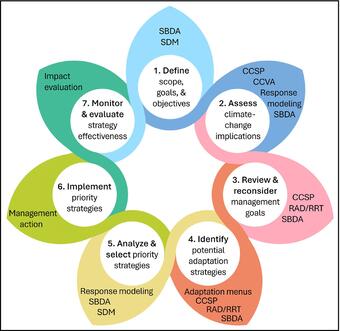
A new publication by Climate Adaptation Science Center scientists and partners from four other federal agencies tackles the growing challenge of climate adaptation tool proliferation by demonstrating how the many tools work in tandem to encourage, not prevent, coordination and shared learning.
In the paper, the authors compare several leading adaptation planning processes and outline the steps they have in common. They then specifically highlight tools that have emerged and gained traction in recent years, such as climate vulnerability assessments, climate change scenario planning, and conceptual frameworks (including Resistance-Resilience-Transition and Resist-Accept-Direct). In their research, they found that prevailing adaptation processes are fundamentally similar and have substantial overlap. With this insight, the authors lay out a generalized seven-step process for climate-informed planning and identify where relevant tools can support each stage.
By identifying commonalities across planning processes and showing how key tools fit into and support the planning process, the authors hope to reduce confusion and strengthen coordination across institutions and landscapes. The result of this research is a clearer picture of how different climate-adaptation tools can complement one another as resource managers, adaptation practitioners, and scientists navigate uncertain futures.