



CAP Future of Species Range Shifts Cohort (2025-2027)
The 2025-2027 Climate Adaptation Postdoctoral (CAP) Fellows cohort will explore how climate change is driving changes in species’ geographic distributions through range shifts and identify implications for natural resource management objectives and ecosystem services.
About
Among the most widely anticipated effects of climate change is changes in species’ geographic distributions through range shifts, as species track climate niches altered by changing climate conditions. Species’ range shifts have the potential to alter ecological communities with important implications for natural resource management objectives and ecosystem services, and a failure of species to track favorable climate conditions could result in local extirpations or extinctions. While range shifts are well documented and substantial among some taxa, there exists tremendous variation across regions and taxonomic groups, as well as substantial uncertainty about the mechanisms driving climate-mediated species movement; the effect of such shifts on ecological communities; interactions with other non-climate anthropogenic stressors, such as land use change and urbanization; and the resulting impact of species movement on ecosystems, ecosystem services and local communities.
The 2025-2027 Climate Adaptation Postdoctoral (CAP) Fellows cohort will explore how climate change is driving changes in species’ geographic distributions through range shifts and identify implications for natural resource management objectives and ecosystem services. Fellows situated at each of the nine regional CASCs will work with USGS, university, and regional partners to conduct research directly applicable to regional management priorities relating to species’ range shifts. The fellows will also work with each other on a national synthesis project on the topic and participate in professional development training on conducting management-focused research.
Learn more about the CAP Fellows Program >>
Future of Species Range Shifts Projects
The CAP Fellows Program is supported through the National CASC supported project "Future of Species Range Shifts."
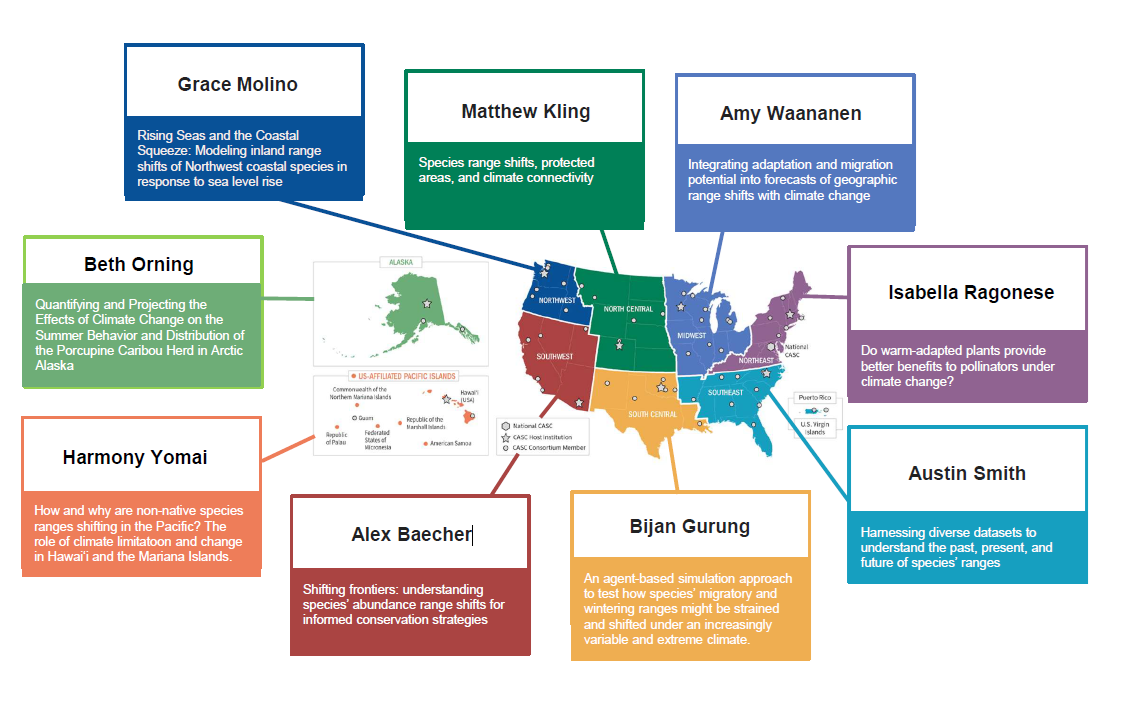
CASC | Project Title | Principal Investigator(s) | Location | Fellow (Coming Soon) |
|---|---|---|---|---|
Alaska | Heather Johnson and Ophélie Couriot | USGS | Beth Orning | |
Midwest | David Moeller | University of Minnesota - Twin Cities | Amy Waananen | |
North Central | Solomon Dobrowski and Sean Parks | University of Montana | Matthew Kling | |
Northeast | Laura Figueroa | University of Massachusetts, Amherst | Isabella Ragonese | |
Northwest | Josh Lawler and Meade Krosby | University of Washington | Grace Molino | |
Pacific Islands | Elliott Parsons and Helen Sofaer | The University of Hawaiʻi at Mānoa | Harmony Yomai | |
South Central | Jeremy Ross and Eli Bridge | University of Oklahoma | Bijan Gurung | |
Southeast | Brett Sheffers and Corey T. Callaghan | University of Florida | Austin Smith | |
Southwest | T.J. Clark-Wolf and Erica Stuber | Utah State University | Alex Baecher |
<< Return to the CAP Fellows Program

Shifting frontiers: understanding species’ abundance range shifts for informed conservation strategies
Harnessing diverse datasets to understand the past, present, and future of species’ ranges
An agent-based simulation approach to test how species’ migratory and wintering ranges might be strained and shifted under an increasingly variable and extreme climate
Future of Species Range Shifts: Rising Seas and the Coastal Squeeze: Modeling inland range shifts of Northwest coastal species in response to sea level rise
Future of Species Range Shifts: Do warm-adapted plants provide better benefits to pollinators under climate change?
Future of Species Range Shifts: Species range shifts, protected areas, and climate connectivity
Future of Species Range Shifts: Quantifying and Projecting the Effects of Climate Change on the Summer Behavior and Distribution of the Porcupine Caribou Herd in Arctic Alaska
Future of Species Range Shifts: Integrating adaptation and migration potential into forecasts of geographic range shifts with climate change
The 2025-2027 Climate Adaptation Postdoctoral (CAP) Fellows cohort will explore how climate change is driving changes in species’ geographic distributions through range shifts and identify implications for natural resource management objectives and ecosystem services.
About
Among the most widely anticipated effects of climate change is changes in species’ geographic distributions through range shifts, as species track climate niches altered by changing climate conditions. Species’ range shifts have the potential to alter ecological communities with important implications for natural resource management objectives and ecosystem services, and a failure of species to track favorable climate conditions could result in local extirpations or extinctions. While range shifts are well documented and substantial among some taxa, there exists tremendous variation across regions and taxonomic groups, as well as substantial uncertainty about the mechanisms driving climate-mediated species movement; the effect of such shifts on ecological communities; interactions with other non-climate anthropogenic stressors, such as land use change and urbanization; and the resulting impact of species movement on ecosystems, ecosystem services and local communities.
The 2025-2027 Climate Adaptation Postdoctoral (CAP) Fellows cohort will explore how climate change is driving changes in species’ geographic distributions through range shifts and identify implications for natural resource management objectives and ecosystem services. Fellows situated at each of the nine regional CASCs will work with USGS, university, and regional partners to conduct research directly applicable to regional management priorities relating to species’ range shifts. The fellows will also work with each other on a national synthesis project on the topic and participate in professional development training on conducting management-focused research.
Learn more about the CAP Fellows Program >>
Future of Species Range Shifts Projects
The CAP Fellows Program is supported through the National CASC supported project "Future of Species Range Shifts."
CASC | Project Title | Principal Investigator(s) | Location | Fellow (Coming Soon) |
|---|---|---|---|---|
Alaska | Heather Johnson and Ophélie Couriot | USGS | Beth Orning | |
Midwest | David Moeller | University of Minnesota - Twin Cities | Amy Waananen | |
North Central | Solomon Dobrowski and Sean Parks | University of Montana | Matthew Kling | |
Northeast | Laura Figueroa | University of Massachusetts, Amherst | Isabella Ragonese | |
Northwest | Josh Lawler and Meade Krosby | University of Washington | Grace Molino | |
Pacific Islands | Elliott Parsons and Helen Sofaer | The University of Hawaiʻi at Mānoa | Harmony Yomai | |
South Central | Jeremy Ross and Eli Bridge | University of Oklahoma | Bijan Gurung | |
Southeast | Brett Sheffers and Corey T. Callaghan | University of Florida | Austin Smith | |
Southwest | T.J. Clark-Wolf and Erica Stuber | Utah State University | Alex Baecher |
<< Return to the CAP Fellows Program
Shifting frontiers: understanding species’ abundance range shifts for informed conservation strategies
Harnessing diverse datasets to understand the past, present, and future of species’ ranges
An agent-based simulation approach to test how species’ migratory and wintering ranges might be strained and shifted under an increasingly variable and extreme climate
Future of Species Range Shifts: Rising Seas and the Coastal Squeeze: Modeling inland range shifts of Northwest coastal species in response to sea level rise
Future of Species Range Shifts: Do warm-adapted plants provide better benefits to pollinators under climate change?
Future of Species Range Shifts: Species range shifts, protected areas, and climate connectivity
Future of Species Range Shifts: Quantifying and Projecting the Effects of Climate Change on the Summer Behavior and Distribution of the Porcupine Caribou Herd in Arctic Alaska