



Explore More RADish Profiles
Explore interviews with scientists and managers researching and implementing the resist-accept-direct (RAD) framework.
Dr. Frank Rahel
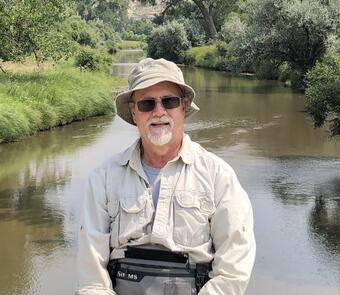
Emeritus Professor of Zoology and Physiology, University of Wyoming
Frank Rahel taught fisheries biology classes and conducted aquatic research at the University of Wyoming before his recent retirement. Throughout his career, his research focused on fish-habitat relationships ranging from micro- to macroscales. One major area of interest was the impact of human activities on fish assemblages, particularly how species introductions and extirpations have resulted in the homogenization of fish faunas across the United States. He also examined how climate change alters fish distributions as coldwater species retract and warmwater species expand their ranges. Most recently Rahel explored how the main tools available to fisheries managers (stocking, harvest regulations, habitat improvements, and community manipulations) can be used most effectively within the Resist-Accept-Direct (RAD) framework and he co-edited a special issue on managing fisheries using RAD.
Q: How long have you been a RADish?
I have been involved in fisheries education and research throughout my career. Over the years, I taught a variety of fisheries courses and participated in numerous research projects which allowed me to develop a strong appreciation for the challenges in managing aquatic resources.
I volunteered to serve on a panel of biologists organized through the American Fisheries Society and The Wildlife Society. The goal was to bring researchers and managers together to discuss how climate change affects both terrestrial and aquatic environments and how managers can respond to these changes. We wanted to emphasize collaboration and the exchange of ideas between the two fields. At a 2018 workshop in Seattle, I met Abby Lynch and became involved with this group of researchers and the RAD framework. That experience led to a series of RAD publications that explored the application to fisheries and aquatic ecosystems, in addition to broader terrestrial environmental management.
The initial publication that helped introduce RAD appeared in the journal Fisheries. The paper included 16 co-authors and explained how the RAD framework could be applied in natural resource management. The group represented many environmental disciplines, with individuals who conduct on the ground environmental management alongside academics like myself who approach these questions from a basic research and climate change perspective.
Q: How have you seen the concept of RAD evolve and how does it continue to be useful?
I have witnessed the RAD framework gain immense traction due to the increasing concerns regarding climate adaptation and mitigation. One measure of the relevance of the RAD framework is the growing number of publications that apply the framework to a wide variety of natural resource management issues. It is particularly gratifying to see applications from areas outside of North America.
Historically, much of conservation was focused on preventing change or restoring ecosystems to the way they were prior to alteration by humans. However, the RAD framework encourages thinking beyond simply trying to reverse those changes and considers other possibilities: resisting change when it is feasible to do so, accepting change and managing the new conditions as best you can, or actively directing change toward desired outcomes.
In that sense, RAD opens up the entire playbook for land managers, providing more ways to think about and respond to environmental change rather than assuming there is only one correct approach.
Q: What are some of the biggest challenges you've seen managers face when choosing between resisting, accepting, or directing change?
Those of us in academia have the ability to think about environmental issues from a strictly biological perspective, unconstrained by economics or politics. Managers, on the other hand, have to deal with the socio-political realities of the world and make decisions that directly or indirectly impact not only ecosystems, but the humans living in those ecosystems. One notable challenge is convincing stakeholders that alternative approaches, such as accepting or directing the environment are realistic and worth considering. Management actions that are most beneficial to plants and animals may conflict with what is in the best interest of some stakeholders. Commercial fisheries provide a classic example of this conflict whereby reducing harvest might help recovery of depleted fish stocks but may be opposed by fishers whose livelihoods would be affected.
From an academic perspective, it is easy to suggest certain approaches, but managers must also consider practical limitations, competing interests, and the expectation of the stakeholders involved. Even when managers understand that these approaches may be necessary, they still have to communicate their reasoning and weigh the long-term versus short-term benefits of a proposed management action. Ultimately, I think successful environmental management requires managers to find a balance between scientific knowledge, ecological realities and stakeholder expectations. It’s not about choosing the ideal approach on paper but finding a realistic solution that can be supported and implemented effectively.
Q: In one sentence (or as close as you can get), how would you explain RAD to someone outside of science?
The world is changing and we will have to figure out how to deal with that change by either taking things back to the way they were, accepting change and managing as best we can, or moving forward to direct changes in ways most acceptable to society.
Explore interviews with scientists and managers researching and implementing the resist-accept-direct (RAD) framework.
Dr. Frank Rahel
Emeritus Professor of Zoology and Physiology, University of Wyoming
Frank Rahel taught fisheries biology classes and conducted aquatic research at the University of Wyoming before his recent retirement. Throughout his career, his research focused on fish-habitat relationships ranging from micro- to macroscales. One major area of interest was the impact of human activities on fish assemblages, particularly how species introductions and extirpations have resulted in the homogenization of fish faunas across the United States. He also examined how climate change alters fish distributions as coldwater species retract and warmwater species expand their ranges. Most recently Rahel explored how the main tools available to fisheries managers (stocking, harvest regulations, habitat improvements, and community manipulations) can be used most effectively within the Resist-Accept-Direct (RAD) framework and he co-edited a special issue on managing fisheries using RAD.
Q: How long have you been a RADish?
I have been involved in fisheries education and research throughout my career. Over the years, I taught a variety of fisheries courses and participated in numerous research projects which allowed me to develop a strong appreciation for the challenges in managing aquatic resources.
I volunteered to serve on a panel of biologists organized through the American Fisheries Society and The Wildlife Society. The goal was to bring researchers and managers together to discuss how climate change affects both terrestrial and aquatic environments and how managers can respond to these changes. We wanted to emphasize collaboration and the exchange of ideas between the two fields. At a 2018 workshop in Seattle, I met Abby Lynch and became involved with this group of researchers and the RAD framework. That experience led to a series of RAD publications that explored the application to fisheries and aquatic ecosystems, in addition to broader terrestrial environmental management.
The initial publication that helped introduce RAD appeared in the journal Fisheries. The paper included 16 co-authors and explained how the RAD framework could be applied in natural resource management. The group represented many environmental disciplines, with individuals who conduct on the ground environmental management alongside academics like myself who approach these questions from a basic research and climate change perspective.
Q: How have you seen the concept of RAD evolve and how does it continue to be useful?
I have witnessed the RAD framework gain immense traction due to the increasing concerns regarding climate adaptation and mitigation. One measure of the relevance of the RAD framework is the growing number of publications that apply the framework to a wide variety of natural resource management issues. It is particularly gratifying to see applications from areas outside of North America.
Historically, much of conservation was focused on preventing change or restoring ecosystems to the way they were prior to alteration by humans. However, the RAD framework encourages thinking beyond simply trying to reverse those changes and considers other possibilities: resisting change when it is feasible to do so, accepting change and managing the new conditions as best you can, or actively directing change toward desired outcomes.
In that sense, RAD opens up the entire playbook for land managers, providing more ways to think about and respond to environmental change rather than assuming there is only one correct approach.
Q: What are some of the biggest challenges you've seen managers face when choosing between resisting, accepting, or directing change?
Those of us in academia have the ability to think about environmental issues from a strictly biological perspective, unconstrained by economics or politics. Managers, on the other hand, have to deal with the socio-political realities of the world and make decisions that directly or indirectly impact not only ecosystems, but the humans living in those ecosystems. One notable challenge is convincing stakeholders that alternative approaches, such as accepting or directing the environment are realistic and worth considering. Management actions that are most beneficial to plants and animals may conflict with what is in the best interest of some stakeholders. Commercial fisheries provide a classic example of this conflict whereby reducing harvest might help recovery of depleted fish stocks but may be opposed by fishers whose livelihoods would be affected.
From an academic perspective, it is easy to suggest certain approaches, but managers must also consider practical limitations, competing interests, and the expectation of the stakeholders involved. Even when managers understand that these approaches may be necessary, they still have to communicate their reasoning and weigh the long-term versus short-term benefits of a proposed management action. Ultimately, I think successful environmental management requires managers to find a balance between scientific knowledge, ecological realities and stakeholder expectations. It’s not about choosing the ideal approach on paper but finding a realistic solution that can be supported and implemented effectively.
Q: In one sentence (or as close as you can get), how would you explain RAD to someone outside of science?
The world is changing and we will have to figure out how to deal with that change by either taking things back to the way they were, accepting change and managing as best we can, or moving forward to direct changes in ways most acceptable to society.