



A Case Study for Radon as a Tracer of Seabed Minerals
During the 2026 American Samoa ROV + Mapping Exploration expedition, the team collected water samples from just above the seafloor as well as sediment and mineral samples. Scientists from the USGS Global Seabed Mineral Resources program will analyze these samples for naturally occurring radioactive radon, which may be a useful geochemical tracer for locating deep-sea mineral deposits.
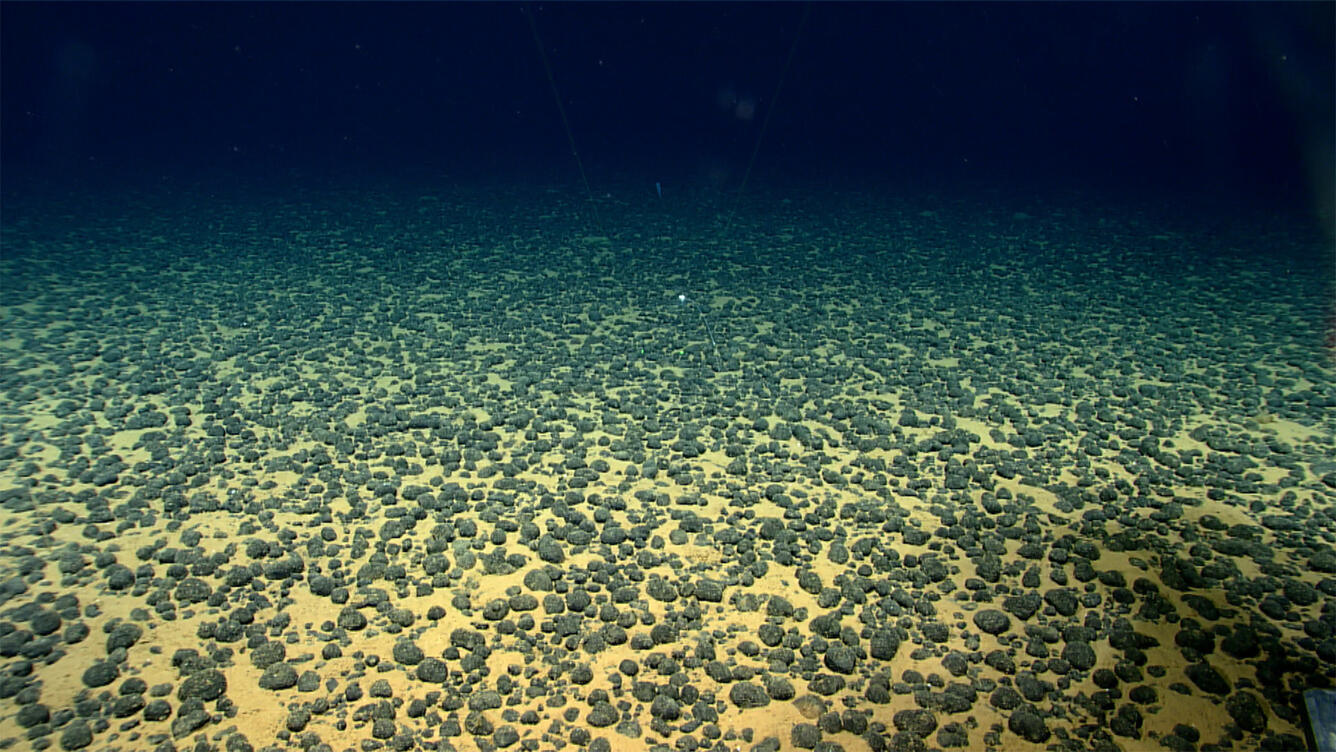
Abyssal plains are seafloor regions that lie between 3,000 and 6,000 meters (1.9 and 3.7 miles) depth. They cover nearly half of Earth’s surface and are one of the most underexplored regions of our planet. During this expedition, we used a remotely operated vehicle to visually explore the seafloor at abyssal depths and collected biological, geological, and chemical samples to further characterize the environment. Our plan was to explore regions of the seafloor that host polymetallic crusts and nodules, which are metal-rich minerals that form over millions of years.
Polymetallic crusts grow on seamounts and ferromanganese nodules have been found on seamounts but are primarily found on abyssal plain sediments across the globe. One of the Global Seabed Mineral Resources project’s main objectives is to study the oceanographic processes that control global seabed mineral distribution and abundance. Using modern day ocean conditions to predict where and how ferromanganese minerals have been growing over millions of years is challenging, as the ocean has undergone significant changes within that time frame.
Polymetallic nodules contain radioactive elements like thorium and radium in addition to elements designated as “critical minerals” like nickel, copper, cobalt, and manganese. Radioactive elements naturally decay with time at known rates (called half-lives), releasing energy and transforming from “parent” to “daughter” isotopes.
In recent years, radon in deep ocean water has been proposed as a potential “tracer” of manganese nodule occurrence (Guo et al. 2022); the radioactivity of nodules has also been raised as a potential impact of seabed mineral extraction (Volz et al. 2023). Thorium, which is present throughout the oceans, naturally chemically attaches to ferromanganese nodules and decays to radium, which then decays to radon, a dissolved gas found at low concentrations in deep ocean water. Excess radon in deep ocean water (radon daughter isotopes in excess of parent radium isotopes) is hypothesized to come from this decay. The correlation between elevated radon and nodule occurrence was identified on a global scale using extrapolated data and predicted nodule abundance.
Here in American Samoa, we are pairing direct measurements of nodule abundance and radon measurements to further explore this correlation and to investigate the viability of radon to refine predicted locations of seabed minerals. These datasets may also be useful to inform any risk analyses or assessments associated with potential onward seabed mineral extraction.
Related

Global Seabed Mineral Resources
Related