



Collaborative Innovation for Giant Sequoia Conservation
The USGS and partners are developing an AI-based tool capable of detecting dead and dying giant sequoia trees from high-resolution remote sensing imagery.
New Challenges for Ancient Trees
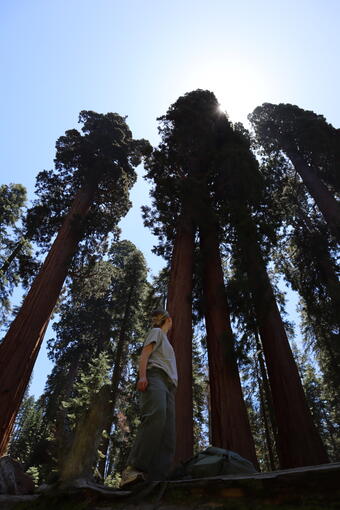
Giant sequoias grow natively only on the western slopes of the Sierra Nevada in California, between 4,000 and 8,000 feet in elevation. Scattered across fewer than 100 groves, these towering trees are an iconic species that inspire public admiration and draw millions of visitors each year.
Giant sequoias are known for their longevity and resilience, but over the past decade they have experienced higher mortality rates as environmental conditions change. Since 2015, an estimated 18% of all large giant sequoias within their native range have been lost to large wildfires that burned more intensely than the fires these trees evolved to survive. A number of trees have also died due to apparent bark beetle attack—a phenomenon never before documented in the species and one that has alarmed resource managers charged with protecting giant sequoias. While the mechanisms driving bark beetle-related mortality are still being investigated, early evidence suggests an association with fire and severe drought, both of which can weaken trees and make them more susceptible to beetle attacks.
Monitoring the health of giant sequoias is more important than ever. However, there is currently no practical method for systematically detecting individual dead or dying giant sequoia trees at the landscape-scale. For example, the National Park Service (NPS) currently relies on ad hoc observations from ground crews to report sequoia mortalities, with larger scale efforts being infeasible. And while satellite monitoring services exist to track deforestation, the resolution is coarse and cannot identify individual trees or classify their health status. This poses a significant challenge for managers working to increase the resilience of sequoias and to researchers trying to understand their vulnerability.
An Artificial Intelligence-Based Solution
To address this need for an effective monitoring tool, in 2024 the U.S. Geological Survey teamed up with the NPS and the non-profit Conservation X Labs (CXL) to develop an artificial intelligence-based tool capable of detecting dead and dying giant sequoias from high-resolution remote sensing imagery. The tool supports full-park monitoring, rapid processing of large datasets, and generating time-series images that reveal how tree health has changed over time.
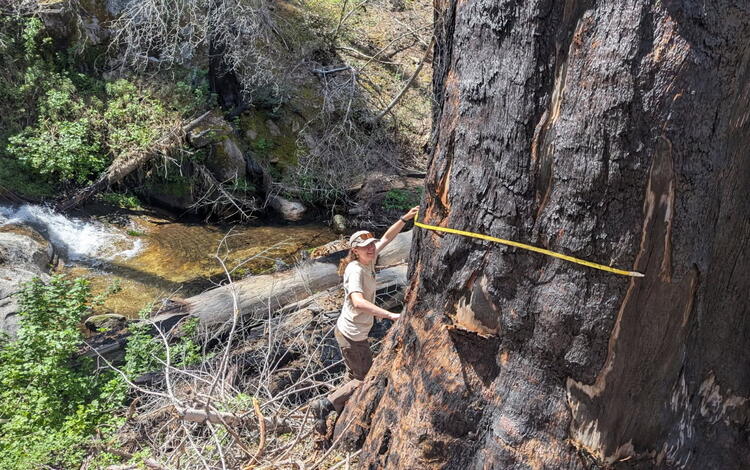
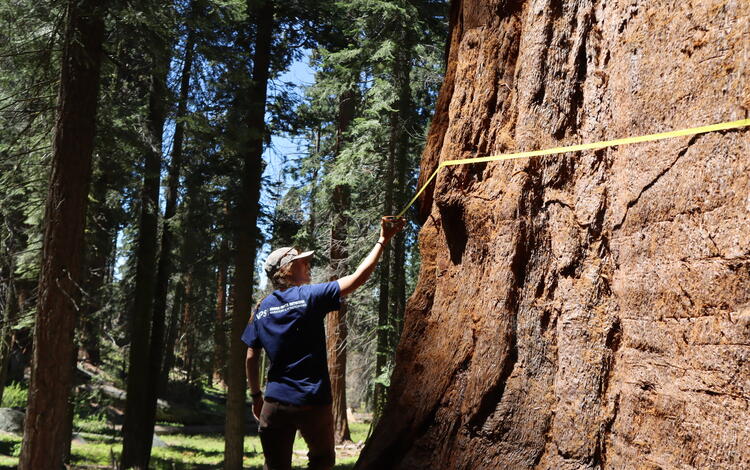
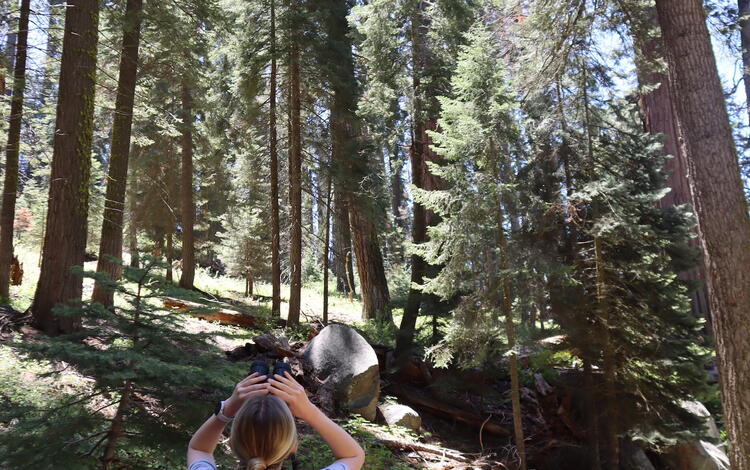
Prototype versions of the tool have already produced preliminary detections of dead and dying trees for several groves in Sequoia and Kings Canyon National Parks (SEKI), and USGS and NPS field teams are currently field validating those detections to further develop and refine the AI model.
While initial work is being conducted at SEKI, the ultimate goal is for this product to be applicable to the entire Giant Sequoia Lands Coalition, a broad consortium that comprises all federal, Tribal, state, and local agencies and organizations that manage giant sequoia groves in public, Tribal, or private nonprofit ownership.
Expanding Applications
Looking ahead, the team hopes to use satellite archives to track the progression of tree mortality over time. They are also working with the Microsoft AI for Good Lab to explore the multispectral signatures (or light reflection “fingerprints”) that reveal physiological stress before it’s visible and could warn managers that trees are stressed before they begin to brown and die.
The team also hopes to expand the tool beyond sequoias to support monitoring of other threatened forest systems, such as ash trees facing infestation from the invasive emerald ash borer and coastal redwoods.
Because dead trees eventually become wildfire fuel and standing dead trees have been linked to especially severe fire behavior, expanding the tool for broader dead tree detection would also increase its ability to support wildfire management needs.