Are you afraid of the dark?
Not this scientist. He is using a special technique to examine sediment samples that can help scientists study historical hurricanes.


Official websites use .gov
A .gov website belongs to an official government organization in the United States.

Secure .gov websites use HTTPS
A lock () or https:// means you’ve safely connected to the .gov website. Share sensitive information only on official, secure websites.

Zach Clifton is a Physical Scientist and has been with the U.S. Geological Survey since 2018, currently working at the MD-DE-DC Water Science Center in the Baltimore office.
In his time with the Survey Zach has worked on several interdisciplinary projects that incorporate elements of hydrology, geomorphology, remote sensing, and urban geography that span from the Catskills to Washington, D.C.'s sewers. His current research interests include expanding the scale of feasibility for sediment fingerprinting techniques, developing high-resolution hydraulic flow models, and leveraging U.S. Geological Survey sediment archives to support the needs of cooperators.

Are you afraid of the dark?
Not this scientist. He is using a special technique to examine sediment samples that can help scientists study historical hurricanes.
Are you afraid of the dark?
Not this scientist. He is using a special technique to examine sediment samples that can help scientists study historical hurricanes.

Physical Scientists Leah Staub and Zachary Clifton assess a stream along the Chesterville Branch on the Eastern shore of Maryland.
Physical Scientists Leah Staub and Zachary Clifton assess a stream along the Chesterville Branch on the Eastern shore of Maryland.

Physical Scientists Leah Staub and Zachary Clifton assess a stream along the Chesterville Branch on the Eastern shore of Maryland.
Physical Scientists Leah Staub and Zachary Clifton assess a stream along the Chesterville Branch on the Eastern shore of Maryland.

It’s not just the big rivers and streams. USGS MD-DE-DC Water Science Center scientists also collect samples from local parks. Zach and Leah collect sediment auger samples from Langdon Park in Washington DC as part of a study to find the sources of sediment runoff.
It’s not just the big rivers and streams. USGS MD-DE-DC Water Science Center scientists also collect samples from local parks. Zach and Leah collect sediment auger samples from Langdon Park in Washington DC as part of a study to find the sources of sediment runoff.

The USGS wants to know where nutrient-rich sediment in the DC area is coming from.
Through its sediment fingerprinting project with the D.C. Department of Energy and Environment, the USGS is looking into the sources of the excess sediments that are found in Hickey Run and the National Arboretum.
The USGS wants to know where nutrient-rich sediment in the DC area is coming from.
Through its sediment fingerprinting project with the D.C. Department of Energy and Environment, the USGS is looking into the sources of the excess sediments that are found in Hickey Run and the National Arboretum.

The USGS wants to know where nutrient-rich sediment in the DC area is coming from.
Through its sediment fingerprinting project with the D.C. Department of Energy and Environment, the USGS is looking into the sources of the excess sediments that are found in Hickey Run and the National Arboretum.
The USGS wants to know where nutrient-rich sediment in the DC area is coming from.
Through its sediment fingerprinting project with the D.C. Department of Energy and Environment, the USGS is looking into the sources of the excess sediments that are found in Hickey Run and the National Arboretum.

It’s not just the big rivers and streams. USGS MD-DE-DC Water Science Center scientists also collect samples from local parks. Zach and Leah collect sediment auger samples from Langdon Park in Washington DC as part of a study to find the sources of sediment runoff.
It’s not just the big rivers and streams. USGS MD-DE-DC Water Science Center scientists also collect samples from local parks. Zach and Leah collect sediment auger samples from Langdon Park in Washington DC as part of a study to find the sources of sediment runoff.
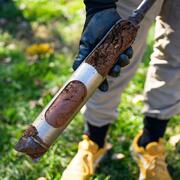
Are you afraid of the dark?
Not this scientist. He is using a special technique to examine sediment samples that can help scientists study historical hurricanes.
Are you afraid of the dark?
Not this scientist. He is using a special technique to examine sediment samples that can help scientists study historical hurricanes.
Physical Scientists Leah Staub and Zachary Clifton assess a stream along the Chesterville Branch on the Eastern shore of Maryland.
Physical Scientists Leah Staub and Zachary Clifton assess a stream along the Chesterville Branch on the Eastern shore of Maryland.
Physical Scientists Leah Staub and Zachary Clifton assess a stream along the Chesterville Branch on the Eastern shore of Maryland.
Physical Scientists Leah Staub and Zachary Clifton assess a stream along the Chesterville Branch on the Eastern shore of Maryland.
It’s not just the big rivers and streams. USGS MD-DE-DC Water Science Center scientists also collect samples from local parks. Zach and Leah collect sediment auger samples from Langdon Park in Washington DC as part of a study to find the sources of sediment runoff.
It’s not just the big rivers and streams. USGS MD-DE-DC Water Science Center scientists also collect samples from local parks. Zach and Leah collect sediment auger samples from Langdon Park in Washington DC as part of a study to find the sources of sediment runoff.
The USGS wants to know where nutrient-rich sediment in the DC area is coming from.
Through its sediment fingerprinting project with the D.C. Department of Energy and Environment, the USGS is looking into the sources of the excess sediments that are found in Hickey Run and the National Arboretum.
The USGS wants to know where nutrient-rich sediment in the DC area is coming from.
Through its sediment fingerprinting project with the D.C. Department of Energy and Environment, the USGS is looking into the sources of the excess sediments that are found in Hickey Run and the National Arboretum.
The USGS wants to know where nutrient-rich sediment in the DC area is coming from.
Through its sediment fingerprinting project with the D.C. Department of Energy and Environment, the USGS is looking into the sources of the excess sediments that are found in Hickey Run and the National Arboretum.
The USGS wants to know where nutrient-rich sediment in the DC area is coming from.
Through its sediment fingerprinting project with the D.C. Department of Energy and Environment, the USGS is looking into the sources of the excess sediments that are found in Hickey Run and the National Arboretum.
It’s not just the big rivers and streams. USGS MD-DE-DC Water Science Center scientists also collect samples from local parks. Zach and Leah collect sediment auger samples from Langdon Park in Washington DC as part of a study to find the sources of sediment runoff.
It’s not just the big rivers and streams. USGS MD-DE-DC Water Science Center scientists also collect samples from local parks. Zach and Leah collect sediment auger samples from Langdon Park in Washington DC as part of a study to find the sources of sediment runoff.