



Aerial view of the Kīlauea summit eruption from a Hawaiian Volcano Observatory overflight at approximately 11:20 a.m. HST. The two active fissure locations continue to feed lava into the growing lava lake in Halema‘uma‘u crater, with the northern fissure (pictured right) remaining dominant.
Images
Kīlauea images of eruptive activity, field work, and more.
Filter Total Items: 3089

Aerial view of the Kīlauea summit eruption
Aerial view of the Kīlauea summit eruption from a Hawaiian Volcano Observatory overflight at approximately 11:20 a.m. HST. The two active fissure locations continue to feed lava into the growing lava lake in Halema‘uma‘u crater, with the northern fissure (pictured right) remaining dominant.

Thick gas plume and fresh tire tracks in Kilauea tephra 12/21/20
Thick gas plume and fresh tire tracks in Kilauea tephra 12/21/20Hawaiian Volcano Observatory field crews captured this photo of the thick gas plume, produced by the Kīlauea summit eruption, obscuring the intensity of the sun.
Thick gas plume and fresh tire tracks in Kilauea tephra 12/21/20
Thick gas plume and fresh tire tracks in Kilauea tephra 12/21/20Hawaiian Volcano Observatory field crews captured this photo of the thick gas plume, produced by the Kīlauea summit eruption, obscuring the intensity of the sun.

Kīlauea summit thermal map - Dec 21, 2020) at approximately ~11:30 AM
Kīlauea summit thermal map - Dec 21, 2020) at approximately ~11:30 AMA helicopter overflight today (Dec 21, 2020) at approximately ~11:30 AM HST allowed for aerial visual and thermal imagery to be collected of the new eruption within Halema'uma'ucrater at the summit of Kīlauea Volcano. This preliminary thermal map shows that the new lava lake is 580 m (yd) E-W axis and 320 m (yd) in N-S axis.
Kīlauea summit thermal map - Dec 21, 2020) at approximately ~11:30 AM
Kīlauea summit thermal map - Dec 21, 2020) at approximately ~11:30 AMA helicopter overflight today (Dec 21, 2020) at approximately ~11:30 AM HST allowed for aerial visual and thermal imagery to be collected of the new eruption within Halema'uma'ucrater at the summit of Kīlauea Volcano. This preliminary thermal map shows that the new lava lake is 580 m (yd) E-W axis and 320 m (yd) in N-S axis.

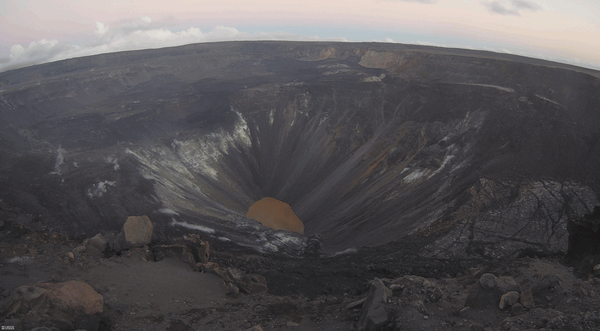
KW webcam image taken on December 21, 2020, just after 6:30 a.m. HST.
KW webcam image taken on December 21, 2020, just after 6:30 a.m. HST.Kīlauea summit KW webam image taken on December 21, 2020, just after 6:30 a.m. HST. The water lake, present until the evening of December 20, 2020, has been replaced by a lava lake; fissures in the wall of Halemaʻumaʻu feed a lava lake that continues to fill the crater.
KW webcam image taken on December 21, 2020, just after 6:30 a.m. HST.
KW webcam image taken on December 21, 2020, just after 6:30 a.m. HST.Kīlauea summit KW webam image taken on December 21, 2020, just after 6:30 a.m. HST. The water lake, present until the evening of December 20, 2020, has been replaced by a lava lake; fissures in the wall of Halemaʻumaʻu feed a lava lake that continues to fill the crater.

Geophysicist deploys campaign GPS sites on the Kīlauea caldera floor
Geophysicist deploys campaign GPS sites on the Kīlauea caldera floorA Hawaiian Volcano Observatory geophysicist deploys campaign GPS sites on the Kīlauea caldera floor in Hawai‘i Volcanoes National Park to measure changes in ground motion. The gas plume from the summit eruption within Halema‘uma‘u crater is visible in the background. USGS photo taken by A. Ellis on December 21.
Geophysicist deploys campaign GPS sites on the Kīlauea caldera floor
Geophysicist deploys campaign GPS sites on the Kīlauea caldera floorA Hawaiian Volcano Observatory geophysicist deploys campaign GPS sites on the Kīlauea caldera floor in Hawai‘i Volcanoes National Park to measure changes in ground motion. The gas plume from the summit eruption within Halema‘uma‘u crater is visible in the background. USGS photo taken by A. Ellis on December 21.

Scientists use a FTIR spectrometer
On the morning of Dec. 21, Hawaiian Volcano Observatory gas scientists use a FTIR spectrometer on the rim of Halema‘uma‘u crater. The FTIR measures the composition of the gases being emitted during Kīlauea Volcano's ongoing summit eruption by measuring how the plume absorbs infrared energy.
On the morning of Dec. 21, Hawaiian Volcano Observatory gas scientists use a FTIR spectrometer on the rim of Halema‘uma‘u crater. The FTIR measures the composition of the gases being emitted during Kīlauea Volcano's ongoing summit eruption by measuring how the plume absorbs infrared energy.

Close-up of tephra sample from Kilauea eruption 12/21/20
Close-up of tephra sample from Kilauea eruption 12/21/20A close-up photo of a tephra sample taken from one of the sample collection buckets. These small fragments of volcanic glass include Pele’s Hair and Pele’s tears—formed during lava fountaining—which are light weight and can be wafted downwind with the plume.
Close-up of tephra sample from Kilauea eruption 12/21/20
Close-up of tephra sample from Kilauea eruption 12/21/20A close-up photo of a tephra sample taken from one of the sample collection buckets. These small fragments of volcanic glass include Pele’s Hair and Pele’s tears—formed during lava fountaining—which are light weight and can be wafted downwind with the plume.

Geologist labels tephra samples Kilauea eruption 12/21/20
Geologist labels tephra samples Kilauea eruption 12/21/20HVO geologist retrieves and labels tephra samples from collection buckets placed downwind of Halema‘uma‘u crater after the onset of the Kīlauea summit eruption. These samples are collected for petrological analysis to gain further insight into the eruption dynamics.
Geologist labels tephra samples Kilauea eruption 12/21/20
Geologist labels tephra samples Kilauea eruption 12/21/20HVO geologist retrieves and labels tephra samples from collection buckets placed downwind of Halema‘uma‘u crater after the onset of the Kīlauea summit eruption. These samples are collected for petrological analysis to gain further insight into the eruption dynamics.

December 21, 2020—Kīlauea summit eruption lava lake depth map
December 21, 2020—Kīlauea summit eruption lava lake depth mapAerial visual imagery collected during an overflight of Kīlauea Volcano's summit just after 11 a.m. HST on December 21, 2020, was used to create a preliminary topographic model. When compared to pre-eruption topographic models, it shows that the bottom of Halema'uma'u crater has been filled by over 100 m (yd) of lava. Map by B. Carr.
December 21, 2020—Kīlauea summit eruption lava lake depth map
December 21, 2020—Kīlauea summit eruption lava lake depth mapAerial visual imagery collected during an overflight of Kīlauea Volcano's summit just after 11 a.m. HST on December 21, 2020, was used to create a preliminary topographic model. When compared to pre-eruption topographic models, it shows that the bottom of Halema'uma'u crater has been filled by over 100 m (yd) of lava. Map by B. Carr.

Scientists monitor the Halema‘uma‘u lava lake
USGS Hawaiian Volcano Observatory (HVO) scientists monitor the Halema‘uma‘u lava lake using state-of-the-art instruments acquired through the Additional Supplemental Appropriations for Disaster Relief Act of 2019. Supplemental funds are supporting HVO’s recovery and rebuilding in the wake of Kīlauea’s 2018
USGS Hawaiian Volcano Observatory (HVO) scientists monitor the Halema‘uma‘u lava lake using state-of-the-art instruments acquired through the Additional Supplemental Appropriations for Disaster Relief Act of 2019. Supplemental funds are supporting HVO’s recovery and rebuilding in the wake of Kīlauea’s 2018

Hawaiian Volcano Observatory gas scientists use a FTIR spectrometer
Hawaiian Volcano Observatory gas scientists use a FTIR spectrometerOn the morning of Dec. 21, Hawaiian Volcano Observatory gas scientists use a FTIR spectrometer on the rim of Halema‘uma‘u crater. The FTIR measures the composition of the gases being emitted during Kīlauea Volcano's ongoing summit eruption by measuring how the plume absorbs infrared energy.
Hawaiian Volcano Observatory gas scientists use a FTIR spectrometer
Hawaiian Volcano Observatory gas scientists use a FTIR spectrometerOn the morning of Dec. 21, Hawaiian Volcano Observatory gas scientists use a FTIR spectrometer on the rim of Halema‘uma‘u crater. The FTIR measures the composition of the gases being emitted during Kīlauea Volcano's ongoing summit eruption by measuring how the plume absorbs infrared energy.

Kīlauea summit eruption and plume on Dec. 21, 2020
Kīlauea summit eruption and plume on Dec. 21, 2020Photo shows volcanic gases from the current eruption at Kīlauea’s summit being transported southwest into the closed area (left side of photo). This photo also shows the cracks, cliffs, and uneven ground surfaces present in the closed area of Hawai‘i Volcanoes National Park. USGS photo by K. Mulliken on 12/21/2020.
Kīlauea summit eruption and plume on Dec. 21, 2020
Kīlauea summit eruption and plume on Dec. 21, 2020Photo shows volcanic gases from the current eruption at Kīlauea’s summit being transported southwest into the closed area (left side of photo). This photo also shows the cracks, cliffs, and uneven ground surfaces present in the closed area of Hawai‘i Volcanoes National Park. USGS photo by K. Mulliken on 12/21/2020.

An eruption commenced at the summit of Kīlauea Volcano
An eruption commenced at the summit of Kīlauea VolcanoShortly after approximately 9:30 p.m. HST, an eruption commenced at the summit of Kīlauea Volcano. Red spots are the approximate locations of fissure vents feeding lava flowing into the bottom of Halema‘uma‘u crater. The water lake at the base of Halema‘uma‘u crater has been replaced with a growing lava lake.
An eruption commenced at the summit of Kīlauea Volcano
An eruption commenced at the summit of Kīlauea VolcanoShortly after approximately 9:30 p.m. HST, an eruption commenced at the summit of Kīlauea Volcano. Red spots are the approximate locations of fissure vents feeding lava flowing into the bottom of Halema‘uma‘u crater. The water lake at the base of Halema‘uma‘u crater has been replaced with a growing lava lake.

December 20, 2020, Kīlauea volcanic plume
December 20, 2020, Kīlauea volcanic plume shown from the Gemini Observatory on Mauna Kea (left) and a 3D radar visualization from the same perspective. The radar reflectivity isosurfaces reveal the plume’s internal and external structure.
December 20, 2020, Kīlauea volcanic plume shown from the Gemini Observatory on Mauna Kea (left) and a 3D radar visualization from the same perspective. The radar reflectivity isosurfaces reveal the plume’s internal and external structure.

KW webcam image taken on December 20, 2020, just before 6 p.m. HST.
KW webcam image taken on December 20, 2020, just before 6 p.m. HST.Kīlauea summit KW webcam image taken on December 20, 2020, just before 6 p.m. HST. Three and a half hours later, at 9:30 p.m., an eruption began in the walls of Halemaʻumaʻu crater, vaporizing the lake.
KW webcam image taken on December 20, 2020, just before 6 p.m. HST.
KW webcam image taken on December 20, 2020, just before 6 p.m. HST.Kīlauea summit KW webcam image taken on December 20, 2020, just before 6 p.m. HST. Three and a half hours later, at 9:30 p.m., an eruption began in the walls of Halemaʻumaʻu crater, vaporizing the lake.

2D and 3D radar visualization of December 20, 2020, Kīlauea plume
2D and 3D radar visualization of December 20, 2020, Kīlauea plumeExample of 2D and 3D radar visualization of the December 20, 2020, Kīlauea volcanic plume. Displayed in photo (top, USGS photo), 2D radar scan from station PHWA (middle, NOAA Weather and Climate Toolkit), and 3D radar visualization (bottom, Google Earth).
2D and 3D radar visualization of December 20, 2020, Kīlauea plume
2D and 3D radar visualization of December 20, 2020, Kīlauea plumeExample of 2D and 3D radar visualization of the December 20, 2020, Kīlauea volcanic plume. Displayed in photo (top, USGS photo), 2D radar scan from station PHWA (middle, NOAA Weather and Climate Toolkit), and 3D radar visualization (bottom, Google Earth).

KWcam webcam image from December 2 at 6:00 p.m. HST
KWcam webcam image from December 2 at 6:00 p.m. HSTKWcam webcam image from December 2 at 6:00 p.m. HST, immediately following a M3.1 earthquake at Kīlauea summit. Several rockfalls down the talus slope impacted the summit water lake, causing some brief localized color changes of the lake surface (circled in yellow).
KWcam webcam image from December 2 at 6:00 p.m. HST
KWcam webcam image from December 2 at 6:00 p.m. HSTKWcam webcam image from December 2 at 6:00 p.m. HST, immediately following a M3.1 earthquake at Kīlauea summit. Several rockfalls down the talus slope impacted the summit water lake, causing some brief localized color changes of the lake surface (circled in yellow).
KWcam webcam animated GIF December 2, 2020
ANIMATED GIF: At Kīlauea summit, the KWcam webcam recorded several small color changes along the lake margin following rockfalls which impacted the lake surface. These rockfalls immediately followed a M3.1 earthquake Wednesday evening, December 2, at 5:59 p.m. HST. This animated image file (GIF) continuously loops two consecutive webcam images from 5:50 p.m.
ANIMATED GIF: At Kīlauea summit, the KWcam webcam recorded several small color changes along the lake margin following rockfalls which impacted the lake surface. These rockfalls immediately followed a M3.1 earthquake Wednesday evening, December 2, at 5:59 p.m. HST. This animated image file (GIF) continuously loops two consecutive webcam images from 5:50 p.m.

Tephra layers preserved at the summit of Kīlauea
Tephra layers preserved at the summit of Kīlauea from at least three different eruptions. Deposits below the top of the scale are predominantly juvenile and deposits above it containing many lithics. Notice the larger size of the yellow pumice clasts compared to the much denser and finer grey lapilli and ash surrounding them from 7 to 18 on the scale.
Tephra layers preserved at the summit of Kīlauea from at least three different eruptions. Deposits below the top of the scale are predominantly juvenile and deposits above it containing many lithics. Notice the larger size of the yellow pumice clasts compared to the much denser and finer grey lapilli and ash surrounding them from 7 to 18 on the scale.

Lake at Kīlauea's summit
Dark brown colors dominated the central and western portions of the lake at Kīlauea's summit. The greenish hues were present in areas that appear to be zone of hot water influx into the lake. USGS photo by M. Patrick.
Dark brown colors dominated the central and western portions of the lake at Kīlauea's summit. The greenish hues were present in areas that appear to be zone of hot water influx into the lake. USGS photo by M. Patrick.

Kīlauea's summit lake between rain showers
A quick visit to the western caldera rim provided brief views of Kīlauea's summit lake between rain showers. The lake colors were particularly vibrant today, with a deep blue-green color in the western end (bottom of photo), with dark brown near the center. USGS photo by M. Patrick.
A quick visit to the western caldera rim provided brief views of Kīlauea's summit lake between rain showers. The lake colors were particularly vibrant today, with a deep blue-green color in the western end (bottom of photo), with dark brown near the center. USGS photo by M. Patrick.