



This spectrogram shows four hours of USGS Hawaiian Volcano Observatory data streams across six seismic stations at Kīlauea’s summit on May 6, 2025. Each panel is 10 minutes of data. Over the four-hour period, an earthquake, pulsing, and eruptive tremor are visible.
Images
Kīlauea images of eruptive activity, field work, and more.
Filter Total Items: 3024

Kīlauea spectrogram before episode 20
This spectrogram shows four hours of USGS Hawaiian Volcano Observatory data streams across six seismic stations at Kīlauea’s summit on May 6, 2025. Each panel is 10 minutes of data. Over the four-hour period, an earthquake, pulsing, and eruptive tremor are visible.

May 22, 2025 — Kīlauea summit V3cam
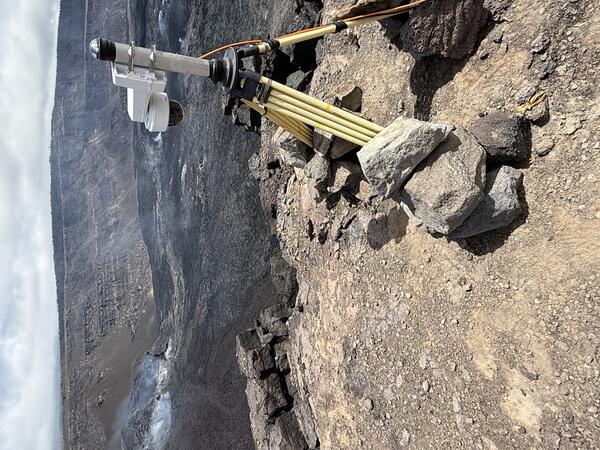
A view of the V3cam site located on the south rim of Halemaʻumaʻu crater and Kaluapele. The camera, which was installed with permission from Hawaiʻi Volcanoes National Park, is one of three that provide livestream views of the ongoing episodic eruption at the summit of Kīlauea. USGS photo by M. Warren.
A view of the V3cam site located on the south rim of Halemaʻumaʻu crater and Kaluapele. The camera, which was installed with permission from Hawaiʻi Volcanoes National Park, is one of three that provide livestream views of the ongoing episodic eruption at the summit of Kīlauea. USGS photo by M. Warren.
May 22, 2025 — Kīlauea V3cam
This photograph shows the new V3cam, installed by the USGS Hawaiian Volcano Observatory (HVO) in mid-May 2025. The V3cam, like all of the HVO monitoring cameras that start with "V," is a pan-tilt-zoom model that can be controlled remotely. This capability is useful in evaluating the ongoing episodic eruptive activity within Halemaʻumaʻu, and the associated hazards.
This photograph shows the new V3cam, installed by the USGS Hawaiian Volcano Observatory (HVO) in mid-May 2025. The V3cam, like all of the HVO monitoring cameras that start with "V," is a pan-tilt-zoom model that can be controlled remotely. This capability is useful in evaluating the ongoing episodic eruptive activity within Halemaʻumaʻu, and the associated hazards.

May 22, 2025 — FTIR at Kīlauea summit
A USGS Hawaiian Volcano Observatory geologist uses an FTIR (Fourier transform infrared spectrometer) to measure the chemical composition of volcanic gas during cycles of spattering and seismic tremor at the active vent at Kīlauea summit on May 22, 2025. USGS photo by M. Patrick.
A USGS Hawaiian Volcano Observatory geologist uses an FTIR (Fourier transform infrared spectrometer) to measure the chemical composition of volcanic gas during cycles of spattering and seismic tremor at the active vent at Kīlauea summit on May 22, 2025. USGS photo by M. Patrick.

May 22, 2025 — Adjusting V3cam at the summit of Kīlauea
May 22, 2025 — Adjusting V3cam at the summit of KīlaueaOn May 22, 2025, USGS Hawaiian Volcano Observatory (HVO) staff stabilized the new V3cam livestream camera. The camera was installed just last week and views since then were shaky due to the strong winds which are common in the caldera. The camera was moved from a tall mast to a more stable tripod setup.
May 22, 2025 — Adjusting V3cam at the summit of Kīlauea
May 22, 2025 — Adjusting V3cam at the summit of KīlaueaOn May 22, 2025, USGS Hawaiian Volcano Observatory (HVO) staff stabilized the new V3cam livestream camera. The camera was installed just last week and views since then were shaky due to the strong winds which are common in the caldera. The camera was moved from a tall mast to a more stable tripod setup.
May 21, 2025 — UAS overview of eruptive vents
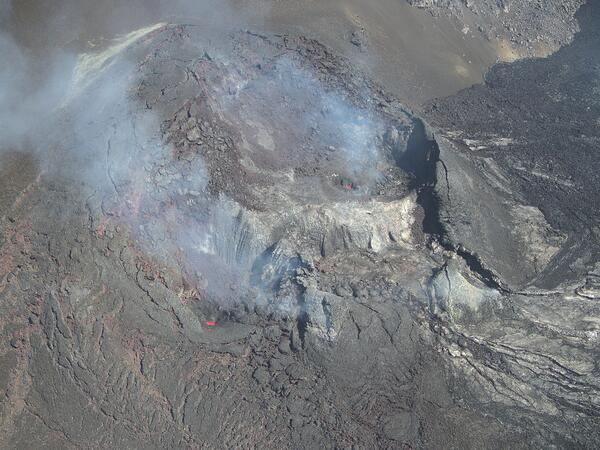
On May 21, USGS Hawaiian Volcano Observatory geologists flew UAS (uncrewed aircraft systems) into Halemaʻumaʻu to monitor the ongoing Kīlauea summit eruption. This oblique aerial photo provides an overview of the two eruptive vents, north (back) and south (front).
On May 21, USGS Hawaiian Volcano Observatory geologists flew UAS (uncrewed aircraft systems) into Halemaʻumaʻu to monitor the ongoing Kīlauea summit eruption. This oblique aerial photo provides an overview of the two eruptive vents, north (back) and south (front).

May 21, 2025 — Kīlauea flaming vent
Kīlauea summit livestream camera viewers have recently observed flames within the vents in Halemaʻumaʻu. These flames, which are often a yellowish orange color result from hydrogen gas burning in air. Hydrogen is a minor component of volcanic gas released from the hot magma below, and it can sometimes be ignited causing the flames observed recently.
Kīlauea summit livestream camera viewers have recently observed flames within the vents in Halemaʻumaʻu. These flames, which are often a yellowish orange color result from hydrogen gas burning in air. Hydrogen is a minor component of volcanic gas released from the hot magma below, and it can sometimes be ignited causing the flames observed recently.

May 21, 2025 — UAS view of north vent
During UAS (uncrewed aircraft systems) overflights on May 21, the north vent within Halemaʻumaʻu at the summit of Kīlauea was occasionally spattering and consistently glowing with incandescence.
During UAS (uncrewed aircraft systems) overflights on May 21, the north vent within Halemaʻumaʻu at the summit of Kīlauea was occasionally spattering and consistently glowing with incandescence.

May 21, 2025 — UAS close-up of south vent lava pond
May 21, 2025 — UAS close-up of south vent lava pondDuring UAS (uncrewed aircraft systems) overflights on May 21, USGS Hawaiian Volcano Observatory geologists flew their aircraft directly above the south vent within Halemaʻumaʻu at the summit of Kīlauea.
May 21, 2025 — UAS close-up of south vent lava pond
May 21, 2025 — UAS close-up of south vent lava pondDuring UAS (uncrewed aircraft systems) overflights on May 21, USGS Hawaiian Volcano Observatory geologists flew their aircraft directly above the south vent within Halemaʻumaʻu at the summit of Kīlauea.

May 16, 2025 — Late north vent lava fountaining at Kīlauea volcano
May 16, 2025 — Late north vent lava fountaining at Kīlauea volcanoLate during episode 22 of the ongoing summit eruption at Kīlauea volcano, lava fountains failed to even reach 160 feet (50 meters) above the north vent within Halemaʻumaʻu crater. This image was captured from the northwest rim of the crater around 2:00 p.m. on Friday, May 16. USGS photo by M. Zoeller.
May 16, 2025 — Late north vent lava fountaining at Kīlauea volcano
May 16, 2025 — Late north vent lava fountaining at Kīlauea volcanoLate during episode 22 of the ongoing summit eruption at Kīlauea volcano, lava fountains failed to even reach 160 feet (50 meters) above the north vent within Halemaʻumaʻu crater. This image was captured from the northwest rim of the crater around 2:00 p.m. on Friday, May 16. USGS photo by M. Zoeller.

May 16, 2025 — Geologist photographs episode 22 at Kīlauea volcano
May 16, 2025 — Geologist photographs episode 22 at Kīlauea volcanoOn Friday, May 16, during episode 22 of the ongoing summit eruption at Kīlauea volcano, USGS Hawaiian Volcano Observatory geologists visited the northwest rim of Halemaʻumaʻu crater to photograph the activity and collect laser rangefinder measurements of eruptive features. USGS photo by M. Zoeller.
May 16, 2025 — Geologist photographs episode 22 at Kīlauea volcano
May 16, 2025 — Geologist photographs episode 22 at Kīlauea volcanoOn Friday, May 16, during episode 22 of the ongoing summit eruption at Kīlauea volcano, USGS Hawaiian Volcano Observatory geologists visited the northwest rim of Halemaʻumaʻu crater to photograph the activity and collect laser rangefinder measurements of eruptive features. USGS photo by M. Zoeller.

May 16, 2025 — Early north vent lava fountaining at Kīlauea volcano
May 16, 2025 — Early north vent lava fountaining at Kīlauea volcanoEarly during episode 22 of the ongoing summit eruption at Kīlauea volcano, lava fountains reached more than 500 feet (150 meters) above the north vent within Halemaʻumaʻu crater. This image was captured from the northwest rim of the crater around 8:40 a.m. on Friday, May 16. USGS photo by M. Zoeller.
May 16, 2025 — Early north vent lava fountaining at Kīlauea volcano
May 16, 2025 — Early north vent lava fountaining at Kīlauea volcanoEarly during episode 22 of the ongoing summit eruption at Kīlauea volcano, lava fountains reached more than 500 feet (150 meters) above the north vent within Halemaʻumaʻu crater. This image was captured from the northwest rim of the crater around 8:40 a.m. on Friday, May 16. USGS photo by M. Zoeller.

May 16, 2025 — Spatter-fed flows from north vent at Kīlauea volcano
May 16, 2025 — Spatter-fed flows from north vent at Kīlauea volcanoDuring the ongoing Kīlauea summit eruption, not all spatter in the lava fountain falls as solid tephra outside Halemaʻumaʻu crater; instead, some remains molten and feeds lava flows on the flanks of the eruptive vents. In this image captured on Friday, May 16, two spatter-fed flows can be seen descending the north side of the north vent.
May 16, 2025 — Spatter-fed flows from north vent at Kīlauea volcano
May 16, 2025 — Spatter-fed flows from north vent at Kīlauea volcanoDuring the ongoing Kīlauea summit eruption, not all spatter in the lava fountain falls as solid tephra outside Halemaʻumaʻu crater; instead, some remains molten and feeds lava flows on the flanks of the eruptive vents. In this image captured on Friday, May 16, two spatter-fed flows can be seen descending the north side of the north vent.

May 16, 2025 — Tephra fall at Kīlauea volcano
Downwind of lava fountains from the ongoing Kīlauea summit eruption, substantial tephra is being deposited on the rim of Halemaʻumaʻu crater.
Downwind of lava fountains from the ongoing Kīlauea summit eruption, substantial tephra is being deposited on the rim of Halemaʻumaʻu crater.

Photograph of a polished piece of lava
Photograph of a polished Kīlauea lava sample collected from an ooze out in Halemaʻumaʻu before the onset of episode 12 during episode on March 4, 2025. Each light-colored blotch (example in red circle) on the black background is a cluster of minerals that has an approximate diameter of less than 1 millimeter (0.03 inches). USGS photo.
Photograph of a polished Kīlauea lava sample collected from an ooze out in Halemaʻumaʻu before the onset of episode 12 during episode on March 4, 2025. Each light-colored blotch (example in red circle) on the black background is a cluster of minerals that has an approximate diameter of less than 1 millimeter (0.03 inches). USGS photo.

May 11, 2025 — Kīlauea summit eruption episode 21
Visitors at the lookout on the eastern caldera rim in Hawai‘i Volcanoes National Park, at the summit of Kīlauea, had clear views of episode 21 lava fountaining from the north vent and the rising outgassing plume. USGS photo by M. Patrick.
Visitors at the lookout on the eastern caldera rim in Hawai‘i Volcanoes National Park, at the summit of Kīlauea, had clear views of episode 21 lava fountaining from the north vent and the rising outgassing plume. USGS photo by M. Patrick.

May 11, 2025 — ʻAmaʻu fern at Kīlauea volcano
Recent eruptive episodes at the summit of Kīlauea have unfortunately been destructive to vegetation in the tephra fallout zone downwind of the lava fountains. However, several native plant species are demonstrating remarkable resilience in the harsh conditions.
Recent eruptive episodes at the summit of Kīlauea have unfortunately been destructive to vegetation in the tephra fallout zone downwind of the lava fountains. However, several native plant species are demonstrating remarkable resilience in the harsh conditions.

May 11, 2025 — North vent lava fountaining at Kīlauea volcano
May 11, 2025 — North vent lava fountaining at Kīlauea volcanoOn May 11, USGS Hawaiian Volcano Observatory scientists visited the western rim of Halemaʻumaʻu crater to observe episode 21 of the ongoing Kīlauea summit eruption.
May 11, 2025 — North vent lava fountaining at Kīlauea volcano
May 11, 2025 — North vent lava fountaining at Kīlauea volcanoOn May 11, USGS Hawaiian Volcano Observatory scientists visited the western rim of Halemaʻumaʻu crater to observe episode 21 of the ongoing Kīlauea summit eruption.

May 11, 2025 — Scientist watches episode 20 at Kīlauea volcano
May 11, 2025 — Scientist watches episode 20 at Kīlauea volcanoThis photo of a USGS Hawaiian Volcano Observatory scientist watching the ongoing Kīlauea summit eruption was captured on the western rim of Halemaʻumaʻu crater at the former site of the KWcam and F1cam webcams.
May 11, 2025 — Scientist watches episode 20 at Kīlauea volcano
May 11, 2025 — Scientist watches episode 20 at Kīlauea volcanoThis photo of a USGS Hawaiian Volcano Observatory scientist watching the ongoing Kīlauea summit eruption was captured on the western rim of Halemaʻumaʻu crater at the former site of the KWcam and F1cam webcams.

May 11, 2025 — Kīlauea episode 21
Passing showers resulted in variable visibility across the caldera in the afternoon of May 11, but clear views showed that the lava fountaining at the summit produced a towering outgassing plume. This photo was taken from the eastern caldera rim. USGS photo by M. Patrick.
Passing showers resulted in variable visibility across the caldera in the afternoon of May 11, but clear views showed that the lava fountaining at the summit produced a towering outgassing plume. This photo was taken from the eastern caldera rim. USGS photo by M. Patrick.

May 11, 2025 — Episode 21 north vent lava fountain and plume at Kīlauea volcano
May 11, 2025 — Episode 21 north vent lava fountain and plume at Kīlauea volcanoKīlauea volcano's episode 21 occurred on May 11, 2025. This photo was taken a little more than an hour after lava fountaining started, and shows the north vent lava fountain with a volcanic gas plume rising above it. The height from the crater floor to the top of the cliff behind the fountain is approximately 540 feet (165 meters).
May 11, 2025 — Episode 21 north vent lava fountain and plume at Kīlauea volcano
May 11, 2025 — Episode 21 north vent lava fountain and plume at Kīlauea volcanoKīlauea volcano's episode 21 occurred on May 11, 2025. This photo was taken a little more than an hour after lava fountaining started, and shows the north vent lava fountain with a volcanic gas plume rising above it. The height from the crater floor to the top of the cliff behind the fountain is approximately 540 feet (165 meters).