U.S. flag

An official website of the United States government

Images

Kīlauea images of eruptive activity, field work, and more.

Filter Total Items: 3024
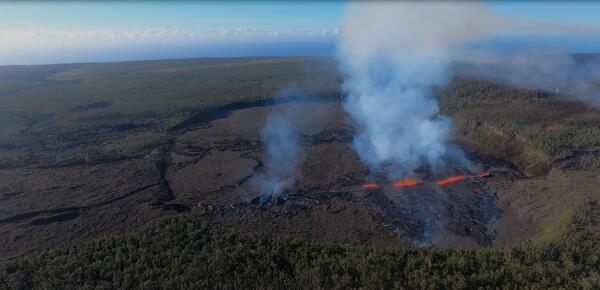
Color photograph of erupting lava
September 17, 2024 —Kīlauea middle East Rift Zone eruption

This photograph of Kīlauea's ongoing middle East Rift Zone eruption was captured during a Hawaiian Volcano Observatory helicopter overflight during the morning of September 17, 2024. This photo was taken at 8:11 am H.S.T.

This photograph of Kīlauea's ongoing middle East Rift Zone eruption was captured during a Hawaiian Volcano Observatory helicopter overflight during the morning of September 17, 2024. This photo was taken at 8:11 am H.S.T.

Color webcam view showing glowing lava and a volcanic plume in the background
S2cam views of the eruption in Nāpau Crater on September 17, 2024

The S2cam was deployed on September 17, 2024, to monitor the Kīlauea middle East Rift Zone eruption. The webcam is located just east of Nāpau Crater, where the eruption is occurring, and looks to the southwest. USGS webcam image. 

The S2cam was deployed on September 17, 2024, to monitor the Kīlauea middle East Rift Zone eruption. The webcam is located just east of Nāpau Crater, where the eruption is occurring, and looks to the southwest. USGS webcam image. 

Color photograph of fissures erupting lava in crater
September 17, 2024 —Kīlauea middle East Rift Zone eruption

This photograph of Kīlauea's ongoing middle East Rift Zone eruption was captured during a Hawaiian Volcano Observatory helicopter overflight during the morning of September 17, 2024. This photo was taken at 7:30 am H.S.T.

This photograph of Kīlauea's ongoing middle East Rift Zone eruption was captured during a Hawaiian Volcano Observatory helicopter overflight during the morning of September 17, 2024. This photo was taken at 7:30 am H.S.T.

Color photograph of tripod on lava flow
September 17, 2024 — Annual Kīlauea GPS campaign underway

A benchmark on Kīlauea being surveyed by GPS campaign instruments. The metal disk on the ground beneath the tripod is the benchmark, which is cemented to the lava flow surface. During annual GPS surveys, measurements are made on the benchmarks to allow for comparisons to previous surveys. USGS photo by A. Ellis.

A benchmark on Kīlauea being surveyed by GPS campaign instruments. The metal disk on the ground beneath the tripod is the benchmark, which is cemented to the lava flow surface. During annual GPS surveys, measurements are made on the benchmarks to allow for comparisons to previous surveys. USGS photo by A. Ellis.

Color photograph of scientist near lava flow
September 17, 2024 —Kīlauea middle East Rift Zone eruption sampling

USGS Hawaiian Volcano Observatory geologists collected a sample of the middle East Rift Zone Kīlauea eruption in Nāpau Crater, within a closed area Hawaiʻi Volcanoes National Park. Geologists put molten lava into a metal bucket and rapidly quench it with water.

USGS Hawaiian Volcano Observatory geologists collected a sample of the middle East Rift Zone Kīlauea eruption in Nāpau Crater, within a closed area Hawaiʻi Volcanoes National Park. Geologists put molten lava into a metal bucket and rapidly quench it with water.

Color photograph of vents erupting lava within a crater
Low-angle view of fissures bisecting Nāpau Crater during the eruption of Kīlauea's middle East Rift Zone, September 17, 2024

This photograph of Kīlauea's ongoing middle East Rift Zone eruption was captured during a Hawaiian Volcano Observatory helicopter overflight during the morning of September 17, 2024. This low-angle view looking southwest shows three lava fountains; the tallest is approximately 10 meters (30 feet) high.

Color map of lava flows and fissure vents
September 17, 2024 —Kīlauea middle East Rift Zone eruption reference map

This reference map depicts fissures and lava flows from the Kīlauea middle East Rift Zone eruption on Tuesday, September 17, 2024. The presented data are current as of the final Hawaiian Volcano Observatory helicopter overflight of the day, which occurred at approximately 10:30 a.m.

This reference map depicts fissures and lava flows from the Kīlauea middle East Rift Zone eruption on Tuesday, September 17, 2024. The presented data are current as of the final Hawaiian Volcano Observatory helicopter overflight of the day, which occurred at approximately 10:30 a.m.

Color map of lava flows and fissure vents
September 16, 2024 —Kīlauea middle East Rift Zone eruption preliminary reference map

This reference map depicts the approximate location of the fissures that erupted from the Kīlauea middle East Rift Zone, likely between approximately 9:00 and 10:00 p.m. HST on Sunday 15, 2024, in a remote and closed area of Hawaiʻi Volcanoes National Park. Small lava pads erupted from two fissure segments in a couple hundred meters (hundred yards).

This reference map depicts the approximate location of the fissures that erupted from the Kīlauea middle East Rift Zone, likely between approximately 9:00 and 10:00 p.m. HST on Sunday 15, 2024, in a remote and closed area of Hawaiʻi Volcanoes National Park. Small lava pads erupted from two fissure segments in a couple hundred meters (hundred yards).

Color photograph of volcanic crater surrounded by forest and a fissure emitting volcanic gas
September 16, 2024 —Kīlauea middle East Rift Zone eruption

Another aerial view of the small lava flows erupted by Kīlauea over about an hour on September 15, 2024. This eruption took place on the remote middle East Rift Zone, within Hawaiʻi Volcanoes National Park. Although the eruption was over during the USGS Hawaiian Volcano Observatory morning overflight, volcanic gas emissions were continuing.

Another aerial view of the small lava flows erupted by Kīlauea over about an hour on September 15, 2024. This eruption took place on the remote middle East Rift Zone, within Hawaiʻi Volcanoes National Park. Although the eruption was over during the USGS Hawaiian Volcano Observatory morning overflight, volcanic gas emissions were continuing.

Color photograph of eruption site
September 16, 2024 — Overflight of eruption site near Nāpau crater, Kīlauea

A brief, small eruption occurred on the middle East Rift Zone of Kīlauea late on September 15. The eruption produced two small pads of lava just west of Nāpau Crater, which is west (uprift) of the former Pu‘u‘ō‘ō eruption site. USGS photo by M. Patrick.

A brief, small eruption occurred on the middle East Rift Zone of Kīlauea late on September 15. The eruption produced two small pads of lava just west of Nāpau Crater, which is west (uprift) of the former Pu‘u‘ō‘ō eruption site. USGS photo by M. Patrick.

Color photograph of recent eruption site emitting volcanic gas and steam
September 16, 2024 —Kīlauea middle East Rift Zone eruption

An east-facing view showing Nāpau Crater in the background and the recent eruption in the foreground. This brief eruption took place on the middle East Rift Zone of Kīlauea over about an hour during heavy rain that obscured webcam views the evening of September 15, 2024. USGS photo by M. Zoeller. 

An east-facing view showing Nāpau Crater in the background and the recent eruption in the foreground. This brief eruption took place on the middle East Rift Zone of Kīlauea over about an hour during heavy rain that obscured webcam views the evening of September 15, 2024. USGS photo by M. Zoeller. 

Color photograph of recently active volcanic vents emitting volcanic gas and steam
September 16, 2024—Brief eruption near Napau Crater on Kīlauea Middle East Rift Zone
A photo taken from a helicopter shows a steaming fresh lava flow that has cut a slash through a green, forested landscape.
Lava flow erupted west of Nāpau Crater on the middle East Rift Zone of Kīlauea, observed September 16, 2024

During a USGS Hawaiian Volcano Observatory overflight at approximately 10:30 a.m. HST on September 16, geologists observed freshly erupted lava west of Nāpau Crater on the remote middle East Rift Zone of Kīlauea, within Hawaiʻi Volcanoes National Park. This eruption likely occurred between approximately 9–10 p.m. HST on September 15.  

During a USGS Hawaiian Volcano Observatory overflight at approximately 10:30 a.m. HST on September 16, geologists observed freshly erupted lava west of Nāpau Crater on the remote middle East Rift Zone of Kīlauea, within Hawaiʻi Volcanoes National Park. This eruption likely occurred between approximately 9–10 p.m. HST on September 15.  

Looking down from a helicopter, this photo shows charred and brown trees surrounded by a new, steaming lava flow.
Dead vegetation surrounded by fresh lava observed on Hawaiian Volcano Observatory overflight at ~10:30 a.m. HST, September 16, 2024

Dead trees and vegetation are surrounded by freshly erupted lava west of Nāpau Crater on the remote middle East Rift Zone of Kīlauea, within Hawaiʻi Volcanoes National Park. This eruption likely occurred between approximately 9–10 p.m. HST on September 15.  USGS photo by M. Zoeller. 

A photo taken from a helicopter shows plumes of white steam rising above a small fresh lava flow cutting through a jungle
Steam rises from a new lava flow erupted west of Nāpau Crater on the middle East Rift Zone of Kīlauea, September 16, 2024

During a USGS Hawaiian Volcano Observatory overflight at approximately 10:30 a.m. HST on September 16, geologists observed steam rising above freshly erupted lava west of Nāpau Crater on the remote middle East Rift Zone of Kīlauea, within Hawaiʻi Volcanoes National Park. This eruption likely occurred between approximately 9–10 p.m.

During a USGS Hawaiian Volcano Observatory overflight at approximately 10:30 a.m. HST on September 16, geologists observed steam rising above freshly erupted lava west of Nāpau Crater on the remote middle East Rift Zone of Kīlauea, within Hawaiʻi Volcanoes National Park. This eruption likely occurred between approximately 9–10 p.m.

Color map of lava flows and fissure vents
September 16, 2024 —Kīlauea middle East Rift Zone eruption reference map

This reference map depicts the fissure and lava flows from the Kīlauea middle East Rift Zone eruption of Sunday, September 15, 2024. The eruption occurred between approximately 9:00 and 10:00 p.m., in a remote and closed area of Hawaiʻi Volcanoes National Park.

This reference map depicts the fissure and lava flows from the Kīlauea middle East Rift Zone eruption of Sunday, September 15, 2024. The eruption occurred between approximately 9:00 and 10:00 p.m., in a remote and closed area of Hawaiʻi Volcanoes National Park.

Color photograph of lidar point cloud and photograph of volcanic cone
Point cloud and photograph of Pu‘ukoa‘e on Kīlauea

Left: A snapshot of the point cloud from HVO’s September 5, 2024, lidar test flight along Kīlauea’s Southwest Rift Zone, providing an east-looking oblique view of Pu‘ukoa‘e (upper left) and another unnamed cinder cone (lower right).

Left: A snapshot of the point cloud from HVO’s September 5, 2024, lidar test flight along Kīlauea’s Southwest Rift Zone, providing an east-looking oblique view of Pu‘ukoa‘e (upper left) and another unnamed cinder cone (lower right).

Color photograph of scientist measuring crack in road
August 22, 2024 — Measuring cracks on Chain of Craters Road, Kīlauea

USGS Hawaiian Volcano Observatory geologist Mike Cappos takes the bearing of a crack that formed in Chain of Craters Road during a recent intrusive event near Pauahi Crater in Hawai‘i Volcanoes National Park. USGS photo by C. Sealing.

USGS Hawaiian Volcano Observatory geologist Mike Cappos takes the bearing of a crack that formed in Chain of Craters Road during a recent intrusive event near Pauahi Crater in Hawai‘i Volcanoes National Park. USGS photo by C. Sealing.

Color photograph of scientist measuring cracks in road
August 22, 2024 — Measuring cracks on Chain of Craters Road, Kīlauea

USGS Hawaiian Volcano Observatory geologist Mike Cappos measures cracks that formed in Chain of Craters Road during a recent intrusive event near PAUAHI Crater in Hawai‘i Volcanoes National Park. USGS photo by C. Sealing.

USGS Hawaiian Volcano Observatory geologist Mike Cappos measures cracks that formed in Chain of Craters Road during a recent intrusive event near PAUAHI Crater in Hawai‘i Volcanoes National Park. USGS photo by C. Sealing.

Color map showing deformation and earthquakes on volcano
August 22, 2024—InSAR image of ground deformation and map of seismicity for Kīlauea upper East Rift Zone intrusion

The map on the left shows recent deformation at Kīlauea over the timeframe of August 9–21, 2024. Data were acquired by the European Space Agency's Sentinel-1A satellite. Colored fringes denote areas of ground deformation, with more fringes indicating more deformation. Each color cycle represents 2.8 cm (1.1 in) of ground motion.

The map on the left shows recent deformation at Kīlauea over the timeframe of August 9–21, 2024. Data were acquired by the European Space Agency's Sentinel-1A satellite. Colored fringes denote areas of ground deformation, with more fringes indicating more deformation. Each color cycle represents 2.8 cm (1.1 in) of ground motion.

Color photograph of scientist photographing summit caldera of volcano
August 20, 2024 — Routine field visit to Kīlauea summit

USGS scientists made a routine visit to the summit of Kīlauea for maintenance work on a webcam and general observations. The weather offered clear views of Kaluapele (the summit caldera), and only minor outgassing from several spots on the caldera floor. USGS photo by M. Patrick.

USGS scientists made a routine visit to the summit of Kīlauea for maintenance work on a webcam and general observations. The weather offered clear views of Kaluapele (the summit caldera), and only minor outgassing from several spots on the caldera floor. USGS photo by M. Patrick.

Was this page helpful?