An official website of the United States government
Here's how you know
Official websites use .gov
A .gov website belongs to an official government organization in the United States.
Secure .gov websites use HTTPS
A lock () or https:// means you’ve safely connected to the .gov website. Share sensitive information only on official, secure websites.
Due to a lapse in appropriations, the majority of USGS websites may not be up to date and may not reflect current conditions. Websites displaying real-time data, such as Earthquake, Volcano, LANDSAT and Water information needed for public health and safety will be updated with limited support. Additionally, USGS will not be able to respond to inquiries until appropriations are enacted. For more information, please see www.doi.gov/shutdown.
Looking down on southwestern part of Pu`u `O`o, showing active lava lakes in the main crater (upper left), the Episode 55 pit (nearest camera), and Puka Nui, just above and right of Episode 55 pit. The small West Gap Pit along left edge of view is inactive.
Dark `a`a flow, about 1 kilometer long, from spill out of Puka Nui crater. Fuming cone of Pu`u `O`o looms above Puka Nui, which has been eating into the cone for several years.
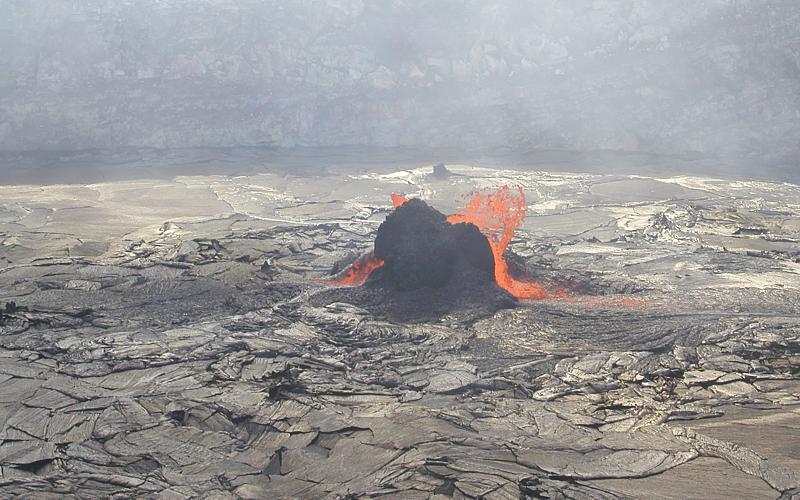
Active vents on floor of Pu`u `O`o, viewed from north rim. Left. January cone, in center of photo, is the most active today, but East Pond Vent, near left edge, is putting out a healthy amount of lava, too. Short flows from the two vents have built a high-standing mound. Smooth crust in foreground is on a lava lake that nearly encircles the mound. The "rippled" surface of the lake crust attests to a previous episode of overturning (see photo below).
Crust on the lava lake is overturning, sweeping toward camera in a counterclockwise direction. East Pond Vent is actively spattering and supplying lava into the lake. Crater rim is about 17 meters above the black "bathtub ring" marking the high stand of the lake.
A drainback hole in the lake roars and spits spatter, while in the distance, above and left of the hole, a cone at the South Wall Complex tosses out spatter from its incandescent top. These features are between the January cone and the Beehive vent, which today is inactive.