An official website of the United States government
Here's how you know
Official websites use .gov
A .gov website belongs to an official government organization in the United States.
Secure .gov websites use HTTPS
A lock () or https:// means you’ve safely connected to the .gov website. Share sensitive information only on official, secure websites.
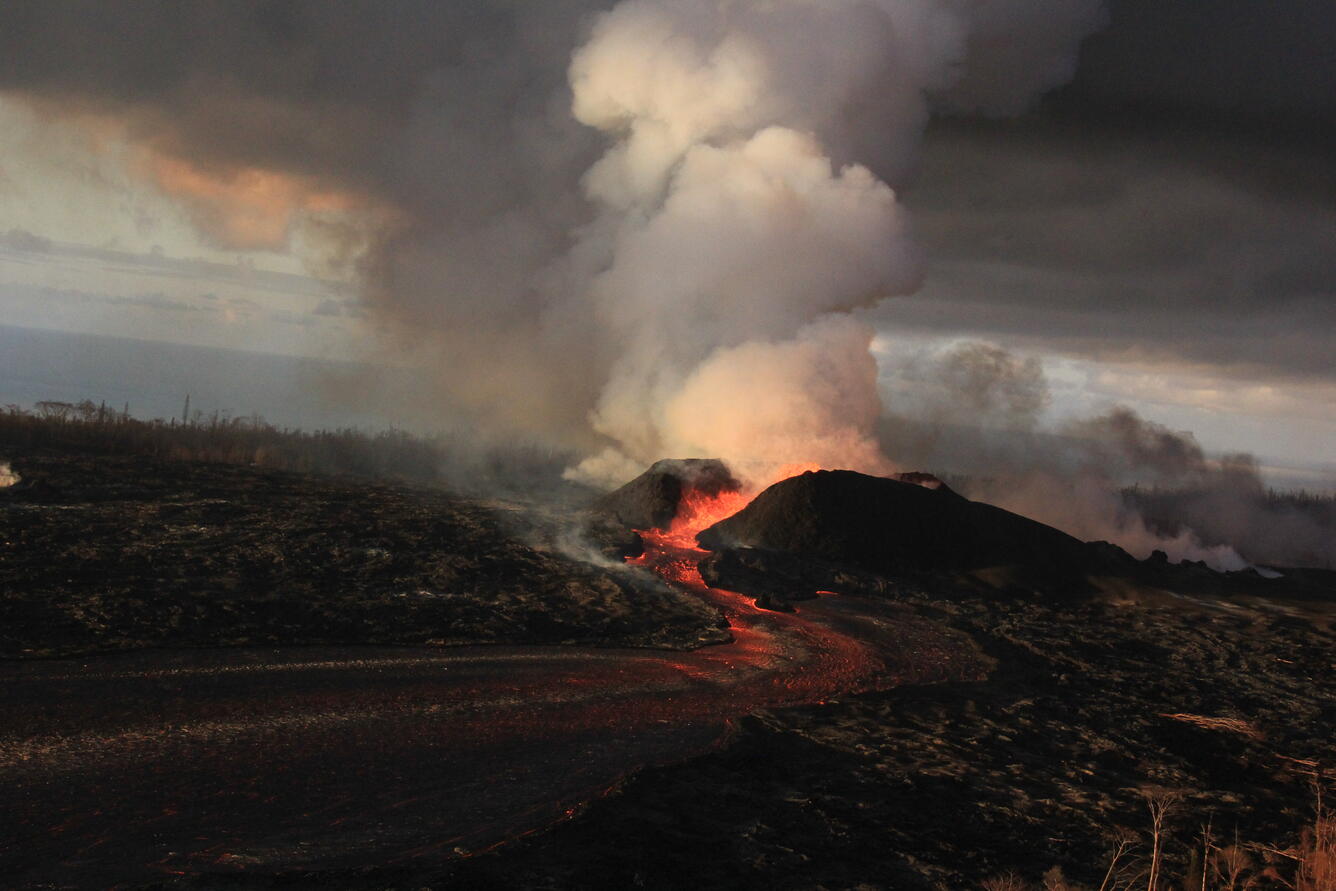
Fountains from the fissure 8 spatter cone continue to supply lava to an open channel. The spatter cone is now about 55 m (180 ft) tall at its highest point. As observed during this morning's helicopter overflight, the fountains rarely rise above the rim of the spatter cone.
Lava from fissure 8 is fed into a channel that travels about 13 km (8 mi) to the sea. A plumemarks the location of fissure 8, visible in the upper right; a small plume in the upper center marks the location of fissure 22. Each morning, HVO field crews conduct an overflight of the lava channel to determine if there have been any overflows. Intermittent small, short-lived overflows have occurred, but these overflows rarely extend beyond the existing flow field.
Lava flows around islands in the lava channel. The direction of flow is from the upper right to lower left. Field crews can make a rough calculation of velocity by timing large blocks as they pass between two landmarks that are a known distance apart.
Lava was entering the ocean over a broad area this morning. This image shows an active entry area along the northern flow front at Kapoho. View to the south.
Hawaiian Volcano Observatory geologist Matt Patrick acquires video of fissure 8 and the lava channel from Pohoiki Road/Highway 132. The video is used to document fountain behavior and lava flow characteristics, and how they change with time.