



Whitney Creek on the slopes of Mount Shasta in northern California is regularly reshaped by debris flows, created by melting snow and ice or precipitation. Although the stream channel itself is relatively small, these flows are capable of carrying large volumes of volcanic debris, including boulders in excess of several meters. USGS photo by J. Ball.
Multimedia
Images
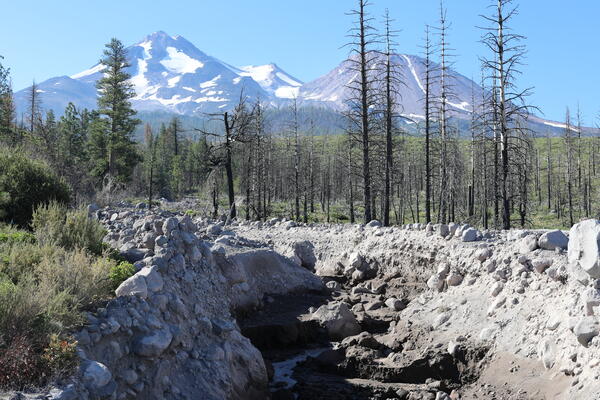
Whitney Creek, Mount Shasta, California
Whitney Creek on the slopes of Mount Shasta in northern California is regularly reshaped by debris flows, created by melting snow and ice or precipitation. Although the stream channel itself is relatively small, these flows are capable of carrying large volumes of volcanic debris, including boulders in excess of several meters. USGS photo by J. Ball.
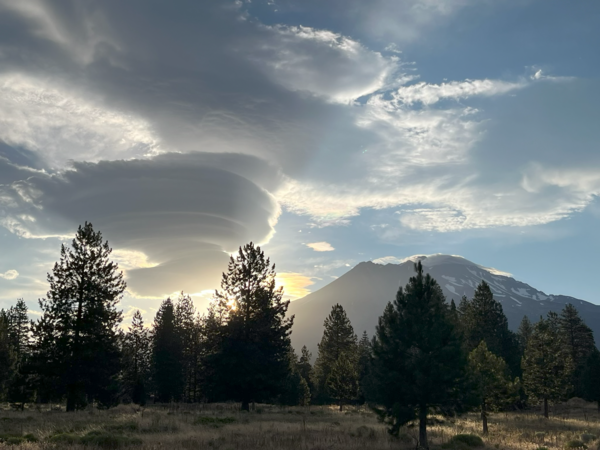
Lenticular clouds over Mount Shasta
Lenticular clouds form when moist air flows up the slopes of a volcano (or other peak), cools, and condenses. The resulting clouds often drop a bit after pushing over the summit, like an eddy over a rock in a stream, and create seemingly stationary shapes that hover over the landscape. USGS photo by Andrew Calvert.
Lenticular clouds form when moist air flows up the slopes of a volcano (or other peak), cools, and condenses. The resulting clouds often drop a bit after pushing over the summit, like an eddy over a rock in a stream, and create seemingly stationary shapes that hover over the landscape. USGS photo by Andrew Calvert.

Phil Dawson at Mount Shasta
Phil Dawson, a Volcano Seismologist with the California Volcano Observatory, stands next to a volcanic rock on the flank of Mount Shasta, California.
Phil Dawson, a Volcano Seismologist with the California Volcano Observatory, stands next to a volcanic rock on the flank of Mount Shasta, California.

Mount Shasta, a steep-sided Cascade Range stratovolcano in Northern Ca
Mount Shasta, a steep-sided Cascade Range stratovolcano in Northern CaMount Shasta, a steep-sided Cascade Range stratovolcano in Northern California, looms above Little Glass Mountain, a thick obsidian flow erupted from the Medicine Lake shield volcano about 1,000 years ago. These are just two of the young volcanic areas monitored by the USGS California Volcano Observatory. USGS photo.
Mount Shasta, a steep-sided Cascade Range stratovolcano in Northern Ca
Mount Shasta, a steep-sided Cascade Range stratovolcano in Northern CaMount Shasta, a steep-sided Cascade Range stratovolcano in Northern California, looms above Little Glass Mountain, a thick obsidian flow erupted from the Medicine Lake shield volcano about 1,000 years ago. These are just two of the young volcanic areas monitored by the USGS California Volcano Observatory. USGS photo.

View of a snow-covered Mount Shasta, CA, photo taken in June 2017
View of a snow-covered Mount Shasta, CA, photo taken in June 2017The photo was taken from a vantage looking up Avalanche Gulch at Red Banks (a line of cliffs along the ridge central to the photograph).
View of a snow-covered Mount Shasta, CA, photo taken in June 2017
View of a snow-covered Mount Shasta, CA, photo taken in June 2017The photo was taken from a vantage looking up Avalanche Gulch at Red Banks (a line of cliffs along the ridge central to the photograph).

Plot of quakes in Mount Shasta region greater M1.0 from 2010 to 2016
Plot of quakes in Mount Shasta region greater M1.0 from 2010 to 2016Plot of earthquakes in Mount Shasta region greater than M1.0 from April 3, 2010 to April 3, 2015.
Plot of quakes in Mount Shasta region greater M1.0 from 2010 to 2016
Plot of quakes in Mount Shasta region greater M1.0 from 2010 to 2016Plot of earthquakes in Mount Shasta region greater than M1.0 from April 3, 2010 to April 3, 2015.