An official website of the United States government
Here's how you know
Official websites use .gov
A .gov website belongs to an official government organization in the United States.
Secure .gov websites use HTTPS
A lock () or https:// means you’ve safely connected to the .gov website. Share sensitive information only on official, secure websites.
Case History: A captive, adult male, 930-g Gyrfalcon (Falco rusticolus) was found dead in its enclosure on December 8, 2014.
This was a privately-owned falconry bird. The bird was flown and had hunted on December 6, 2014 approximately five miles from Wiser Lake, Washington, USA. The falcon caught and killed an American wigeon (Anas americanus) and was allowed to consume a small portion of the duck as a behavioral reward. Later that day, the owner used remains of this duck to feed three additional falcons that he maintained at his home. By December 8, 2014, three falcons were dead, and the remaining sick bird was euthanized on that same day.
Gross Findings: There were no significant findings from the external examination. On internal examination, there was scant subcutaneous, visceral, and epicardial fat indicating marginal body condition. The liver and spleen were moderately enlarged. The lungs were deep red and firm on palpation, and sections sank in formalin (Fig. 1). Petechial and ecchymotic hemorrhages were present in the pancreas. Multiple areas of greenish pallor were present in the heart; the myocardium in the affected foci was soft and friable. Several small (1- to 2-mm) foci of hemorrhage were seen on the surface of the brain after removal of the meninges. The intestines contained abundant creamy yellow to green mucoid material.
Figure 1. Lung, diffuse severe congestion and edema. (Credit: Valerie I. Shearn-Bochsler, USGS National Wildlife Health Center. Public domain.)
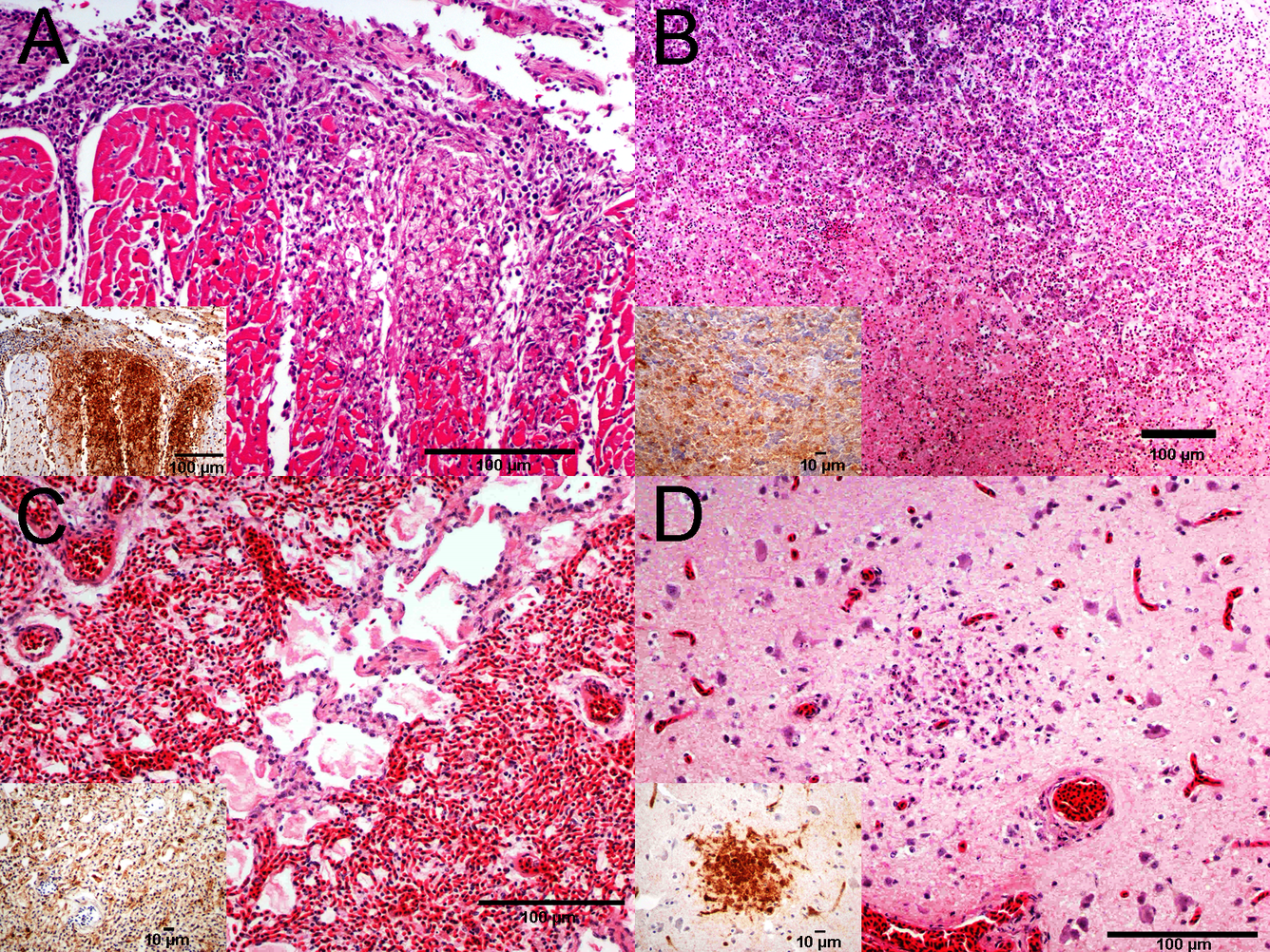
Histopathological Findings: Areas of acute necrosis, often accompanied by hemorrhage and/or heterophilic infiltrates, were present in the myocardium, exocrine pancreas, spleen, adrenals, and brain (Fig 2, plates A, B, and D). Diffuse severe pulmonary congestion and hemorrhage were present in the lungs (Fig 2, plate C). Immunohistochemistry was positive for influenza A virus antigen in affected tissues.
Figure 2. A. Heart, multifocal and focally extensive necrotizing myocarditis. H&E. Inset: Section of same heart tissue; immunohistochemical staining of influenza A virus antigen is strongly positive in areas of necrosis. B. Pancreas, multifocal and focally extensive necrosis of the acinar epithelium. H&E. Inset: Immunohistochemical staining of influenza A virus antigen is strongly positive in areas of necrosis. C. Lung, diffuse pulmonary congestion and edema. Hematoxylin and eosin (H&E) stain. Inset: Positive immunohistochemical staining of influenza A virus antigen is present within pulmonary histiocytes and the capillary endothelium. D. Brain (cerebrum), focal necrotizing encephalitis. H&E. Inset: Areas of necrosis shows strong positive immunohistochemical staining of influenza A virus antigen. (Credit: Valerie I. Shearn-Bochsler, USGS National Wildlife Health Center. Public domain.)
Disease: Highly Pathogenic Avian Influenza (HPAI)
Etiology: Eurasian lineage H5 clade 2.3.4.4 AIV, A/gyrfalcon/Washington/41088-6/2014 (H5N8) (GenBank taxon no. 1589663), was isolated from the brain (HPAI H5N8).
Distribution: The HPAI H5N8 virus isolated from this gyrfalcon is not known to be circulating in North America at this time. The falcon became ill and died after consumption of a (presumptively) HPAI virus-infected American wigeon (Anas americanus) from Wiser Lake in Washington, USA. Waterfowl carrying HPAI viruses were detected at Wiser Lake in December 2014, near the beginning of a poultry epizootic in North America caused by HPAI.
Seasonality: Influenza viruses, generally of low pathogenicity, are found in waterfowl year-round, with the highest occurrence of infection in the late summer and the lowest in the spring. In shorebirds and gulls, infection with influenza viruses is most common in the spring. The H5N8 HPAI virus isolated from this gyrfalcon was identified in wild raptors only during the HPAI epizootic in North American poultry in 2014-2015.
Host range: Waterfowl, shorebirds, gulls, and terns are most commonly infected, but most avian species can be infected, as can mammals, including humans.
Transmission: Fecal-oral, ingestion, or aerosol transmission in a contaminated environment. Predation or scavenging in avian predators.
Clinical signs: Vomiting and lethargy were reported in the captive gyrfalcon, but most of the wild HPAI virus infected raptors detected during the 2014-2015 poultry epizootic were found dead. In an infection trial of American kestrels (Falco sparverius) with H5N1 HPAI, neurologic signs were reported. Signs are highly variable in poultry, including respiratory, enteric, and reproductive abnormalities.
Diagnosis: Isolation of a highly pathogenic avian influenza virus from a clinically ill or dead bird with evidence of systemic illness.
Public health concerns: Certain HPAI viruses can be transmitted from animals, including birds, to humans, and are a serious health risk.
Wildlife population impacts: During this epizootic event in poultry, a small number of dead raptors from geographic regions where HPAI was present were submitted to the USGS National Wildlife Health Center for necropsy and were found to have died due to HPAI.
References:
Hall JS, Ip HS, Franson JC, Meteyer C, Nashold S, TeSlaa JL, et al. 2009. Experimental Infection of a North American Raptor, American Kestrel (Falco sparverius), with Highly Pathogenic Avian Influenza Virus (H5N1). PLoS ONE 4(10): e7555. https://doi.org/10.1371/journal.pone.0007555
Ip HS, Torchetti MK, Crespo R, Kohrs P, DeBruyn P, Mansfield KG,Baszler T, Badcoe L, Bodenstein B, Shearn-Bochsler V, Killian ML, Pedersen JC, Hines, N, Gidlewski T, Deliberto TJ, and Sleeman, JM.2015. Novel Eurasian highly pathogenic influenza A H5 viruses in wild birds, Washington, USA, 2014.Emerg Infect Dis. 21(5): 886-890. https://doi.org/10.3201/eid2105.142020
Short KR, Richard M, Verhagen JH, et al. 2015. One health, multiple challenges: The inter-species transmission of influenza A virus. One Health 1: 1-13. https://doi.org/10.1016/j.onehlt.2015.03.001
WHISPers, the Wildlife Health Information Sharing Partnership - event reporting system, is a web-based repository of basic information on current and historic wildlife mortality (death) and/or morbidity (illness) events reported by partners nationwide. It is also the portal to request diagnostic and epidemiologic services from the USGS National Wildlife Health Center.
WHISPers, the Wildlife Health Information Sharing Partnership - event reporting system, is a web-based repository of basic information on current and historic wildlife mortality (death) and/or morbidity (illness) events reported by partners nationwide. It is also the portal to request diagnostic and epidemiologic services from the USGS National Wildlife Health Center.
The Necropsy and Pathology services are performed by board-certified veterinary pathologists and necropsy technical staff whose principal role is to determine the cause of death for animals submitted to the USGS National Wildlife Health Center.
The Necropsy and Pathology services are performed by board-certified veterinary pathologists and necropsy technical staff whose principal role is to determine the cause of death for animals submitted to the USGS National Wildlife Health Center.
The USGS National Wildlife Health Center (NWHC) conducts laboratory investigations to determine the causes of wildlife mortality events, especially large-scale die-offs or those that are otherwise unusual.
The USGS National Wildlife Health Center (NWHC) conducts laboratory investigations to determine the causes of wildlife mortality events, especially large-scale die-offs or those that are otherwise unusual.
Images of heart, pancreas, lung, and brain tissue from gyrfalcon
A. Heart, multifocal and focally extensive necrotizing myocarditis. H&E. Inset: Section of same heart tissue; immunohistochemical staining of influenza A virus antigen is strongly positive in areas of necrosis. B. Pancreas, multifocal and focally extensive necrosis of the acinar epithelium. H&E.
A. Heart, multifocal and focally extensive necrotizing myocarditis. H&E. Inset: Section of same heart tissue; immunohistochemical staining of influenza A virus antigen is strongly positive in areas of necrosis. B. Pancreas, multifocal and focally extensive necrosis of the acinar epithelium. H&E.
Novel Eurasian lineage avian influenza A(H5N8) virus has spread rapidly and globally since January 2014. In December 2014, H5N8 and reassortant H5N2 viruses were detected in wild birds in Washington, USA, and subsequently in backyard birds. When they infect commercial poultry, these highly pathogenic viruses pose substantial trade issues.
Authors
S. Ip, Mia Kim Torchetti, Rocio Crespo, Paul Kohrs, Paul DeBruyn, Kristin G. Mansfield, Timothy Baszler, Lyndon Badcoe, Barbara L. Bodenstein, Valerie Shearn-Bochsler, Mary L. Killian, Janice C. Pederson, Nichole Hines, Thomas Gidlewski, Thomas J. DeLiberto, Jonathan M. Sleeman
Several species of wild raptors have been found in Eurasia infected with highly pathogenic avian influenza virus (HPAIV) subtype H5N1. Should HPAIV (H5N1) reach North America in migratory birds, species of raptors are at risk not only from environmental exposure, but also from consuming infected birds and carcasses. In this study we used American kestrels as a representative species of a...
Authors
Jeffrey S. Hall, Hon S. Ip, J. C. Franson, C. Meteyer, Sean W. Nashold, Joshua L. Teslaa, J. French, P. Redig, C. Brand
WHISPers, the Wildlife Health Information Sharing Partnership - event reporting system, is a web-based repository of basic information on current and historic wildlife mortality (death) and/or morbidity (illness) events reported by partners nationwide. It is also the portal to request diagnostic and epidemiologic services from the USGS National Wildlife Health Center.
WHISPers, the Wildlife Health Information Sharing Partnership - event reporting system, is a web-based repository of basic information on current and historic wildlife mortality (death) and/or morbidity (illness) events reported by partners nationwide. It is also the portal to request diagnostic and epidemiologic services from the USGS National Wildlife Health Center.
The Necropsy and Pathology services are performed by board-certified veterinary pathologists and necropsy technical staff whose principal role is to determine the cause of death for animals submitted to the USGS National Wildlife Health Center.
The Necropsy and Pathology services are performed by board-certified veterinary pathologists and necropsy technical staff whose principal role is to determine the cause of death for animals submitted to the USGS National Wildlife Health Center.
The USGS National Wildlife Health Center (NWHC) conducts laboratory investigations to determine the causes of wildlife mortality events, especially large-scale die-offs or those that are otherwise unusual.
The USGS National Wildlife Health Center (NWHC) conducts laboratory investigations to determine the causes of wildlife mortality events, especially large-scale die-offs or those that are otherwise unusual.
Images of heart, pancreas, lung, and brain tissue from gyrfalcon
A. Heart, multifocal and focally extensive necrotizing myocarditis. H&E. Inset: Section of same heart tissue; immunohistochemical staining of influenza A virus antigen is strongly positive in areas of necrosis. B. Pancreas, multifocal and focally extensive necrosis of the acinar epithelium. H&E.
A. Heart, multifocal and focally extensive necrotizing myocarditis. H&E. Inset: Section of same heart tissue; immunohistochemical staining of influenza A virus antigen is strongly positive in areas of necrosis. B. Pancreas, multifocal and focally extensive necrosis of the acinar epithelium. H&E.
Novel Eurasian lineage avian influenza A(H5N8) virus has spread rapidly and globally since January 2014. In December 2014, H5N8 and reassortant H5N2 viruses were detected in wild birds in Washington, USA, and subsequently in backyard birds. When they infect commercial poultry, these highly pathogenic viruses pose substantial trade issues.
Authors
S. Ip, Mia Kim Torchetti, Rocio Crespo, Paul Kohrs, Paul DeBruyn, Kristin G. Mansfield, Timothy Baszler, Lyndon Badcoe, Barbara L. Bodenstein, Valerie Shearn-Bochsler, Mary L. Killian, Janice C. Pederson, Nichole Hines, Thomas Gidlewski, Thomas J. DeLiberto, Jonathan M. Sleeman
Several species of wild raptors have been found in Eurasia infected with highly pathogenic avian influenza virus (HPAIV) subtype H5N1. Should HPAIV (H5N1) reach North America in migratory birds, species of raptors are at risk not only from environmental exposure, but also from consuming infected birds and carcasses. In this study we used American kestrels as a representative species of a...
Authors
Jeffrey S. Hall, Hon S. Ip, J. C. Franson, C. Meteyer, Sean W. Nashold, Joshua L. Teslaa, J. French, P. Redig, C. Brand