



Sarah Schoen and pilot Chris Klosterman search for beachcast Common Murres along the Alaska Peninsula following the massive die-off of murres in 2015/2016. Wide Bay, Alaska Peninsula
Beginning in 2015, large numbers of dead seabirds have been appearing on beaches in most marine areas of Alaska. Although seabird die-offs are known to occur sporadically (e.g. 1970, 1989, 1993, 1997/1998, and 2004) in Alaska, these recent die-offs have been distinguished from past events by their increased frequency, duration, geographic extent, and number of different species involved.
Return to Ecosystems >> Marine Ecosystems >> Seabirds and Forage Fish Ecology
Recent die-offs
Media

Sources/Usage: Public Domain. View Media Details
The first large die-off occurred from spring of 2015 to spring of 2016 when about 47,000 Common Murres (Uria aalge), an abundant and important subsistence seabird species in Alaska, were discovered dying or dead on beaches and lakes across Alaska. The die-off was centered in the Gulf of Alaska but stretched all the way from southern California to the southeast Bering Sea. Total mortality was estimated to range from 0.5-1.2 million birds, marking the largest die-off of seabirds ever recorded in the Pacific Ocean.
Multiple die-off events of smaller magnitude have also occurred in Alaska since 2016, primarily in the Bering and Chukchi seas, including die-offs of Tufted (Fratercula cirrhata) and Horned (Fratercula corniculata) puffin, Thick-billed Murre (Uria lomvia), Crested Auklet (Aethia cristatella), Northern Fulmar (Fulmarus glacialis), and a few other species. For example, in summer 2019 over 8,500 Short-tailed Shearwater (Puffinus tenuirostris) were discovered dead in the Bering and Chukchi seas.
What is USGS doing about seabird die-offs?
Researchers at the USGS Alaska Science Center have been working in collaboration with many partner agencies, non-governmental organizations, universities and rehabilitation centers to investigate seabird die-offs. We conduct surveys to investigate the distribution and magnitude of die-off events, and we examine carcasses to determine the possible cause(s) of death. We are also trying to understand the potential role of harmful algal bloom toxins and are monitoring forage fish populations to better understand the availability and quality of seabird prey. Additionally, we study the effects of the die-offs on seabird reproduction and population size.
Media

Sources/Usage: Public Domain. View Media Details
(Credit: Sarah Schoen, U.S. Geological Survey)
Why do seabird die-offs occur?
Most seabird die-offs occur when birds are not able to find, catch and eat enough food to keep up with their high energetic demands. Examination of carcasses following die-offs usually indicate that most birds have died of starvation. Die-offs often occur during the winter, when it is colder and requires more food to maintain body condition, and frequently follow storms, which can push birds away from their prey and make it harder to forage. Changes in prey availability owing to overfishing or competition for prey with other bird, mammal and fish predators can also result in die-offs. Other factors that can lead to die-offs include poisoning by harmful algal bloom neurotoxins and oil spills.
Are die-offs associated with marine heatwaves?
Marine heatwaves are characterized by unusually warm water that can extend over large areas of the ocean and last for long periods of time. Seabird die-offs have occurred at the same time as marine heatwaves in the North Pacific and Bering and Chukchi seas.
What happened to seabird prey during the North Pacific marine heatwave in 2014-2016?
The North Pacific marine heatwave in 2014-2016 was the longest marine heatwave documented at the time, with high sea surface temperatures recorded through multiple winters. During this period of unusual ocean warming, the availability and quality of prey resources decreased abruptly. For example, the occurrence of key forage fish species including Pacific capelin and Pacific sand lance declined in seabird diets. By summer of 2016 the energy content of Pacific sand lance was reduced by 89% compared to 2012-2013 when waters were cooler. Lower prey availability and lower prey quality likely explain why the majority of die-off seabirds starved during 2015-2016. It also appears likely that warm ocean temperatures increased the metabolic rates of large predatory fish like Pacific cod and walleye pollock, leading to a large increase in their consumption of prey also eaten by seabirds.
From Partners
Below are other science projects associated with this project.

Seabirds and Forage Fish Ecology
Alaska's coastal and offshore waters provide foraging habitat for an estimated 100 million birds comprising more than 90 different species; from loons and seaducks that nest inland, to petrels and puffins that breed on islands off shore. All these birds depend on the sea to provide a wide variety of food types— from clams, crabs and urchins nearshore— to krill, forage fish, and squid offshore. The...

Harmful Algal Bloom Toxins in Alaska Seabirds
Elevated ocean temperatures are linked to the development of harmful algal blooms (HABs). Toxins from these blooms may pose health threats to marine organisms, including seabirds. Since 2015, the USGS has worked with a variety of stakeholders to develop testing methods and research projects to better understand the geographic extent, timing and impacts of algal toxins in Alaska marine ecosystems...

Detecting Long-term Changes in Forage Fish Populations in Prince William Sound, Alaska
Forage fish are small pelagic schooling fish that play a key role in transferring energy between plankton and top marine predators. Many seabirds, marine mammals, and commercial fish species depend on forage fish to grow and survive.

Cook Inlet Seabird and Forage Fish Study
A massive die-off of Common Murres was documented in the Gulf of Alaska (GOA) during the fall and winter of 2015-2016 in association with a record-breaking marine heat wave in the GOA.

Algal Toxins and Wildlife Health
Harmful algal blooms (HABs) have the potential to harm fish and wildlife, domestic animals, livestock, and humans through toxin production or ecological disturbances such as oxygen depletion and blockage of sunlight.

Condition of Forage Fish in Prince William Sound During the Marine Heatwave
Changes in the body condition of a key forage fish species, Pacific sand lance ( Ammodytes personatus), are examined to understand how energy transfer to predators may have been disrupted during the recent marine heatwave in the North Pacific (late 2013 to mid 2016).
Below are multimedia items associated with this project.
Filter Total Items: 35

Scientists search for beachcast Common Murres
Sarah Schoen and pilot Chris Klosterman search for beachcast Common Murres along the Alaska Peninsula following the massive die-off of murres in 2015/2016. Wide Bay, Alaska Peninsula

Tony DeGange searches for Common Murre carcasses above the high tide
Tony DeGange searches for Common Murre carcasses above the high tideRetired USGS biologist Tony DeGange searches for Common Murre carcasses above the high tide line on the Alaska Peninsula following the massive die-off of murres in 2015/2016. Wide Bay, Alaska Peninsula
Tony DeGange searches for Common Murre carcasses above the high tide
Tony DeGange searches for Common Murre carcasses above the high tideRetired USGS biologist Tony DeGange searches for Common Murre carcasses above the high tide line on the Alaska Peninsula following the massive die-off of murres in 2015/2016. Wide Bay, Alaska Peninsula

A Common Murre carcass decomposes
A Common Murre carcass decomposes along the Alaska Peninsula following the massive die-off of murres in 2015/2016. Portage Bay, Alaska Peninsula.
A Common Murre carcass decomposes along the Alaska Peninsula following the massive die-off of murres in 2015/2016. Portage Bay, Alaska Peninsula.

Sarah Schoen identifies and counts Common Murre carcasses
Sarah Schoen identifies and counts Common Murre carcassesUSGS biologist Sarah Schoen identifies and counts Common Murre carcasses on the Alaska Peninsula following the massive die-off of murres in 2015/2016. Wide Bay, Alaska Peninsula
Sarah Schoen identifies and counts Common Murre carcasses
Sarah Schoen identifies and counts Common Murre carcassesUSGS biologist Sarah Schoen identifies and counts Common Murre carcasses on the Alaska Peninsula following the massive die-off of murres in 2015/2016. Wide Bay, Alaska Peninsula

Common Murre carcass decomposes just above the high tide
Common Murre carcass decomposes just above the high tideA Common Murre carcass decomposes just above the high tide line along the Alaska Peninsula following the massive die-off of murres in 2015/2016. Wide Bay, Alaska Peninsula
Common Murre carcass decomposes just above the high tide
Common Murre carcass decomposes just above the high tideA Common Murre carcass decomposes just above the high tide line along the Alaska Peninsula following the massive die-off of murres in 2015/2016. Wide Bay, Alaska Peninsula

Common Murre carcass decomposes along the Alaska Peninsula
Common Murre carcass decomposes along the Alaska PeninsulaA Common Murre carcass decomposes along the Alaska Peninsula following the massive die-off of murres in 2015/2016. Wide Bay, Alaska Peninsula.
Common Murre carcass decomposes along the Alaska Peninsula
Common Murre carcass decomposes along the Alaska PeninsulaA Common Murre carcass decomposes along the Alaska Peninsula following the massive die-off of murres in 2015/2016. Wide Bay, Alaska Peninsula.

Dead Common Murres found on the beach along the Alaska Peninsula
Dead Common Murres found on the beach along the Alaska PeninsulaDead Common Murres found on the beach along the Alaska Peninsula May 2, 2016. This bird was part of the large die-off of Common Murres across the Gulf of Alaska in 2015-2016.
Dead Common Murres found on the beach along the Alaska Peninsula
Dead Common Murres found on the beach along the Alaska PeninsulaDead Common Murres found on the beach along the Alaska Peninsula May 2, 2016. This bird was part of the large die-off of Common Murres across the Gulf of Alaska in 2015-2016.

Severely emaciated Common Murre carcass
A severely emaciated Common Murre carcass collected to determine the cause of death following a massive die-off of murres in 2015/2016. Prince William Sound
A severely emaciated Common Murre carcass collected to determine the cause of death following a massive die-off of murres in 2015/2016. Prince William Sound

Biologists walk the beach counting Common Murre carcasses
Biologists walk the beach counting Common Murre carcassesBiologists walk the beach counting Common Murre carcasses following a massive die-off of murres in 2015/2016. Prince William Sound.
Biologists walk the beach counting Common Murre carcasses
Biologists walk the beach counting Common Murre carcassesBiologists walk the beach counting Common Murre carcasses following a massive die-off of murres in 2015/2016. Prince William Sound.

Dead Common Murres found on the beach in Cochrane Bay, Prince William
Dead Common Murres found on the beach in Cochrane Bay, Prince WilliamDead Common Murres found on the beach in Cochrane Bay, Prince William Sound on Jan 10, 2016. These birds were part of the large die-off of Common Murres across the Gulf of Alaska in 2015-2016.
Dead Common Murres found on the beach in Cochrane Bay, Prince William
Dead Common Murres found on the beach in Cochrane Bay, Prince WilliamDead Common Murres found on the beach in Cochrane Bay, Prince William Sound on Jan 10, 2016. These birds were part of the large die-off of Common Murres across the Gulf of Alaska in 2015-2016.

Freshly deceased Common Murre carcass
A freshly deceased Common Murre carcass recovered following the massive die-off of murres in 2015/2016. Cochrane Bay, Prince William Sound
A freshly deceased Common Murre carcass recovered following the massive die-off of murres in 2015/2016. Cochrane Bay, Prince William Sound

Freshly deceased Common Murre carcass recovered
A freshly deceased Common Murre carcass recovered following the massive die-off of murres in 2015/2016. Cochrane Bay, Prince William Sound.
A freshly deceased Common Murre carcass recovered following the massive die-off of murres in 2015/2016. Cochrane Bay, Prince William Sound.
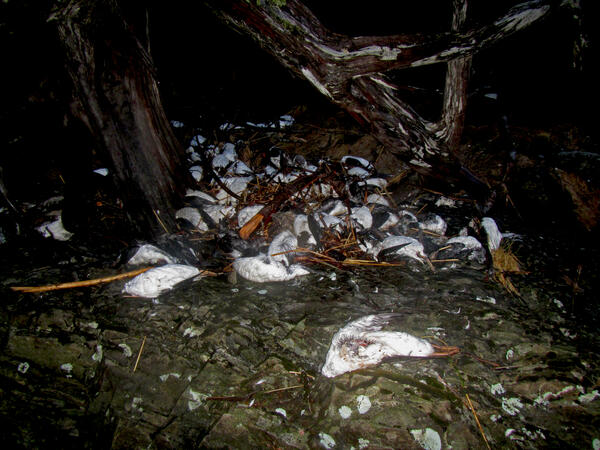
Thousands of Common Murre carcasses on beaches in Pigot Bay
Thousands of Common Murre carcasses on beaches in Pigot BayThousands of Common Murre carcasses piled up on beaches in Pigot Bay following the massive die-off of murres in 2015/2016.
Thousands of Common Murre carcasses on beaches in Pigot Bay
Thousands of Common Murre carcasses on beaches in Pigot BayThousands of Common Murre carcasses piled up on beaches in Pigot Bay following the massive die-off of murres in 2015/2016.
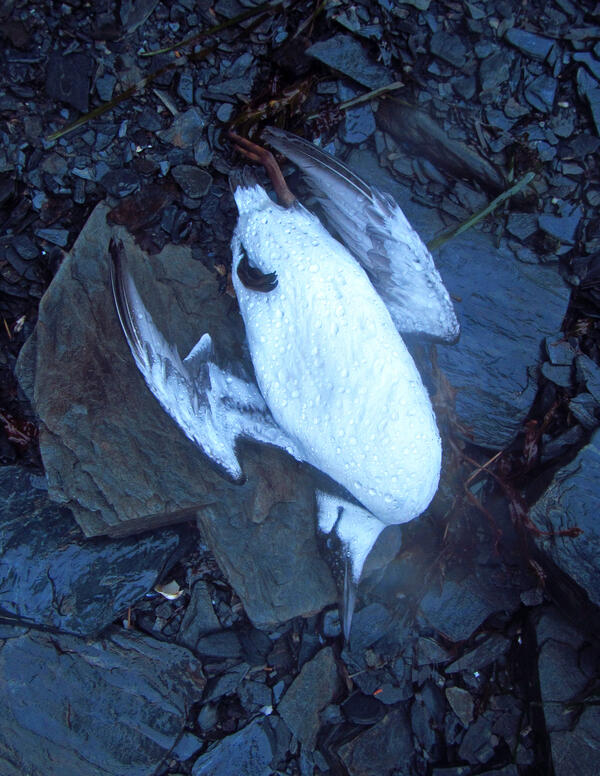
A dead Common Murre found on the beach in Prince William Sound
A dead Common Murre found on the beach in Prince William SoundA dead Common Murre found on the beach in Prince William Sound on Jan 7, 2016. This bird was part of the large die-off of Common Murres across the Gulf of Alaska in 2015-2016.
A dead Common Murre found on the beach in Prince William Sound
A dead Common Murre found on the beach in Prince William SoundA dead Common Murre found on the beach in Prince William Sound on Jan 7, 2016. This bird was part of the large die-off of Common Murres across the Gulf of Alaska in 2015-2016.
Beginning in 2015, large numbers of dead seabirds have been appearing on beaches in most marine areas of Alaska. Although seabird die-offs are known to occur sporadically (e.g. 1970, 1989, 1993, 1997/1998, and 2004) in Alaska, these recent die-offs have been distinguished from past events by their increased frequency, duration, geographic extent, and number of different species involved.
Return to Ecosystems >> Marine Ecosystems >> Seabirds and Forage Fish Ecology
Recent die-offs
Media
Sources/Usage: Public Domain. View Media Details
The first large die-off occurred from spring of 2015 to spring of 2016 when about 47,000 Common Murres (Uria aalge), an abundant and important subsistence seabird species in Alaska, were discovered dying or dead on beaches and lakes across Alaska. The die-off was centered in the Gulf of Alaska but stretched all the way from southern California to the southeast Bering Sea. Total mortality was estimated to range from 0.5-1.2 million birds, marking the largest die-off of seabirds ever recorded in the Pacific Ocean.
Multiple die-off events of smaller magnitude have also occurred in Alaska since 2016, primarily in the Bering and Chukchi seas, including die-offs of Tufted (Fratercula cirrhata) and Horned (Fratercula corniculata) puffin, Thick-billed Murre (Uria lomvia), Crested Auklet (Aethia cristatella), Northern Fulmar (Fulmarus glacialis), and a few other species. For example, in summer 2019 over 8,500 Short-tailed Shearwater (Puffinus tenuirostris) were discovered dead in the Bering and Chukchi seas.
What is USGS doing about seabird die-offs?
Researchers at the USGS Alaska Science Center have been working in collaboration with many partner agencies, non-governmental organizations, universities and rehabilitation centers to investigate seabird die-offs. We conduct surveys to investigate the distribution and magnitude of die-off events, and we examine carcasses to determine the possible cause(s) of death. We are also trying to understand the potential role of harmful algal bloom toxins and are monitoring forage fish populations to better understand the availability and quality of seabird prey. Additionally, we study the effects of the die-offs on seabird reproduction and population size.
Media
Sources/Usage: Public Domain. View Media Details
(Credit: Sarah Schoen, U.S. Geological Survey)
Why do seabird die-offs occur?
Most seabird die-offs occur when birds are not able to find, catch and eat enough food to keep up with their high energetic demands. Examination of carcasses following die-offs usually indicate that most birds have died of starvation. Die-offs often occur during the winter, when it is colder and requires more food to maintain body condition, and frequently follow storms, which can push birds away from their prey and make it harder to forage. Changes in prey availability owing to overfishing or competition for prey with other bird, mammal and fish predators can also result in die-offs. Other factors that can lead to die-offs include poisoning by harmful algal bloom neurotoxins and oil spills.
Are die-offs associated with marine heatwaves?
Marine heatwaves are characterized by unusually warm water that can extend over large areas of the ocean and last for long periods of time. Seabird die-offs have occurred at the same time as marine heatwaves in the North Pacific and Bering and Chukchi seas.
What happened to seabird prey during the North Pacific marine heatwave in 2014-2016?
The North Pacific marine heatwave in 2014-2016 was the longest marine heatwave documented at the time, with high sea surface temperatures recorded through multiple winters. During this period of unusual ocean warming, the availability and quality of prey resources decreased abruptly. For example, the occurrence of key forage fish species including Pacific capelin and Pacific sand lance declined in seabird diets. By summer of 2016 the energy content of Pacific sand lance was reduced by 89% compared to 2012-2013 when waters were cooler. Lower prey availability and lower prey quality likely explain why the majority of die-off seabirds starved during 2015-2016. It also appears likely that warm ocean temperatures increased the metabolic rates of large predatory fish like Pacific cod and walleye pollock, leading to a large increase in their consumption of prey also eaten by seabirds.
From Partners
Below are other science projects associated with this project.
Seabirds and Forage Fish Ecology
Alaska's coastal and offshore waters provide foraging habitat for an estimated 100 million birds comprising more than 90 different species; from loons and seaducks that nest inland, to petrels and puffins that breed on islands off shore. All these birds depend on the sea to provide a wide variety of food types— from clams, crabs and urchins nearshore— to krill, forage fish, and squid offshore. The...
Harmful Algal Bloom Toxins in Alaska Seabirds
Elevated ocean temperatures are linked to the development of harmful algal blooms (HABs). Toxins from these blooms may pose health threats to marine organisms, including seabirds. Since 2015, the USGS has worked with a variety of stakeholders to develop testing methods and research projects to better understand the geographic extent, timing and impacts of algal toxins in Alaska marine ecosystems...
Detecting Long-term Changes in Forage Fish Populations in Prince William Sound, Alaska
Forage fish are small pelagic schooling fish that play a key role in transferring energy between plankton and top marine predators. Many seabirds, marine mammals, and commercial fish species depend on forage fish to grow and survive.
Cook Inlet Seabird and Forage Fish Study
A massive die-off of Common Murres was documented in the Gulf of Alaska (GOA) during the fall and winter of 2015-2016 in association with a record-breaking marine heat wave in the GOA.
Algal Toxins and Wildlife Health
Harmful algal blooms (HABs) have the potential to harm fish and wildlife, domestic animals, livestock, and humans through toxin production or ecological disturbances such as oxygen depletion and blockage of sunlight.
Condition of Forage Fish in Prince William Sound During the Marine Heatwave
Changes in the body condition of a key forage fish species, Pacific sand lance ( Ammodytes personatus), are examined to understand how energy transfer to predators may have been disrupted during the recent marine heatwave in the North Pacific (late 2013 to mid 2016).
Below are multimedia items associated with this project.
Filter Total Items: 35
Scientists search for beachcast Common Murres
Sarah Schoen and pilot Chris Klosterman search for beachcast Common Murres along the Alaska Peninsula following the massive die-off of murres in 2015/2016. Wide Bay, Alaska Peninsula
Sarah Schoen and pilot Chris Klosterman search for beachcast Common Murres along the Alaska Peninsula following the massive die-off of murres in 2015/2016. Wide Bay, Alaska Peninsula
Tony DeGange searches for Common Murre carcasses above the high tide
Tony DeGange searches for Common Murre carcasses above the high tideRetired USGS biologist Tony DeGange searches for Common Murre carcasses above the high tide line on the Alaska Peninsula following the massive die-off of murres in 2015/2016. Wide Bay, Alaska Peninsula
Tony DeGange searches for Common Murre carcasses above the high tide
Tony DeGange searches for Common Murre carcasses above the high tideRetired USGS biologist Tony DeGange searches for Common Murre carcasses above the high tide line on the Alaska Peninsula following the massive die-off of murres in 2015/2016. Wide Bay, Alaska Peninsula
A Common Murre carcass decomposes
A Common Murre carcass decomposes along the Alaska Peninsula following the massive die-off of murres in 2015/2016. Portage Bay, Alaska Peninsula.
A Common Murre carcass decomposes along the Alaska Peninsula following the massive die-off of murres in 2015/2016. Portage Bay, Alaska Peninsula.
Sarah Schoen identifies and counts Common Murre carcasses
Sarah Schoen identifies and counts Common Murre carcassesUSGS biologist Sarah Schoen identifies and counts Common Murre carcasses on the Alaska Peninsula following the massive die-off of murres in 2015/2016. Wide Bay, Alaska Peninsula
Sarah Schoen identifies and counts Common Murre carcasses
Sarah Schoen identifies and counts Common Murre carcassesUSGS biologist Sarah Schoen identifies and counts Common Murre carcasses on the Alaska Peninsula following the massive die-off of murres in 2015/2016. Wide Bay, Alaska Peninsula
Common Murre carcass decomposes just above the high tide
Common Murre carcass decomposes just above the high tideA Common Murre carcass decomposes just above the high tide line along the Alaska Peninsula following the massive die-off of murres in 2015/2016. Wide Bay, Alaska Peninsula
Common Murre carcass decomposes just above the high tide
Common Murre carcass decomposes just above the high tideA Common Murre carcass decomposes just above the high tide line along the Alaska Peninsula following the massive die-off of murres in 2015/2016. Wide Bay, Alaska Peninsula
Common Murre carcass decomposes along the Alaska Peninsula
Common Murre carcass decomposes along the Alaska PeninsulaA Common Murre carcass decomposes along the Alaska Peninsula following the massive die-off of murres in 2015/2016. Wide Bay, Alaska Peninsula.
Common Murre carcass decomposes along the Alaska Peninsula
Common Murre carcass decomposes along the Alaska PeninsulaA Common Murre carcass decomposes along the Alaska Peninsula following the massive die-off of murres in 2015/2016. Wide Bay, Alaska Peninsula.
Dead Common Murres found on the beach along the Alaska Peninsula
Dead Common Murres found on the beach along the Alaska PeninsulaDead Common Murres found on the beach along the Alaska Peninsula May 2, 2016. This bird was part of the large die-off of Common Murres across the Gulf of Alaska in 2015-2016.
Dead Common Murres found on the beach along the Alaska Peninsula
Dead Common Murres found on the beach along the Alaska PeninsulaDead Common Murres found on the beach along the Alaska Peninsula May 2, 2016. This bird was part of the large die-off of Common Murres across the Gulf of Alaska in 2015-2016.
Severely emaciated Common Murre carcass
A severely emaciated Common Murre carcass collected to determine the cause of death following a massive die-off of murres in 2015/2016. Prince William Sound
A severely emaciated Common Murre carcass collected to determine the cause of death following a massive die-off of murres in 2015/2016. Prince William Sound
Biologists walk the beach counting Common Murre carcasses
Biologists walk the beach counting Common Murre carcassesBiologists walk the beach counting Common Murre carcasses following a massive die-off of murres in 2015/2016. Prince William Sound.
Biologists walk the beach counting Common Murre carcasses
Biologists walk the beach counting Common Murre carcassesBiologists walk the beach counting Common Murre carcasses following a massive die-off of murres in 2015/2016. Prince William Sound.
Dead Common Murres found on the beach in Cochrane Bay, Prince William
Dead Common Murres found on the beach in Cochrane Bay, Prince WilliamDead Common Murres found on the beach in Cochrane Bay, Prince William Sound on Jan 10, 2016. These birds were part of the large die-off of Common Murres across the Gulf of Alaska in 2015-2016.
Dead Common Murres found on the beach in Cochrane Bay, Prince William
Dead Common Murres found on the beach in Cochrane Bay, Prince WilliamDead Common Murres found on the beach in Cochrane Bay, Prince William Sound on Jan 10, 2016. These birds were part of the large die-off of Common Murres across the Gulf of Alaska in 2015-2016.
Freshly deceased Common Murre carcass
A freshly deceased Common Murre carcass recovered following the massive die-off of murres in 2015/2016. Cochrane Bay, Prince William Sound
A freshly deceased Common Murre carcass recovered following the massive die-off of murres in 2015/2016. Cochrane Bay, Prince William Sound
Freshly deceased Common Murre carcass recovered
A freshly deceased Common Murre carcass recovered following the massive die-off of murres in 2015/2016. Cochrane Bay, Prince William Sound.
A freshly deceased Common Murre carcass recovered following the massive die-off of murres in 2015/2016. Cochrane Bay, Prince William Sound.
Thousands of Common Murre carcasses on beaches in Pigot Bay
Thousands of Common Murre carcasses on beaches in Pigot BayThousands of Common Murre carcasses piled up on beaches in Pigot Bay following the massive die-off of murres in 2015/2016.
Thousands of Common Murre carcasses on beaches in Pigot Bay
Thousands of Common Murre carcasses on beaches in Pigot BayThousands of Common Murre carcasses piled up on beaches in Pigot Bay following the massive die-off of murres in 2015/2016.
A dead Common Murre found on the beach in Prince William Sound
A dead Common Murre found on the beach in Prince William SoundA dead Common Murre found on the beach in Prince William Sound on Jan 7, 2016. This bird was part of the large die-off of Common Murres across the Gulf of Alaska in 2015-2016.
A dead Common Murre found on the beach in Prince William Sound
A dead Common Murre found on the beach in Prince William SoundA dead Common Murre found on the beach in Prince William Sound on Jan 7, 2016. This bird was part of the large die-off of Common Murres across the Gulf of Alaska in 2015-2016.