



Artemis II Mission returns to the Moon
The Artemis missions are making progress back to the Moon, paving the way for human exploration of the lunar south pole and on to Mars. Artemis II is set to launch in the coming weeks, delivering humans farther into the solar system than we’ve ever been! Although the four astronauts will not land on the Moon this time, we’re getting set up for future landings and beyond!
Launch Schedule
The Artemis II mission is scheduled to launch soon on the Space Launch System rocket (SLS), reported as the most powerful rocket in the world. Humanity is going to take a trip around the Moon before setting boots on the ground in an Apollo-like homecoming during Artemis III. It is important to note that technical reviews and weather conditions can affect the exact launch date, but this is for the safety of our astronauts and spacecraft.
Final Preparations
On February 3, the final Wet Dress Rehearsal was underway and will help narrow the launch date. This involves fueling the rocket and performing a full countdown to ensure everything is ready for the actual launch.
Astronaut Crew
Although Artemis I only carried a mannequin named “Commander Moonikin Campos,” the Artemis II mission will fly four (human) astronauts around the Moon. The astronauts below, (left to right) who will serve as our eyes and ears 230,000 miles away are Reid Wiseman (Commander), Victor Glover (Pilot), and Christina Koch and Jeremy Hansen (Mission Specialists). This will be the step before boots set on the ground during the upcoming Artemis III mission.
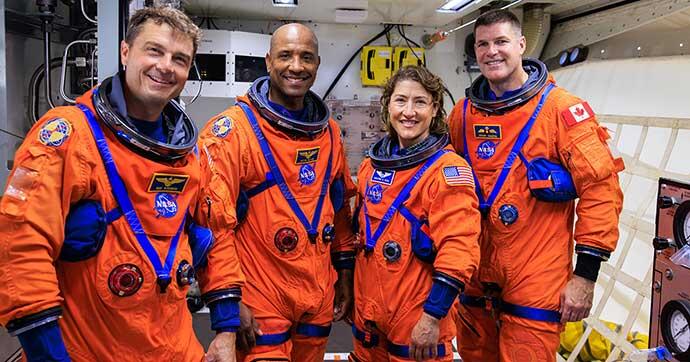
On this 10-day journey, astronauts will fly approximately 4,600 miles beyond the far side of the Moon, take high-resolution photography, and make geological observation of the lunar surface to help scout for future landing sites. The crew will also test a “space broadband” system to transmit high-definition video and massive amounts of data back to Earth at faster speeds. Additionally, Artemis II will also monitor carbon dioxide scrubbing and oxygen production, exercise equipment to maintain muscle in zero gravity, and test Orion’s ability to shield crew from deep space radiation. One can think of it as Artemis II being the pathfinder, and Artemis III the base camp.
Artemis Updates:
To find out more about the status of the Artemis mission a list of various resources can be found on this webpage.
Looking to the future: Every Astronaut that has walked on the Moon trained with us in Flagstaff
Where do we go from here? We’ve been training astronauts since Apollo in physical geography, foundational geology, and geologic methods (including sampling technique and the use of geologic tools) and continue to do that for the Moon and beyond. Artemis astronauts have continued training much like the Apollo astronauts did, with some refinements due to advanced techniques, training, and technology.
Artemis II astronauts may not be landing on the Moon, but physical geography (understanding the natural environment, processes, and features on Earth, the Moon, and beyond) and having a basic understanding of geologic processes is an important part of reconnaissance from orbit. Beyond Artemis II, we’re getting into the use of advanced techniques, geologic sampling, and the development and integration of tools. The Joint Extra Vehicular Activity (EVA) and Human Surface Mobility Test Team (or “JETT”) mission is developing these operations. Learn more about JETT5 activities in this article: Artemis III mission tests in the San Francisco Volcanic Field near Flagstaff, AZ and in Houston, TX | U.S. Geological Survey
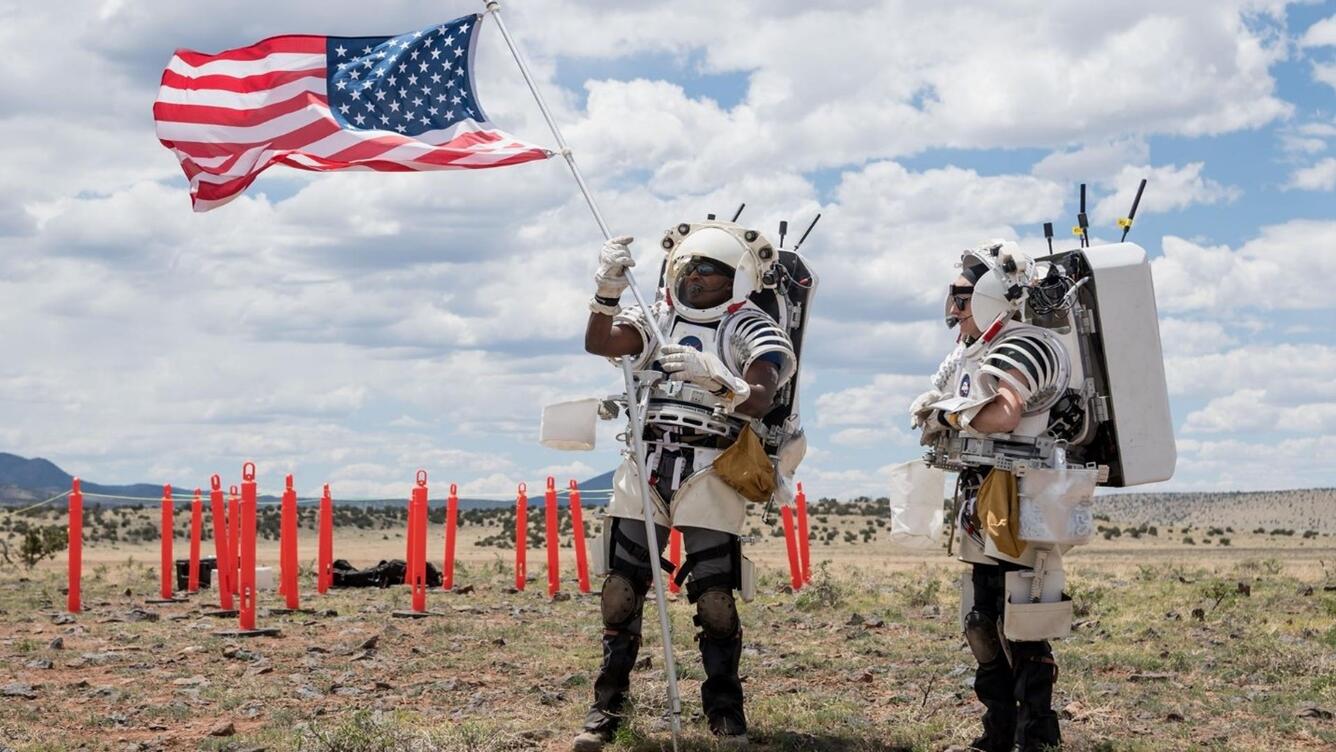
Image caption: NASA astronaut Andre Douglas (backup Artemis II astronaut) raises an American flag next to NASA astronaut Kate Rubins (Expedition 48/49 and Expedition 63/64) during their first simulated moonwalk in a week-long field test in the San Francisco Volcanic Field in Northern Arizona on May 13, 2024. (Image credit: NASA/Josh Valcarcel)