



Hats off to the Voyagers in 2026: The little spacecraft that could!
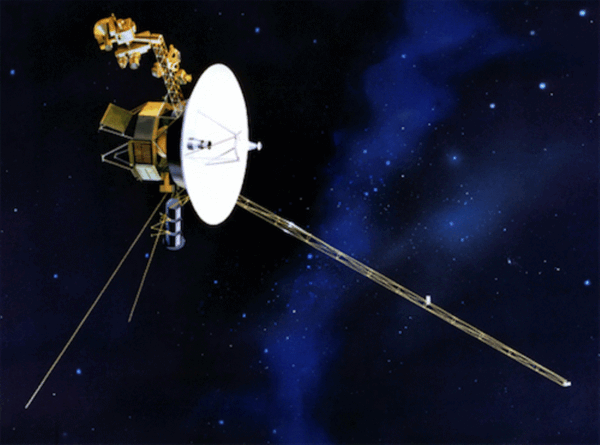
For millennia, our ancestors have gazed at the stars, wondering what lay beyond our cosmic doorstep, but today we no longer must wonder. In 1977, NASA’s Voyagers disclosed the view, returning historic images and stirring groundbreaking science. As we step into 2026, we are watching humanity’s most distant messengers reach a mind-blowing new frontier.
From the early days of Viking to the grand tours of Voyager and Cassini, our doorstep has proven to be diverse and active. This year, we celebrate for good reasons, the profound impact of the Voyager mission—even as we face the reality of its inevitable conclusion.
Voyager 1 discovered new moons and Jupiter’s Ring:
Voyager 1’s primary mission provided unprecedented close-up images of Jupiter and Saturn. It shone a light on new moons and narrow rings around Jupiter in 1979, which were previously hidden from view. Though Galileo Galilei first observed Saturn’s rings in 1610, their actual structure remained a mystery until Voyager 1 delivered the first detailed close-up images of the fine structure of Saturn’s rings.
Voyager 1 photographed active volcanoes on Jupiter’s moon Io:
At the United States Geological Survey (USGS), Astrogeology Science Center (ASC), such mission data are celebrated–the old and new. Without these data the solar system remains a blurry mystery; with it our scientists treat distant planets with the same scientific vigor applied to Earth. It allows them to compare Earth’s geological processes (like volcanism, erosion, and tectonics) with other worlds.

For example, mention mafic lava flows on Earth, Mars, or Jupiter's moon, Io, (anyplace) and you get Dr. Laszlo Kestay’s undivided attention because he is a planetary volcanologist, at ASC.
He said fondly, “The active volcanism on Io lets us see huge volcanic eruptions, the likes of which have not occurred on Earth for millions of years. Watching these giant lava flows is like going to Jurassic Park for a volcanologist!"
In 1979, Linda Morabito first discovered active volcanoes on Jupiter's moon, Io, using images from NASA's Voyager 1 spacecraft.
ASC cartographers appreciate such mission data because it allows them to create geologic maps—the primary tools used to understand the history of the planets. Dr. Kestay was among a team of scientists who produced the first complete 1:15 M-scale global geologic map of Jupiter’s moon Io, which helped garner insights into Io’s volcanism.
Voyager 1 is also credited with capturing a famous image of Earth called “the Pale Blue Dot, ” at the direction of Carl Sagan and the Voyager Imaging Team. The photo serves as a humbling reminder of our place in the universe, memorably described by Sagan as ‘just a tiny, fragile speck in the cosmic ocean.’

Additionally, Voyager 2 explored Uranus, discovering 11 new moons and 2 new rings. It also discovered the great dark spot (a massive storm like Jupiter’s red spot) and confirmed that Neptune also has rings.
The Voyagers’ location now:
NASA’s Voyagers have reached interstellar space and continue their unique journeys deeper into the cosmos. The twins are the first human-made spacecraft to operate in interstellar space. As of January 2026, both Voyagers are more than 13 billion miles away from the Earth. A tracking system and more information about the Voyagers are freely available here.
The Voyagers' physical health assessments:
As of January 2026, these relatively small, 720-kilogram (1,600 pounds) spacecraft continue to be operational and communicating from interstellar space, although they are in survival mode of their 48-year journey. According to NASA, these ambassadors will eventually become silent once their radioisotope thermoelectric generators die (estimated to happen this year but NASA hopes for an even longer time with them).

Dr. Michael Bland, Research Space Scientist, of USGS Astrogeology Science Center said: “Voyager revolutionized our conception of the solar system. After almost 400 years, it transformed the astronomical objects observed by Galileo into true "worlds”.
In 2021, Dr. Bland’s cartography group used decades-old Voyager data that were of limited use and transformed them into a valuable and accessible resource for the planetary science community. See “Improving the Usability of Galileo and Voyager Images of Jupiter’s Moon Europa” to learn more about this work.
As the Voyagers continue in 2026, it is our hope for now and beyond, to continue turning complex mission data into formats that any scientists or students can use, helping with landing site selection, hazard assessment, resource identification, and more–all necessities to safely explore future worlds.