



Heterosigma akashiwo in San Fracisco Bay
Harmful Algal Bloom
Researcher aboard USGS RV Aiken
A new study by several scientists examines the environmental conditions that fueled a massive algal bloom in the San Francisco Bay. By analyzing water quality, circulation, and microscopic communities, the research helps explain how rare combinations of factors can drive major ecological events, including blooms of Heterosigma akashiwo, a species first identified in Japan.
Tracking the Bloom Across the Bay
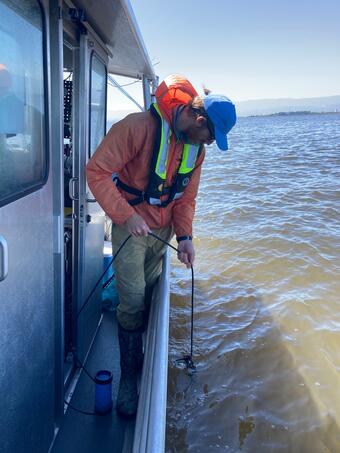
Algal blooms are not unusual in the San Francisco Bay, where nutrient levels are high and seasonal conditions regularly support biological growth. Most blooms, however, remain relatively small. To understand why one particular bloom became so extreme, scientists from the U.S. Geological Survey California Water Science Center and San Francisco Estuary Institute examined conditions from South Bay through Central Bay and into San Pablo Bay.
Using years of monitoring data, researchers looked at how water movement, temperature, and water quality aligned during the event, as well as how microscopic communities shifted as the bloom developed. During this bloom, measured chlorophyll levels, a common indicator of algal abundance, were more than 40 times higher than what is typically seen in the Bay, leading to low-oxygen conditions and widespread fish die-offs.
A similar algal bloom occurred again the following summer, but at lower intensity and with fewer ecological impacts. By closely examining the extreme 2022 event, the study shows how routine blooms can escalate when multiple environmental factors line up at the same time. Understanding those rare combinations helps scientists better anticipate when future blooms may pose greater risks to Bay ecosystems and nearby communities. The research was published in the scientific journal Estuaries and Coasts in December of 2025.