



The “sediment shadow” in Chesapeake Bay’s tidal freshwater rivers has important implications for restoration
Chesapeake Bay restoration efforts are focused on reducing nitrogen, phosphorus, and sediment loads to the estuary. A new synthesis of existing long-term records of suspended-sediment concentrations suggests that only a limited amount of watershed sediment is currently transported by rivers past the tidal freshwater zone and into saltier waters of the Chesapeake Bay.
Issue
Excess fine sediment (like clay and silt) is known to have negative impacts on the health of the Chesapeake Bay. Effective management actions would target the primary sources of sediment in order to improve aquatic and wetland habitat for living resources in the Bay, such as crabs, oysters, and fish. Therefore, managers need to know how much sediment in the Bay is delivered from rivers in the watershed and how much sediment is produced by sources in the Bay, such as eroding shorelines or redistributed sediment on the bed of the Bay. Managers also need to understand how sediment concentrations have changed over multiple decades in the Bay – long-term trends that can guide future management actions.
USGS Study
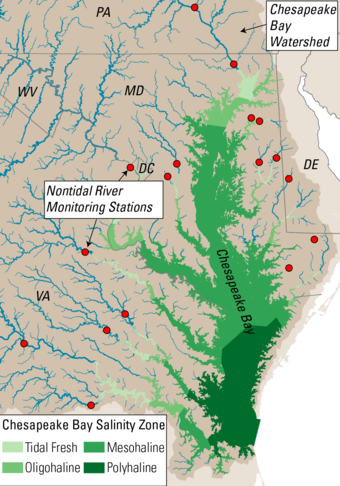
This study analyzed long-term monitoring data collected throughout the Chesapeake Bay and adjacent nontidal rivers to identify spatial patterns and temporal trends of suspended sediment. Sediment concentrations were compared both within and between Chesapeake rivers, from nontidal rivers, across the head-of-tide into the tidal freshwater zone, and down through progressively saltier zones of the tidal river, and into the Chesapeake Bay (Figure 1).
Major Findings
Sediment Trends: Suspended sediment concentrations (measured as suspended solids) in salty parts of the Chesapeake Bay – primarily stations in the mesohaline and polyhaline zones – decreased about 25% on average from 1999 through 2022. Changes over this period were more variable in less salty waters – stations in tidal freshwater and oligohaline zones. This finding suggests that tidal waters most distant from nontidal rivers were the only locations with consistent decreases in sediment and that sediment concentrations likely decreased in these salinity zones due to reasons other than changes in watershed sediment inputs.
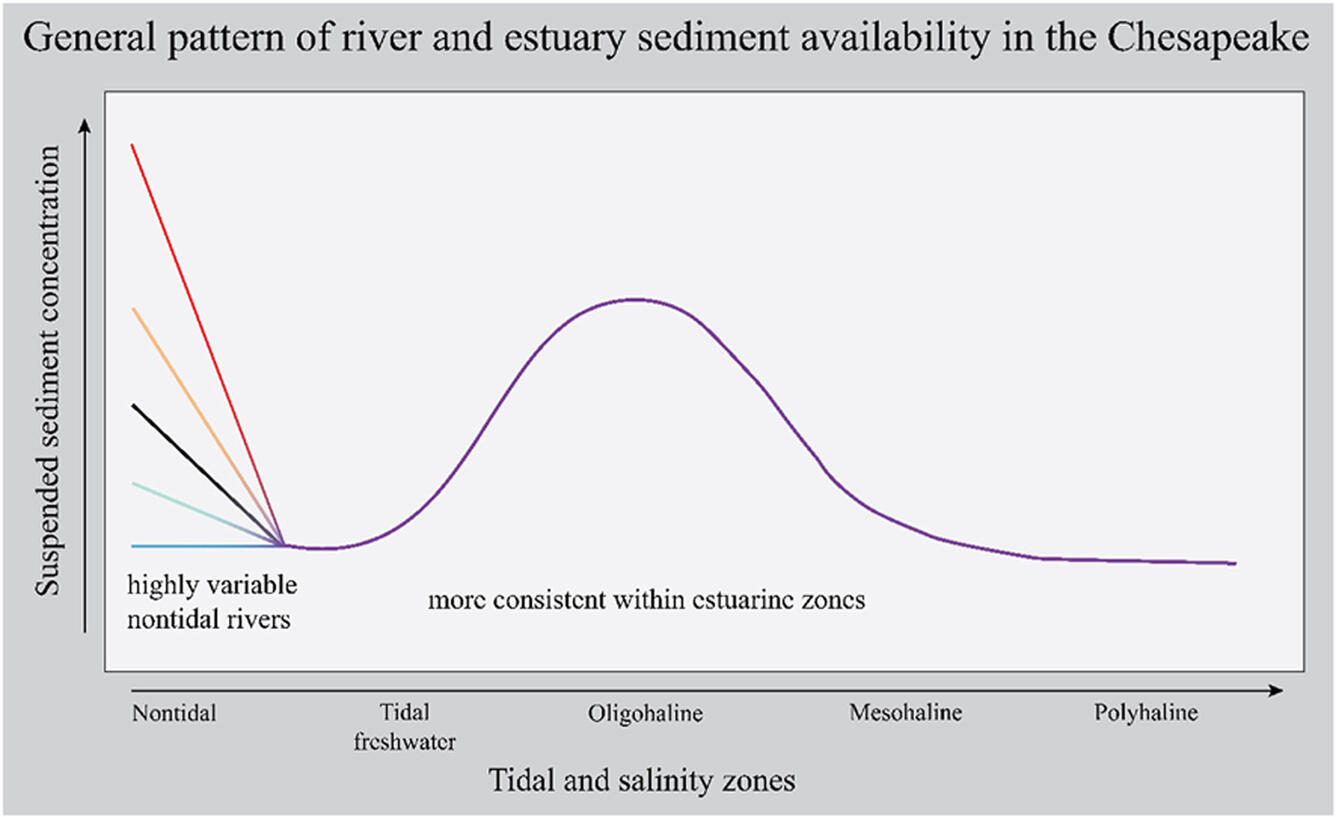
A Sediment Shadow: The tidal freshwater zone – which describes waters between nontidal rivers in the watershed and oligohaline waters in the Bay – has a “sediment shadow”. In other words, tidal freshwaters have lower suspended-sediment concentrations relative to their surrounding waters (Figure 2). This suggests that freshwater sediment inputs become less important in determining the sediment concentration of waters located farther away from nontidal rivers.
Sediment in the Bay: In recent decades, small amounts of sediment delivered from nontidal rivers have likely reached saltier zones of the Chesapeake Bay. Sediment from nontidal rivers clearly reached the Chesapeake Bay in the past, prior to soil conservation efforts and other management practices that reduced river sediment loads. That older “legacy sediment” is likely being eroded and redistributed around the Chesapeake Bay, and along with current shoreline erosion, may represent the largest source of suspended sediment in the Bay in recent years.
Management Implications
Analysis of long-term monitoring data generated several management-relevant insights about sediment transport from the watershed into the Chesapeake Bay. Little of the current watershed sediment load is likely transported past the tidal freshwater zone, except during extreme floods when some sediment may be delivered to saline portions of the estuary. Therefore, while watershed management actions have important benefits associated with sediment reduction, such as improving river habitat quality and reducing the load of phosphorus in the estuary that is frequently attached to sediment, watershed management actions alone are unlikely to meaningfully decrease suspended-sediment concentrations in most of the Bay.
The “sediment shadow” suggests that tidal marshes within the tidal freshwater, mesohaline, and polyhaline zones likely have insufficient sediment to maintain elevation relative to sea-level rise. In contrast, tidal marshes in the oligohaline zone receive higher concentrations of suspended sediment, indicating they may be more resilient than other tidal wetlands. Overall, the relatively low sediment availability to most Chesapeake tidal marshes suggests greater risk of long-term submergence. Tidal wetland restoration efforts could focus on areas with greater sediment availability or include sediment additions to increase the likelihood of long-term success.
For More Information
The full study is published online with open access: https://doi.org/10.1016/j.ecss.2026.109931.
Chesapeake Bay restoration efforts are focused on reducing nitrogen, phosphorus, and sediment loads to the estuary. A new synthesis of existing long-term records of suspended-sediment concentrations suggests that only a limited amount of watershed sediment is currently transported by rivers past the tidal freshwater zone and into saltier waters of the Chesapeake Bay.
Issue
Excess fine sediment (like clay and silt) is known to have negative impacts on the health of the Chesapeake Bay. Effective management actions would target the primary sources of sediment in order to improve aquatic and wetland habitat for living resources in the Bay, such as crabs, oysters, and fish. Therefore, managers need to know how much sediment in the Bay is delivered from rivers in the watershed and how much sediment is produced by sources in the Bay, such as eroding shorelines or redistributed sediment on the bed of the Bay. Managers also need to understand how sediment concentrations have changed over multiple decades in the Bay – long-term trends that can guide future management actions.
USGS Study
This study analyzed long-term monitoring data collected throughout the Chesapeake Bay and adjacent nontidal rivers to identify spatial patterns and temporal trends of suspended sediment. Sediment concentrations were compared both within and between Chesapeake rivers, from nontidal rivers, across the head-of-tide into the tidal freshwater zone, and down through progressively saltier zones of the tidal river, and into the Chesapeake Bay (Figure 1).
Major Findings
Sediment Trends: Suspended sediment concentrations (measured as suspended solids) in salty parts of the Chesapeake Bay – primarily stations in the mesohaline and polyhaline zones – decreased about 25% on average from 1999 through 2022. Changes over this period were more variable in less salty waters – stations in tidal freshwater and oligohaline zones. This finding suggests that tidal waters most distant from nontidal rivers were the only locations with consistent decreases in sediment and that sediment concentrations likely decreased in these salinity zones due to reasons other than changes in watershed sediment inputs.
A Sediment Shadow: The tidal freshwater zone – which describes waters between nontidal rivers in the watershed and oligohaline waters in the Bay – has a “sediment shadow”. In other words, tidal freshwaters have lower suspended-sediment concentrations relative to their surrounding waters (Figure 2). This suggests that freshwater sediment inputs become less important in determining the sediment concentration of waters located farther away from nontidal rivers.
Sediment in the Bay: In recent decades, small amounts of sediment delivered from nontidal rivers have likely reached saltier zones of the Chesapeake Bay. Sediment from nontidal rivers clearly reached the Chesapeake Bay in the past, prior to soil conservation efforts and other management practices that reduced river sediment loads. That older “legacy sediment” is likely being eroded and redistributed around the Chesapeake Bay, and along with current shoreline erosion, may represent the largest source of suspended sediment in the Bay in recent years.
Management Implications
Analysis of long-term monitoring data generated several management-relevant insights about sediment transport from the watershed into the Chesapeake Bay. Little of the current watershed sediment load is likely transported past the tidal freshwater zone, except during extreme floods when some sediment may be delivered to saline portions of the estuary. Therefore, while watershed management actions have important benefits associated with sediment reduction, such as improving river habitat quality and reducing the load of phosphorus in the estuary that is frequently attached to sediment, watershed management actions alone are unlikely to meaningfully decrease suspended-sediment concentrations in most of the Bay.
The “sediment shadow” suggests that tidal marshes within the tidal freshwater, mesohaline, and polyhaline zones likely have insufficient sediment to maintain elevation relative to sea-level rise. In contrast, tidal marshes in the oligohaline zone receive higher concentrations of suspended sediment, indicating they may be more resilient than other tidal wetlands. Overall, the relatively low sediment availability to most Chesapeake tidal marshes suggests greater risk of long-term submergence. Tidal wetland restoration efforts could focus on areas with greater sediment availability or include sediment additions to increase the likelihood of long-term success.
For More Information
The full study is published online with open access: https://doi.org/10.1016/j.ecss.2026.109931.