



Warmer Temperatures and Disease-Driven Population Declines Can Increase Early Life Growth Rates of Smallmouth Bass
Understanding the factors that affect growth rates of commercially and recreationally important fish species can help fisheries managers make informed stock‑assessment and fishing‑regulation decisions. In this study of smallmouth bass in Pennsylvania rivers, USGS scientists found that warmer temperatures were associated with increased early‑life growth rates, and that growth rates increased following a disease outbreak.
Issue
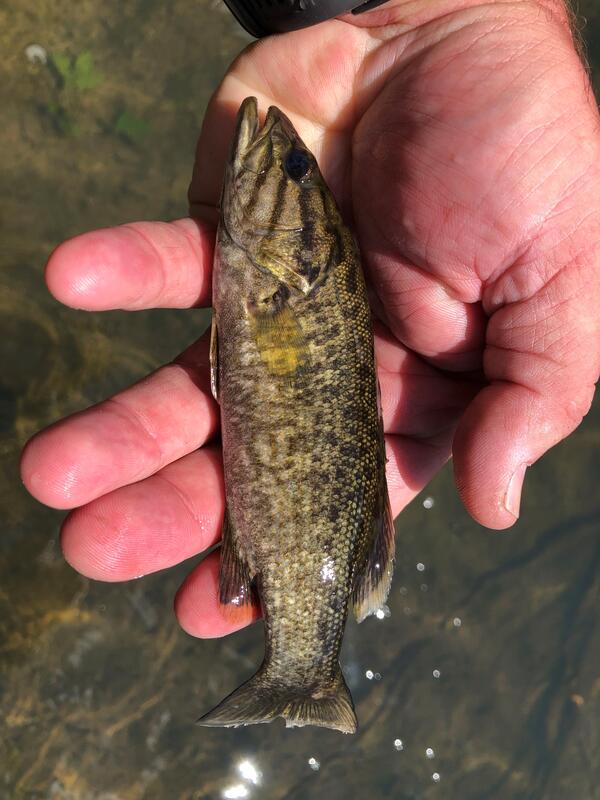
Smallmouth bass (Figure 1) are important gamefish and apex predators in the Chesapeake Bay watershed, yet few studies have assessed why their growth rates vary across locations and over time. Growth rates determine how quickly individuals can reach larger body sizes, which are typically associated with higher survival rates and greater economic benefits than smaller individuals. Numerous environmental and internal factors affect how quickly fish grow, and a lack of information about these factors makes it challenging for fisheries managers to predict how smallmouth bass populations may respond to changing watershed conditions.
USGS Study
The USGS partnered with the Pennsylvania Fish and Boat Commission to compile a 36‑year dataset (from 1986 to 2022) comprised of 54,068 individual smallmouth bass measurements collected across ten river reaches in Pennsylvania. The dataset spans a range of temperature and streamflow and includes a major disease outbreak that began in 2005. Using a von Bertalanffy growth model, researchers predicted early‑life growth rates across these different conditions and assessed the effects of temperature, streamflow, population abundance, and disease outbreak on smallmouth bass early‑life growth rates.
Major Findings
- Warmer temperatures were associated with increased early‑life growth rates, particularly for populations that did not experience any major disease outbreaks (Figure 1A).
- A disease outbreak in 2005 was associated with a rapid increase in early‑life growth rates, likely driven by a decrease in population abundance (Figure 1B).
- Streamflow showed no significant effect on smallmouth bass early‑life growth rate.

Management Implications
The findings from this study highlight several important factors affecting early‑life growth rates of smallmouth bass. Warmer temperatures can increase early‑life growth rates; however, other studies have shown that warm waters can reduce overall body sizes. Therefore, smallmouth bass populations may grow faster but stop growing at a smaller size in warmer waters. As water temperatures warm, disease outbreaks are expected to become more frequent, and disruptive events – such as the outbreak captured in this study – could play an important role in shaping growth trajectories. Land use and similar landscape‑scale factors can also affect instream conditions and growth rates. By considering these combined influences, managers can better anticipate how population growth is expected to progress, and they can more effectively use current data to inform management strategies.
For More Information
The full study is published online with open access: https://doi.org/10.1111/eff.70063.
Understanding the factors that affect growth rates of commercially and recreationally important fish species can help fisheries managers make informed stock‑assessment and fishing‑regulation decisions. In this study of smallmouth bass in Pennsylvania rivers, USGS scientists found that warmer temperatures were associated with increased early‑life growth rates, and that growth rates increased following a disease outbreak.
Issue
Smallmouth bass (Figure 1) are important gamefish and apex predators in the Chesapeake Bay watershed, yet few studies have assessed why their growth rates vary across locations and over time. Growth rates determine how quickly individuals can reach larger body sizes, which are typically associated with higher survival rates and greater economic benefits than smaller individuals. Numerous environmental and internal factors affect how quickly fish grow, and a lack of information about these factors makes it challenging for fisheries managers to predict how smallmouth bass populations may respond to changing watershed conditions.
USGS Study
The USGS partnered with the Pennsylvania Fish and Boat Commission to compile a 36‑year dataset (from 1986 to 2022) comprised of 54,068 individual smallmouth bass measurements collected across ten river reaches in Pennsylvania. The dataset spans a range of temperature and streamflow and includes a major disease outbreak that began in 2005. Using a von Bertalanffy growth model, researchers predicted early‑life growth rates across these different conditions and assessed the effects of temperature, streamflow, population abundance, and disease outbreak on smallmouth bass early‑life growth rates.
Major Findings
- Warmer temperatures were associated with increased early‑life growth rates, particularly for populations that did not experience any major disease outbreaks (Figure 1A).
- A disease outbreak in 2005 was associated with a rapid increase in early‑life growth rates, likely driven by a decrease in population abundance (Figure 1B).
- Streamflow showed no significant effect on smallmouth bass early‑life growth rate.
Management Implications
The findings from this study highlight several important factors affecting early‑life growth rates of smallmouth bass. Warmer temperatures can increase early‑life growth rates; however, other studies have shown that warm waters can reduce overall body sizes. Therefore, smallmouth bass populations may grow faster but stop growing at a smaller size in warmer waters. As water temperatures warm, disease outbreaks are expected to become more frequent, and disruptive events – such as the outbreak captured in this study – could play an important role in shaping growth trajectories. Land use and similar landscape‑scale factors can also affect instream conditions and growth rates. By considering these combined influences, managers can better anticipate how population growth is expected to progress, and they can more effectively use current data to inform management strategies.
For More Information
The full study is published online with open access: https://doi.org/10.1111/eff.70063.