



Branching out: New study reveals when invasive pythons take to the trees
Effective management of invasive species often depends on not only understanding where the species lives, but how it behaves. In Big Cypress National Preserve, USGS scientists are uncovering new insights into the behavior of one of Florida’s most prolific invasive snakes – the Burmese python. A new study provides important context for understanding and managing this formidable snake.
Insights for python management
Burmese pythons are often described as habitat generalists because they can occur in many different environments in southern Florida. This study adds an important layer to that understanding: the way pythons use their environment changes depending on their size, life stage, and time of year.
Burmese pythons are notoriously difficult to find. Their low detectability is one of the major challenges that managers face in their effort to control this invasion. At present, researchers have estimated that the probability of detecting an individual can be less than 5%.
Although climbing trees is relatively uncommon, it may serve important functions for individual snakes, particularly basking during cooler periods. Understanding these patterns can help researchers better understand how Burmese pythons interact with the Greater Everglades ecosystem and give managers additional information for detecting and removing this difficult-to-find invasive species.
When most people picture a Burmese python in the Florida Everglades, they might imagine a large snake moving along the ground through wetlands or tall grasses. However, observations of pythons in the wild show that these invasive snakes sometimes take to trees. While this phenomenon has been observed on occasion, resource managers need more precise information about arboreal habitat use by pythons to inform effective tracking and removal of this invasive reptile.
In a new study from the USGS and collaborators, scientists examined when and how invasive Burmese pythons use trees and shrubs in southern Florida. Researchers radio-tracked 188 adults and 168 juvenile pythons in Big Cypress National Preserve between 2017 and 2024, documenting habitat use in more than 4000 data points.
While researchers did find that both adult and juvenile pythons use arboreal habitat, this behavior was relatively uncommon: less than 3% of all snake observations involved individuals in trees or shrubs. Only about 14% of adult pythons and 17% of juveniles included in the study were observed using arboreal habitat at least once, suggesting that while they are not primarily tree-dwellers, they may use vegetation strategically under specific circumstances. Understanding what these circumstances are could help inform snake management practices.
Tree use varied by python age
One of the clearest patterns was the difference between juvenile and adult pythons. Juvenile pythons used arboreal habitat more frequently than adults. The researchers suggest this may represent an ontogenetic shift, meaning that habitat use changes as an animal grows. Smaller pythons may be better able to navigate branches and other vegetation, while adult snakes with a larger body size may find climbing more difficult.
Researchers also found that the probability of observing a python in a tree generally decreased as its weight increased. The most common observations were from smaller, lighter weight snakes. However, trees with strong branches, such as Brazilian pepper trees and live oaks, were able to support some of the largest pythons.
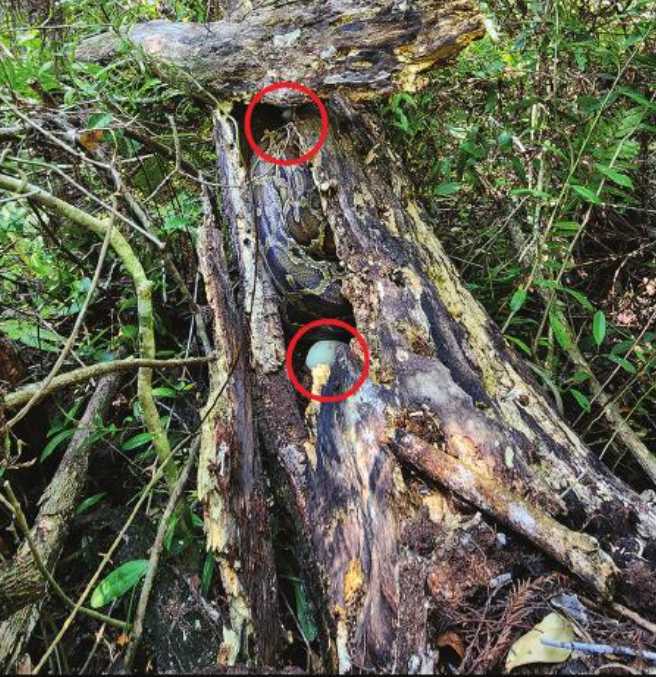
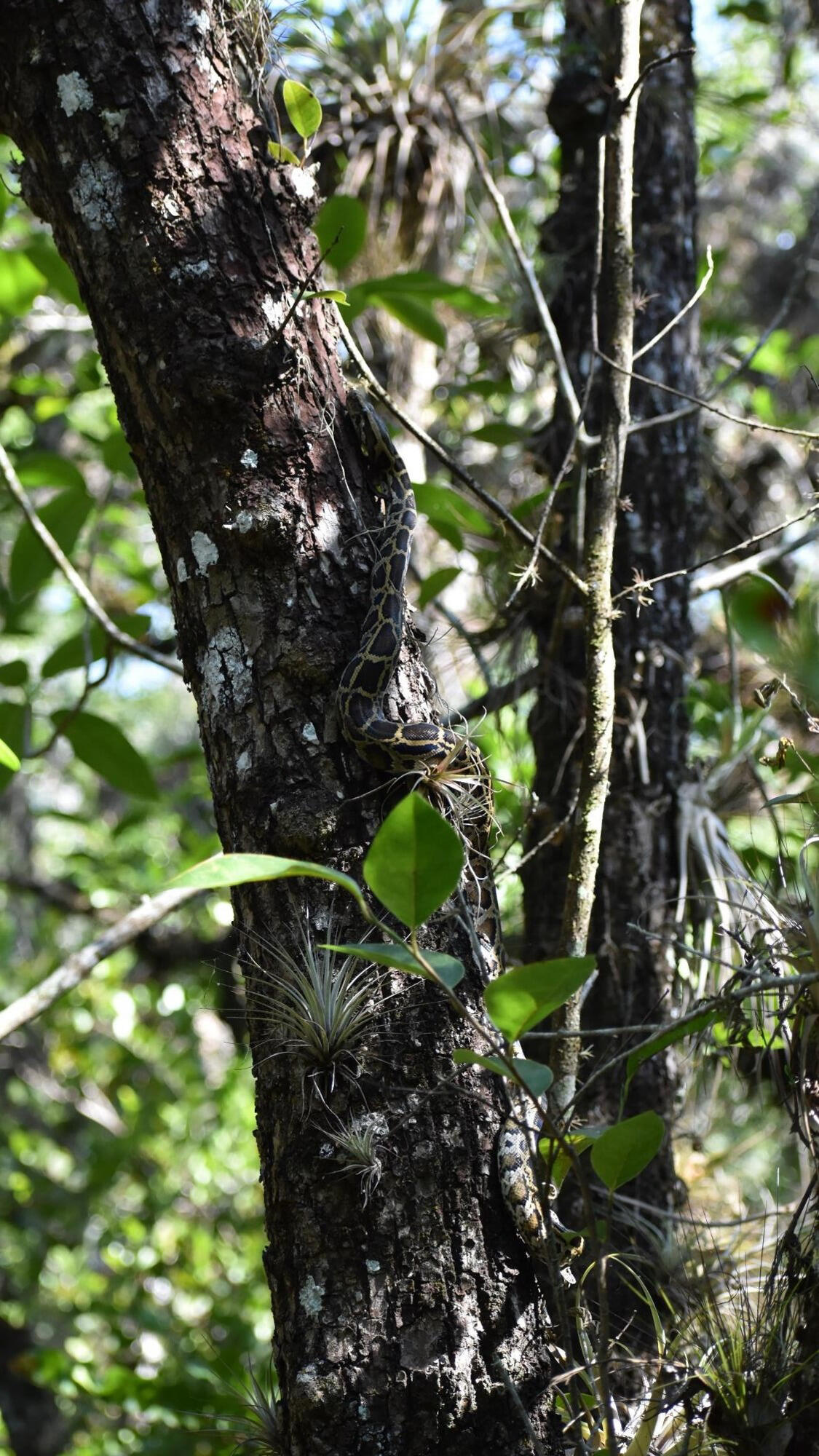
Background image: a juvenile python climbs a tree in Big Cypress National Preserve.
Seasonal influence
Both juvenile and adult pythons were more likely to use arboreal habitat during the cooler, dry season, particularly in December and January. Most adult pythons observed in trees during these months were basking, a behavior that allows reptiles to absorb heat from their surroundings and regulate their body temperature. Researchers therefore suggest that pythons may be using trees and shrubs during dryer cooler months to maintain high body temperature.
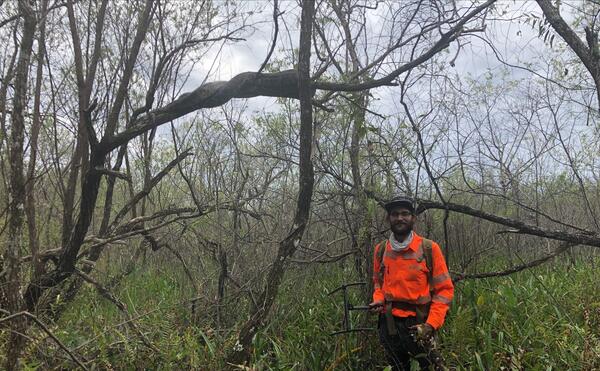
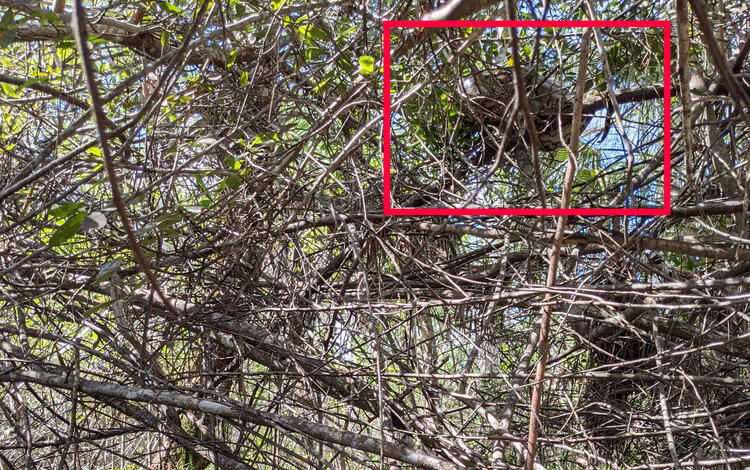
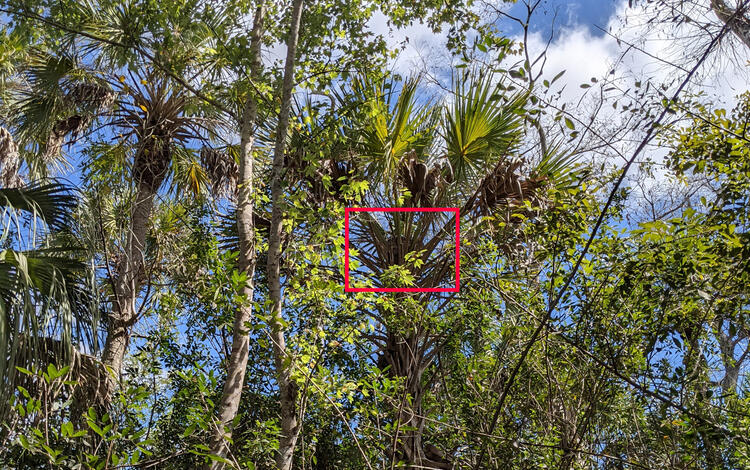
Below: A male adult python was first found basking on top of Brazilian peppertree 5 meters above ground and then ascended to the crown of a cabbage palm tree that was 7 meters above ground in February 2022. Researchers captured both phenomena on camera.
Implications for native fauna
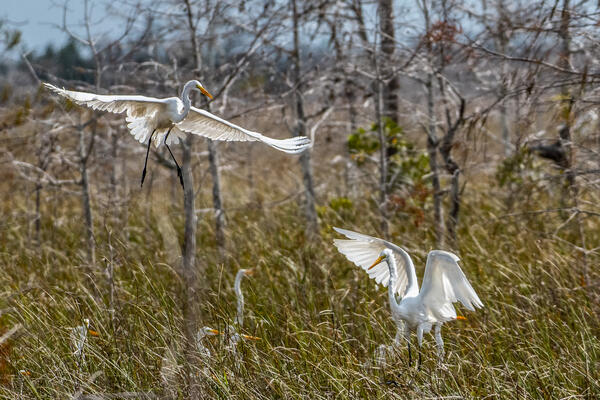
The findings may also have implications for native wildlife. Researchers did not observe Burmese pythons preying on birds in trees during this study. However, previous studies have documented Burmese pythons preying on bird nests in the Everglades, including nests of Great Egrets and White Ibises. This is particularly concerning because the period when adult pythons are most likely to use arboreal habitat overlaps with the nesting season of several wading-bird species.
This does not mean that tree use demonstrated in this study is causing declines in bird populations. Rather, it identifies an additional behavior that could bring an invasive predator into contact with vulnerable animals and highlights an area for continued research.
Related
Invasive Burmese python research in the Greater Everglades
Related