Sarah R Sherburne
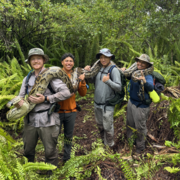
Sarah Sherburne is a biologist with the U.S. Geological Survey specializing in invasive species research to support science-based management strategies.
Sarah's work focuses on invasive reptiles in South Florida, particularly large constrictor snakes like Burmese pythons and tegu lizards. Through her research-supporting role, Sarah contributes to improving detection, monitoring, and control efforts for these ecologically disruptive species.
Sarah brings a unique blend of field expertise and data management to her role. With a passion for both hands-on research and digital innovation, she describes herself as a data manager who isn’t afraid to get muddy in Florida’s swamps. Her experience spans a wide range of species that have included wild hogs, bats, tortoises, mongooses, and king cobras. She specializes in spatial analysis to better understand animal movement and habitat use while also mentoring the next generation of biologists.
Professional Experience
Biologist, US Geological Survey, 2023–Present
Education and Certifications
MSc in Natural Resource Management, King Mongkut's University of Technology Thronburi, Bangkok
BSc in Biology, University of Eastern Michigan, Ypsilanti
Science and Products
Invasive Burmese python research in the Greater Everglades
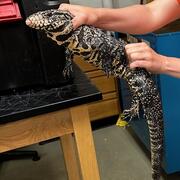
Early detection and rapid response tools for invasive tegu lizards
Consumption of a non-native Walking Catfish (Clarias batrachus) by a Florida Green Watersnake (Nerodia floridana) in Everglades National Park Consumption of a non-native Walking Catfish (Clarias batrachus) by a Florida Green Watersnake (Nerodia floridana) in Everglades National Park
An Eastern Ribbonsnake, Thamnophis sauritus (Linnaeus, 1766), scavenging on a roadkilled Cuban Treefrog, Osteopilus septentrionalis, (Duméril & Bibron, 1841), in Everglades National Park, Florida, USA An Eastern Ribbonsnake, Thamnophis sauritus (Linnaeus, 1766), scavenging on a roadkilled Cuban Treefrog, Osteopilus septentrionalis, (Duméril & Bibron, 1841), in Everglades National Park, Florida, USA
An early detection rapid response case study of the Black and White Tegu (Salvator merianae) and implications for a broader framework An early detection rapid response case study of the Black and White Tegu (Salvator merianae) and implications for a broader framework
Non-USGS Publications**
**Disclaimer: The views expressed in Non-USGS publications are those of the author and do not represent the views of the USGS, Department of the Interior, or the U.S. Government.
Science and Products
Invasive Burmese python research in the Greater Everglades
Early detection and rapid response tools for invasive tegu lizards
Consumption of a non-native Walking Catfish (Clarias batrachus) by a Florida Green Watersnake (Nerodia floridana) in Everglades National Park Consumption of a non-native Walking Catfish (Clarias batrachus) by a Florida Green Watersnake (Nerodia floridana) in Everglades National Park
An Eastern Ribbonsnake, Thamnophis sauritus (Linnaeus, 1766), scavenging on a roadkilled Cuban Treefrog, Osteopilus septentrionalis, (Duméril & Bibron, 1841), in Everglades National Park, Florida, USA An Eastern Ribbonsnake, Thamnophis sauritus (Linnaeus, 1766), scavenging on a roadkilled Cuban Treefrog, Osteopilus septentrionalis, (Duméril & Bibron, 1841), in Everglades National Park, Florida, USA
An early detection rapid response case study of the Black and White Tegu (Salvator merianae) and implications for a broader framework An early detection rapid response case study of the Black and White Tegu (Salvator merianae) and implications for a broader framework
Non-USGS Publications**
**Disclaimer: The views expressed in Non-USGS publications are those of the author and do not represent the views of the USGS, Department of the Interior, or the U.S. Government.