



FORT Science in Action, Part 13: Predictive genetic tools for guiding resource management
FORT scientists developed a flexible simulation model to predict the genetic consequences of planned, proposed, or previously implemented management actions, supporting resource managers in their efforts to effectually manage healthy wildlife populations.
Wildlife management occurs among multiple competing land uses that may require active or ongoing interventions. Species in decline or with limited habitat may be managed with augmentation (that is, introducing individuals into existing populations) while species with high growth rates may require population reduction to minimize resource overexploitation or conflict. Species with limited habitat and high growth rates may require augmentation and population reductions (for example, feral horses and bison). How these actions are implemented can affect genetic retention, a long-term proxy for population health and persistence, in unintuitive ways.
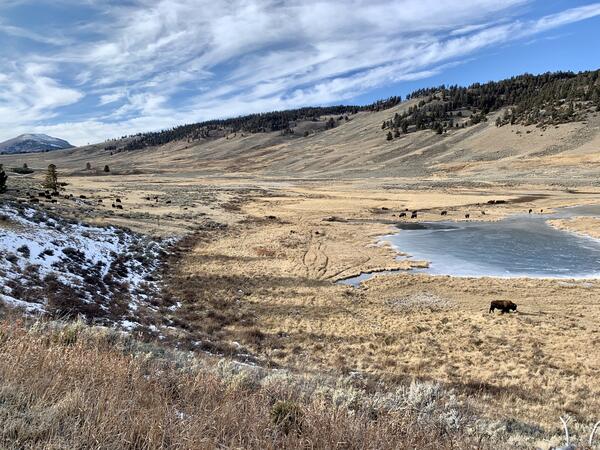
Genetic predictions for management strategies can guide selection of actions or provide insight on expected outcomes. They are a science-based approach for facilitating management decisions, evaluating outcomes, increasing the likelihood of positive outcomes, reducing the risk of wasted efforts (e.g., cost of implementation), and fine-tuning strategies. To facilitate genetic predictions for wildlife managers, FORT geneticists developed a new software: cgSim.
Using cgSim FORT scientists have collaborated with the Bureau of Land Management to generate predictions that facilitate selection among alternative feral horse management strategies. They have also worked with the State of Washington to predict the genetic consequences of sage-grouse augmentation and understand effectiveness of management actions. Additionally, genetic predictions have been an integral part of the collaborative DOI Bison Metapopulation Strategy.
Commercial and scientific genetic simulation software are widely available but are often difficult to implement and have limited flexibility regarding biological parameters and modeling management strategies. FORT scientists are uniquely suited to work with agencies to tailor the modeling framework to the species or strategies relevant to managers. Modeling projects for sharp-tailed grouse in Washington State, bison in Yellowstone National Park, and feral horses in Theodore Roosevelt National Park are ongoing.
More FORT Science in Action
This September, FORT is highlighting how our science projects support sound decision-making. Each day, we will highlight a new project and its applications. To see more, follow the tab below.
FORT Science in Action, Part 12
FORT Science in Action, Part 14
Related

Molecular Ecology Lab (MEL)

Research to support conservation of America’s national mammal, the bison

Fish and wildlife science in support of heritage preservation, efficient decision making, wild ungulate management, and outdoor recreation
Related
Molecular Ecology Lab (MEL)
Research to support conservation of America’s national mammal, the bison