



KWIC Science: Rapid response products to meet resource managers’ priority science needs
Federal public land managers in the US are required by law to use science to inform management decisions. However, managers have limited time to identify science for use in decision making. Literature reviews are one tool to efficiently summarize science for use by managers, but are time-consuming to produce.
Keyword in Context (KWIC) text analysis is a straightforward method of locating specific keywords within a document. USGS researchers have applied KWIC to rapidly identify and characterize relevant research for resource managers within large bodies of science, while ensuring repeatability and defensibility of land management decisions. The result is a new science product – semi-automated annotated bibliographies – and software that facilitates their development. This software quantifies the presence of user-specified keywords in the main text of publications using a simple and customizable code in R, and produces visualizations that summarize information about the publications.
Automating content analysis with KWIC
Quality science is foundational to the analysis of how proposed actions might impact public lands resources and values. However, it can be difficult for resource managers to find relevant science within the growing body of scientific literature.
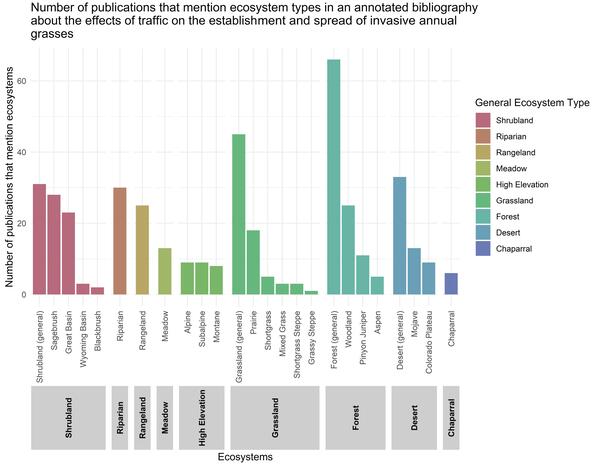
Scientists at USGS recently developed KWICer, a code using KWIC text analysis to rapidly produce an annotated bibliography from a large volume of scientific literature. Outputs include:
- A list of publications that have been determined to be relevant to a specific management question.
- A dataset containing details about each publication, including title and abstract, as well as information on how often user-supplied search terms occur within each publication.
- A set of figures displaying the frequency that different states and provinces or ecosystem types are referenced across the list of publications.
- A heatmap displaying the number of products that mention intersecting search terms typically related to the proposed action and resource of concern.
This information can help users determine which individual products within the list of publications are most relevant to their needs, and synthesize basic information about the nature and content of those publications.
Published bibliographies
To meet the needs of management partners, USGS scientists have used the KWICer software to publish multiple rapid-response annotated bibliographies for specific management issues. Explore the published annotated bibliographies:
Effects of traffic on the establishment and spread of invasive annual grasses
Effects of vegetation and soils surface disturbance and reclamation on invasive annual grasses
Effects of fire and post-fire management on soil condition and stability in North America

Developing structured science syntheses for use in NEPA analyses and decision making in the Bureau of Land Management

USGS Science Syntheses for Public Lands Management

Developing searchable annotated bibliographies for resource managers
Federal public land managers in the US are required by law to use science to inform management decisions. However, managers have limited time to identify science for use in decision making. Literature reviews are one tool to efficiently summarize science for use by managers, but are time-consuming to produce.
Keyword in Context (KWIC) text analysis is a straightforward method of locating specific keywords within a document. USGS researchers have applied KWIC to rapidly identify and characterize relevant research for resource managers within large bodies of science, while ensuring repeatability and defensibility of land management decisions. The result is a new science product – semi-automated annotated bibliographies – and software that facilitates their development. This software quantifies the presence of user-specified keywords in the main text of publications using a simple and customizable code in R, and produces visualizations that summarize information about the publications.
Automating content analysis with KWIC
Quality science is foundational to the analysis of how proposed actions might impact public lands resources and values. However, it can be difficult for resource managers to find relevant science within the growing body of scientific literature.
Scientists at USGS recently developed KWICer, a code using KWIC text analysis to rapidly produce an annotated bibliography from a large volume of scientific literature. Outputs include:
- A list of publications that have been determined to be relevant to a specific management question.
- A dataset containing details about each publication, including title and abstract, as well as information on how often user-supplied search terms occur within each publication.
- A set of figures displaying the frequency that different states and provinces or ecosystem types are referenced across the list of publications.
- A heatmap displaying the number of products that mention intersecting search terms typically related to the proposed action and resource of concern.
This information can help users determine which individual products within the list of publications are most relevant to their needs, and synthesize basic information about the nature and content of those publications.
Published bibliographies
To meet the needs of management partners, USGS scientists have used the KWICer software to publish multiple rapid-response annotated bibliographies for specific management issues. Explore the published annotated bibliographies:
Effects of traffic on the establishment and spread of invasive annual grasses
Effects of vegetation and soils surface disturbance and reclamation on invasive annual grasses
Effects of fire and post-fire management on soil condition and stability in North America
Developing structured science syntheses for use in NEPA analyses and decision making in the Bureau of Land Management
USGS Science Syntheses for Public Lands Management