



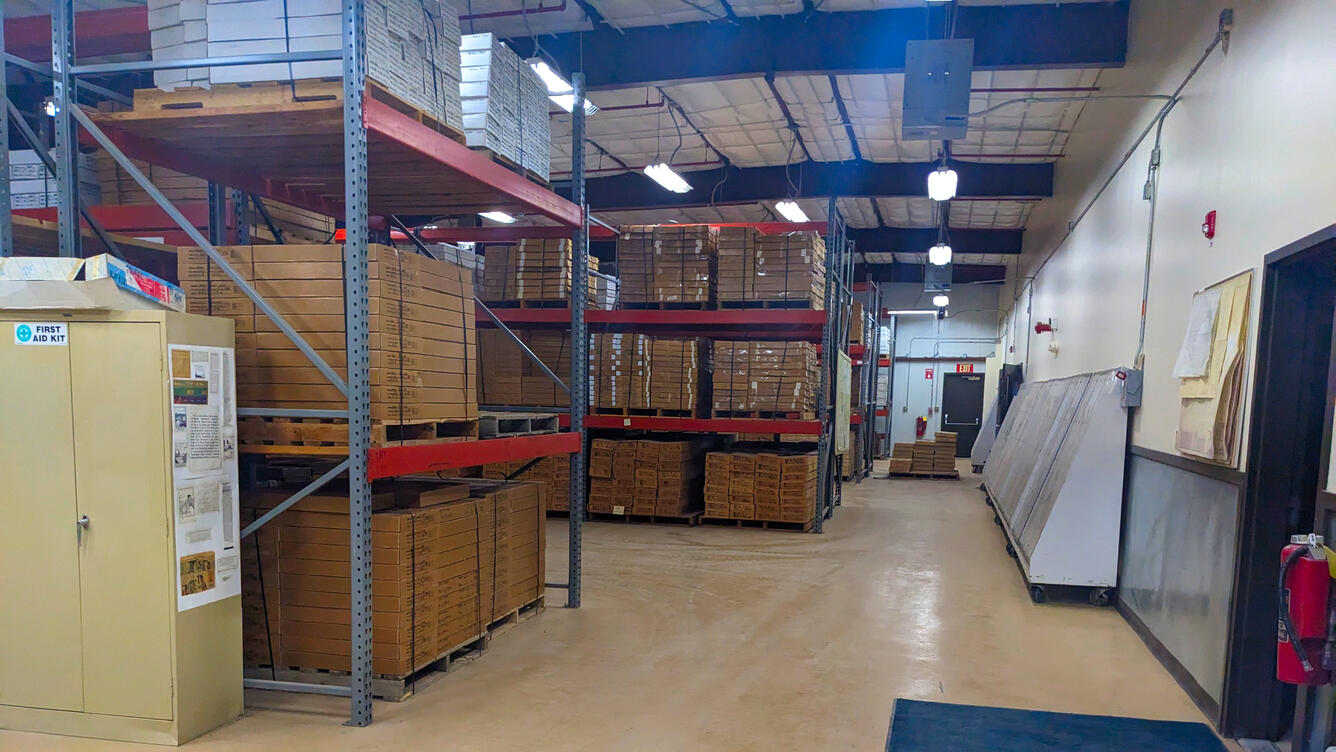
Established in 1990, the INL Lithologic Core Storage Library serves as a centralized facility for the consolidation, cataloging, and permanent storage of nonradioactive drill cores and cuttings from subsurface investigations at and around the Idaho National Laboratory (INL). The library currently houses over 100,000 feet of drill core and cuttings, with new additions made annually. It provides researchers with a dedicated space to examine, sample, and test the stored materials. Researchers interested in accessing the Core Storage Library must contact INLPO personnel in advance to confirm core availability and complete any necessary paperwork.
Core Library Functions
The INL Lithologic Core Storage Library performs several key functions:
- Core Transportation: Locate and transport existing core from INL and other facilities to the Core Storage Library.
- Core Processing: Accept and process newly drilled core and existing core from USGS and contractor projects, cataloging them using a computerized database.
- Chain-of-Custody Maintenance: Maintain chain-of-custody records for newly drilled core upon request.
- Permanent Storage: Store core in an organized and easily retrievable manner across 12,500 square feet of storage space located in the Central Facilities Area of INL.
- Lithologic Logging: Conduct lithologic logging on select cores to support USGS, INL, and collaborating researchers by describing the physical properties of the core.
- Sample Preparation and Testing: Operate the Sample Preparation Room and Laboratory for examination, testing, and sampling of core by USGS, DOE, university faculty and students, INL contractors, and other legitimate research entities.
- Database Management: Maintain a computerized database to track core availability, analyses performed, and data collected on cores and core samples.
- Preservation: Ensure the integrity of stored core for future research.
Logging Core
Lithologic logs have been conducted on over 50 coreholes at and near the Idaho National Laboratory. These logs are created using a standardized procedure developed by the USGS INL Project Office, which emphasizes detailed descriptions while minimizing interpretation. The logs include:
- Photographs of the core arranged to create a continuous column representation.
- Descriptions of igneous and sedimentary structures.
- Lithologic characterizations detailing color, texture, composition, and alteration.
- Numeric values for fracture frequency.
- Graphs illustrating mean vesicle size and vesicle volume percentage.
Sample Preparation Laboratory
The Core Storage Library features a Sample Preparation Room equipped for examination and sampling of core. Key features include:
- Space for laying out 300–400 feet of core at a time.
- Equipment such as binocular and petrographic microscopes, hand lenses, and various hand tools.
- Photographic equipment, including a digital camera and photo jig for documentation.
- Adjacent laboratory space for further examination, sampling, or testing, equipped with soil drying ovens, rock saws, drill presses, and standard laboratory glassware.

Procedure for Delivering Core
To archive core at the Core Storage Library, INL contractors or other entities must submit a paper or electronic notice (preferably before drilling) to the INLPO Project Chief (Hodges and others, 2018). If the core was not drilled by USGS crews, it must be surveyed by a radiological control technician, and a radiological report must accompany the core for acceptance. Additionally, chain-of-custody information must be submitted with the core storage request.
Procedure for Studying Core
The Core Storage Library is open to researchers for examining, sub-sampling, or testing cores. However, access is restricted, and permission must be obtained prior to arrival (Hodges and others, 2018). Appointments can be made by contacting the U.S. Geological Survey Idaho National Laboratory Project Office at (208) 526-2438 or via email at gs-w-idif_ineel_federal_employees@usgs.gov.
Access Requirements:
- U.S. citizens require a minimum of 5 business days for access arrangements.
- Non-U.S. citizens may need 30–90 business days, depending on their country of origin.
- Visitor identification must meet REAL ID requirements as specified by the U.S. Department of Homeland Security.
The Core Storage Library operates Monday through Thursday, 7:30 a.m. to 5:00 p.m., with special arrangements available upon request. Researchers must provide a statement of proposed research detailing the project’s purpose, scope, and analyses to be performed.
Researchers are encouraged to conduct their own sampling after approval. Core Library personnel can assist with machinery operation and sample recording. Under limited circumstances, personnel may sample core for researchers if fewer than 20 samples are requested and arrangements are made in advance.
All borrowed samples must be returned with a description of the material taken and analyses performed. Researchers are encouraged to donate clearly marked thin sections for archiving. A Material Safety Data Sheet must be provided for any chemicals brought into the laboratory.
Established in 1990, the INL Lithologic Core Storage Library serves as a centralized facility for the consolidation, cataloging, and permanent storage of nonradioactive drill cores and cuttings from subsurface investigations at and around the Idaho National Laboratory (INL). The library currently houses over 100,000 feet of drill core and cuttings, with new additions made annually. It provides researchers with a dedicated space to examine, sample, and test the stored materials. Researchers interested in accessing the Core Storage Library must contact INLPO personnel in advance to confirm core availability and complete any necessary paperwork.
Core Library Functions
The INL Lithologic Core Storage Library performs several key functions:
- Core Transportation: Locate and transport existing core from INL and other facilities to the Core Storage Library.
- Core Processing: Accept and process newly drilled core and existing core from USGS and contractor projects, cataloging them using a computerized database.
- Chain-of-Custody Maintenance: Maintain chain-of-custody records for newly drilled core upon request.
- Permanent Storage: Store core in an organized and easily retrievable manner across 12,500 square feet of storage space located in the Central Facilities Area of INL.
- Lithologic Logging: Conduct lithologic logging on select cores to support USGS, INL, and collaborating researchers by describing the physical properties of the core.
- Sample Preparation and Testing: Operate the Sample Preparation Room and Laboratory for examination, testing, and sampling of core by USGS, DOE, university faculty and students, INL contractors, and other legitimate research entities.
- Database Management: Maintain a computerized database to track core availability, analyses performed, and data collected on cores and core samples.
- Preservation: Ensure the integrity of stored core for future research.
Logging Core
Lithologic logs have been conducted on over 50 coreholes at and near the Idaho National Laboratory. These logs are created using a standardized procedure developed by the USGS INL Project Office, which emphasizes detailed descriptions while minimizing interpretation. The logs include:
- Photographs of the core arranged to create a continuous column representation.
- Descriptions of igneous and sedimentary structures.
- Lithologic characterizations detailing color, texture, composition, and alteration.
- Numeric values for fracture frequency.
- Graphs illustrating mean vesicle size and vesicle volume percentage.
Sample Preparation Laboratory
The Core Storage Library features a Sample Preparation Room equipped for examination and sampling of core. Key features include:
- Space for laying out 300–400 feet of core at a time.
- Equipment such as binocular and petrographic microscopes, hand lenses, and various hand tools.
- Photographic equipment, including a digital camera and photo jig for documentation.
- Adjacent laboratory space for further examination, sampling, or testing, equipped with soil drying ovens, rock saws, drill presses, and standard laboratory glassware.
Procedure for Delivering Core
To archive core at the Core Storage Library, INL contractors or other entities must submit a paper or electronic notice (preferably before drilling) to the INLPO Project Chief (Hodges and others, 2018). If the core was not drilled by USGS crews, it must be surveyed by a radiological control technician, and a radiological report must accompany the core for acceptance. Additionally, chain-of-custody information must be submitted with the core storage request.
Procedure for Studying Core
The Core Storage Library is open to researchers for examining, sub-sampling, or testing cores. However, access is restricted, and permission must be obtained prior to arrival (Hodges and others, 2018). Appointments can be made by contacting the U.S. Geological Survey Idaho National Laboratory Project Office at (208) 526-2438 or via email at gs-w-idif_ineel_federal_employees@usgs.gov.
Access Requirements:
- U.S. citizens require a minimum of 5 business days for access arrangements.
- Non-U.S. citizens may need 30–90 business days, depending on their country of origin.
- Visitor identification must meet REAL ID requirements as specified by the U.S. Department of Homeland Security.
The Core Storage Library operates Monday through Thursday, 7:30 a.m. to 5:00 p.m., with special arrangements available upon request. Researchers must provide a statement of proposed research detailing the project’s purpose, scope, and analyses to be performed.
Researchers are encouraged to conduct their own sampling after approval. Core Library personnel can assist with machinery operation and sample recording. Under limited circumstances, personnel may sample core for researchers if fewer than 20 samples are requested and arrangements are made in advance.
All borrowed samples must be returned with a description of the material taken and analyses performed. Researchers are encouraged to donate clearly marked thin sections for archiving. A Material Safety Data Sheet must be provided for any chemicals brought into the laboratory.