U.S. flag

An official website of the United States government

Publications

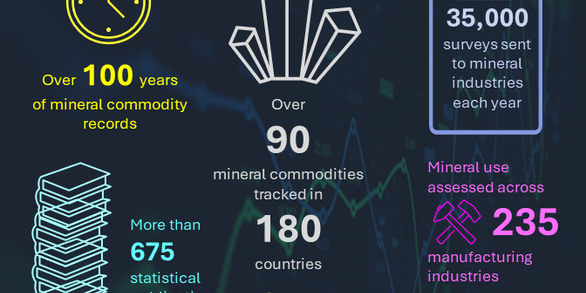
The Center publishes analyses critical to national security on domestic and international mineral supply chains.

Filter Total Items: 606

Mineral resource of the month: lead Mineral resource of the month: lead

The United States is a major producer and consumer of refined lead, representing almost one quarter of total world production and consumption. Two mines in Alaska and six in Missouri accounted for 97 percent of domestic lead production in 2002. The United States also imports enough refined lead to satisfy almost 20 percent of domestic consumption. Other major producers or consumers of...
Authors
David Guberman

Peat Peat

Peat is a natural organic material of botanical origin and commercial significance. Peatlands are situated predominately in shallow wetland areas of the Northern Hemisphere. Commercial deposits are formed from the gradual decomposition of plant matter under anaerobic conditions over about a 5,000-year period.
Authors
S.M. Jasinski

Nitrogen Nitrogen

The ammonia industry partially recovered from the effects of high natural gas prices that had closed a significant portion of the industry in 2001. Ammonia production capacity in the United States in 2002 was about 17.1 Mt (18.8 million st). About 53 percent of this capacity was centered in Louisiana, Oklahoma and Texas where there are large reserves of natural gas.
Authors
D. Kramer

Bentonite Bentonite

Part of the 2002 industrial minerals review. Production, consumption, cost, and trade data for bentonite during 2002 are presented. Predictions on bentonite markets in 2003 are also provided.
Authors
R. Virta

Ball clay Ball clay

Part of the 2002 industrial minerals review. Statistics on ball clay consumption, production, prices, trade, and trends are presented.
Authors
R.L. Virta

Pumice and pumicite Pumice and pumicite

The estimated domestic production of pumice and pumicite in 2002 was 950 kt (1.04 million st), a 3.2 percent increase compared with the revised total of 2001, according to the U.S. Geological Survey (USGS). The amount of pumice and pumicite sold or used in the United States was revised for the years 1998 through 2001 in the USGS Mineral Commodity Summaries, 2003.
Authors
W.P. Bolen

Mineral resource of the month: sulfur Mineral resource of the month: sulfur

Since domestic sulfur production peaked at nearly 11 million metric tons in 1974, the sulfur industry has undergone dramatic change. In 1974, mined sulfur produced using the Frasch hot water method provided 8 million tons of sulfur, representing 75 percent of total elemental sulfur production. (In the Frasch process, hot water is injected directly into the sulfur-containing mineral...
Authors
Joyce A. Ober

Common clay and shale Common clay and shale

Part of the 2002 industrial minerals review. The production, consumption, and price of shale and common clay in the U.S. during 2002 are discussed. The impact of EPA regulations on brick and structural clay product manufacturers is also outlined.
Authors
R.L. Virta

Strontium Strontium

Mexico and Spain are the leading producers of celestite, the most common strontium ore. Those countries produced nearly 80 percent of the estimated 360 kt (397,000 st) of celestite produced worldwide during 2002. China and Turkey are other significant celestite producers.
Authors
J.A. Ober

Mineral resource of the month: fluorspar Mineral resource of the month: fluorspar

Fluorspar, this month’s featured mineral resource commodity, has been widely used in steelmaking since the introduction of basic open-hearth furnace technology in the late 19th century. Its uses have grown and changed over the last 100 years, and now fluorspar’s most important markets are fluorochemicals, aluminum refining and steel. M. Michael Miller, Fluorspar Commodity Specialist for...
Authors
M. Michael Miller

Mineral resource of the month: germanium Mineral resource of the month: germanium

Germanium is a hard, brittle semimetal that first came into use over a half-century ago as a semiconductor material in radar units and in the first transistor ever made. Most germanium is recovered as a byproduct of zinc smelting, but it has also been recovered at some copper smelters and from the fly ash of coal-burning industrial power plants.
Authors
John D. Jorgenson

Mineral resource of the month: silicon Mineral resource of the month: silicon

In the industrialized world, silicon is as ubiquitous in the objects people use every day as it is in nature. The second most abundant element in Earth’s crust and more than 25 percent of the crust by weight, silicon is one of the most useful elements to humans.
Authors
Lisa A. Corathers
Was this page helpful?