An official website of the United States government
Here's how you know
Official websites use .gov
A .gov website belongs to an official government organization in the United States.
Secure .gov websites use HTTPS
A lock () or https:// means you’ve safely connected to the .gov website. Share sensitive information only on official, secure websites.
Zirconium and hafnium are corrosion-resistant metals that are grouped in the same family as titanium on the periodic table. The two elements commonly occur in oxide and silicate minerals and have significant economic importance in everything from ink, ceramics and golf shoes to nuclear fuel rods.
Thallium is known as a poison, its use initially suspected in the recent death of a Russian spy, but it has a variety of more important applications in everything from medical imaging to wireless communications.
Ammonia was produced by 15 companies at 25 plants in 16 states in the United States during 2006. Fifty-seven percent of U.S. ammonia production capacity was centered in Louisiana, Oklahoma and Texas because of their large reserves of natural gas, the dominant domestic feedstock. In 2006, U.S. producers operated at about 72 percent of their rated capacity (excluding plants that were idle...
Silver has been used for thousands of years as ornaments and utensils, for trade and as the basis of many monetary systems. The metal has played an important part in world history. Silver from the mines at Laurion, Greece, for example, financed the Greek victory over the Persians in 480 B.C. Silver from Potosi, Bolivia, helped Spain become a world power in the 16th and 17th centuries...
Vanadium, the name of which comes from Vanadis, a goddess in Scandinavian mythology, is one of the most important ferrous metals. Vanadium has many uses, but the metal’s metallurgical applications, such as an alloying element in iron and steel, account for more than 85 percent of U.S. consumption. The dominant nonmetallurgical use of the metal is as a catalyst for the production of...
In 2005, six companies mined fire clay in Missouri, Ohio and South Carolina. Production was estimate to be 300 kt with a value of $8.3 million. Missouri was the leading producer state followed by Ohio and South Carolina. For the third consecutive year, sales and use of fire clays have been relatively unchanged. For the next few years, sales of fire clay is forecasted to remain around 300...
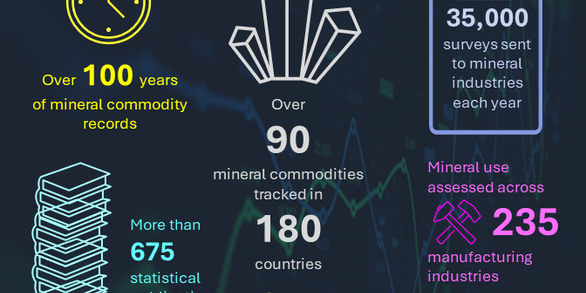
Published on an annual basis, this report is the earliest Government publication to furnish estimates covering nonfuel mineral industry data. Data sheets contain information on the domestic industry structure, Government programs, tariffs, and 5-year salient statistics for over 90 individual minerals and materials.
Lithium, the lightest metallic element, is silvery, white and soft, and highly reactive. It is used most frequently in chemical compounds or traded as mineral concentrates. Its thermal properties make it an ideal component in thermal shock-resistant ceramics, and its electrochemical properties make it an ideal material for several types of batteries.
At present, 150 companies produce common clay and shale in 41 US states. According to the United States Geological Survey (USGS), domestic production in 2005 reached 24.8 Mt valued at $176 million. In decreasing order by tonnage, the leading producer states include North Carolina, Texas, Alabama, Georgia and Ohio. For the whole year, residential and commercial building construction...
In 2005, NYCO Minerals and R.T. Vanderbilt mined wollastonite in the United States. Domestic production increased slightly from 2004. The plastic market accounted for 35%-40% of US sales followed by ceramics (25-30%), metallurgical applications (10%), paint (10%), friction products (10%) and miscellaneous (5%). Towards 2006, wollastonite producers are expected to face more technical and...
In 2005, four companies including H.C. Spinks Clay, Kentucky-Tennessee Clay, Old Hickory Clay and Unimin mined ball clay in four states. Based on a preliminary survey of the ball clay industry, production reached 1.32 Mt valued at $53.3 million. Tennessee was the leading ball clay producer state with 61% of domestic production, followed by Texas, Mississippi and Kentucky.