



USGS Research Informs Big Game Management—Mule Deer Sensitive to Temperature Extremes and Habitat Quality
To help inform big game-related restoration priorities, the USGS and their collaborators assessed the drivers of change in mule deer fawn-to-doe ratios over 20 years in Wyoming in summer and winter use areas.
Mule Deer in the West

Mule deer are an economically and ecologically important species that are widespread throughout the West. They are a valued big game species contributing millions of dollars to local and regional western economies through hunting. However, mule deer have declined in many parts of the West, including in Wyoming, which could lead to negative economic, ecological, and cultural consequences.
The Study
Scientists from the USGS Northern Rocky Mountain Science Center (NOROCK) and Wyoming Cooperative Fish and Wildlife Research Unit, Bureau of Land Management, National Park Service, Wyoming Game and Fish Department, and the University of Wyoming conducted a study as part of the Wyoming Landscape Conservation Initiative assessing drivers influencing mule deer fawn-to-doe ratios over 20 years in Wyoming.
- The numbers of deer fawns-to-does, called age ratios, reflect the number of juvenile mule deer being recruited into populations over time and is one metric of a population’s overall well-being that managers can assess.
- Researchers used location data from 1,473 GPS-collared female deer.
- Data included summer and winter use areas across the state of Wyoming.
- Researchers modeled seasonal habitat selection across Wyoming to assess the relative influence of habitat and weather on deer.
Moderate Temperatures and Quality Habitat
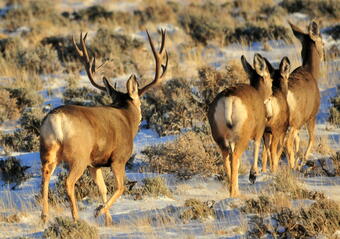
Scientists found that temperature had, by far, the strongest effect on age ratios and seasonal habitat suitability had the second strongest effect.
- Hotter summers and colder winters had negative effects on age ratios, so the number of juvenile mule deer being recruited into mule deer populations decreased in years following extreme temperatures.
- High-quality summer habitat and suitable winter habitat had positive effects on age ratios.
- During the summer, mule deer selected for habitat with non-sagebrush shrubs and perennial forbs and grasses while avoiding annuals.
- In the winter, mule deer selected for habitat containing winter forage like sagebrush and with warmer microclimates such as south-facing slopes and avoided habitat that had deep or dense snowpack—snowpack with a high water content.
- The effects of extreme temperatures on age ratios were 1.3 - 2.5 times stronger than the effect of habitat suitability.
Supporting Resource Managers and Big Game Management
The findings of this research can help guide mule deer management and inform restoration priorities to support big game populations and the economies they help sustain. Statewide habitat selection models can inform plans for conservation and development and highlight annual variability in habitat resources. Temperature played the largest role and is outside manager control; however, this research highlights where they can encourage positive results—supporting habitat improvements for mule deer, an important, but declining big game species in the American West. Actions that could benefit mule deer include:
- Continuing to improve mule deer summer habitat while preserving the current relatively high integrity of winter habitat. For example, retention of sagebrush supports a key component of mule deer diet in winter.
- Adopting practices to decrease soil moisture loss and support refugia to extreme temperatures, plus continued focus on suppressing invasive annual plants.
- Supporting native perennial plants, including drought-resistant species, especially during drought events.