



Bighorn Sheep and Mountain Goat Research in Western National Park Units
Mountain goat and bighorn sheep are iconic symbols of many national lands in the West and are economically important as big game species on some public lands and as tourist attractions in and around national parks. Both species have limited distributions that can be difficult to observe and face multiple stressors including disease, increasing recreation in remote areas, and shifting weather regimes that influence their forage and thermoregulation. As species with relatively small population sizes, understanding relationships between the landscape and populations provides useful information.
In collaboration with multiple parks and universities, USGS NOROCK is using genetic sampling, habitat use and movement models, and spatial capture-recapture methods to understand population status and trends and to connect anthropogenic and environmental stressors and resources to demographics in these relatively small populations.
PROJECTS

1) Mountain goats in Waterton-Glacier International Peace Park (Montana and Alberta, Canada)
The Waterton-Glacier International Peace Park is made up of Glacier National Park (Montana) and Waterton Lakes National Park (Alberta, Canada). NOROCK, in collaboration with the parks, is conducting research to support management of this iconic high elevation species. Scientists used Glacier National Park's citizen science dataset to quantify declines in mountain goat populations between 2008 and 2019 and that spring precipitation and temperature related to those declines. In 2022, park citizen scientists, USGS, Glacier National Park, and Waterton Lakes National Park collected fecal pellets across the full extent of the International Peace Park to evaluate genetic structure, estimate goat population size, and understand goat diets. Researchers found that goats in the Peace Park form a single, relatively well-connected population as of 2022. This information helped provide the two parks that make up the international peace park with important ecological and biological understanding and information to inform visitor use and other management questions.
This research resulted in a large collaboration assessing mountain goat population status across North America.
2) Rocky Mountain bighorn sheep in Glacier National Park (Montana)
Long-term research on bighorn sheep in Glacier National Park has evaluated multiple questions around bighorn sheep ecology including around their habitat use and contacts and their genetic relatedness and diversity. NOROCK, other USGS Science Centers, park scientists, and their collaborators assessed how fire and other landscape change, especially in forest cover, might influence movements between and within subpopulations identified in earlier research. These studies inform options for disease, habitat, and population management for Glacier National Park, Waterton Lakes National Park, and the Blackfeet Nation.
3) Rocky Mountain bighorn sheep in Dinosaur National Monument (Border of Colorado and Utah)
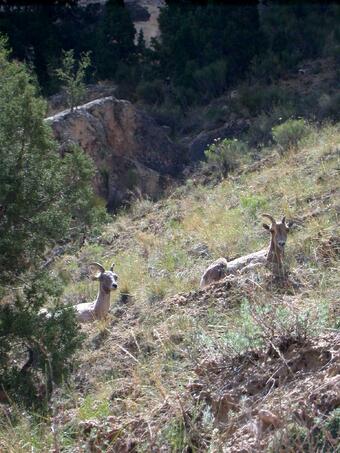
Bighorn sheep are one of the largest and most visible animals in Dinosaur National Monument. As a reintroduced population that is likely consistently exposed to respiratory disease, Monument managers have questions of how to best support this population, so NOROCK scientists worked with the National Park Service and other collaborators to evaluate the population. Researchers used fecal pellets collected by volunteers and park staff over three years, along with GPS collar data collected by NOROCK, to assess the genetic structure of the bighorn sheep population in the monument, estimate population size, and understand how current management and landscape conditions influence the distribution and density of the bighorn sheep. The estimated bighorn sheep population size in 2019 was ~105. The Monument’s bighorn sheep population is spatially structured into 4 genetically distinct subpopulations within a metapopulation. Subpopulation sizes are small, ranging from ~18-34, but have high genetic diversity. Bighorn sheep select rugged habitat near escape terrain (steep slopes) with open habitat and lower canopy cover, and animals tend to move along rivers rather than cross them, making the Green River a weak barrier to gene flow. Antibodies for respiratory pathogens were detected, including Mycoplasma ovipneumoniae—a bacterium causing pneumonia outbreaks in bighorn sheep. This study provides Monument managers with a framework to understand bighorn sheep population structure, habitat use, and potential pathogen threats, and can help tailor recreation and rangeland management strategies based on the needs of specific subpopulations.
4) Desert bighorn sheep in Grand Canyon National Park (Arizona)
In collaboration with park biologists, NOROCK scientists brought together multiple data sources to evaluate bighorn sheep population size and distribution. The scientists leveraged five years of fecal pellet sampling with GPS collar datasets, observations, and disease records along the Colorado River to evaluate disease effects during a respiratory disease outbreak. They also used spatial capture-recapture models to inform sampling along a linear corridor as a monitoring tool for the park and estimate bighorn sheep numbers.
5) Mountain goats in Grand Teton National Park (Wyoming)
NOROCK assessed potential sources of mountain goats that have migrated in and experienced increasing population sizes in Grand Teton National Park to inform park decisions related to goat removal. Mountain goats are an invasive species in this area and there were concerns over competition with native bighorn sheep.


Bighorn Sheep in and near Glacier National Park
Mountain goat and bighorn sheep are iconic symbols of many national lands in the West and are economically important as big game species on some public lands and as tourist attractions in and around national parks. Both species have limited distributions that can be difficult to observe and face multiple stressors including disease, increasing recreation in remote areas, and shifting weather regimes that influence their forage and thermoregulation. As species with relatively small population sizes, understanding relationships between the landscape and populations provides useful information.
In collaboration with multiple parks and universities, USGS NOROCK is using genetic sampling, habitat use and movement models, and spatial capture-recapture methods to understand population status and trends and to connect anthropogenic and environmental stressors and resources to demographics in these relatively small populations.
PROJECTS
1) Mountain goats in Waterton-Glacier International Peace Park (Montana and Alberta, Canada)
The Waterton-Glacier International Peace Park is made up of Glacier National Park (Montana) and Waterton Lakes National Park (Alberta, Canada). NOROCK, in collaboration with the parks, is conducting research to support management of this iconic high elevation species. Scientists used Glacier National Park's citizen science dataset to quantify declines in mountain goat populations between 2008 and 2019 and that spring precipitation and temperature related to those declines. In 2022, park citizen scientists, USGS, Glacier National Park, and Waterton Lakes National Park collected fecal pellets across the full extent of the International Peace Park to evaluate genetic structure, estimate goat population size, and understand goat diets. Researchers found that goats in the Peace Park form a single, relatively well-connected population as of 2022. This information helped provide the two parks that make up the international peace park with important ecological and biological understanding and information to inform visitor use and other management questions.
This research resulted in a large collaboration assessing mountain goat population status across North America.
2) Rocky Mountain bighorn sheep in Glacier National Park (Montana)
Long-term research on bighorn sheep in Glacier National Park has evaluated multiple questions around bighorn sheep ecology including around their habitat use and contacts and their genetic relatedness and diversity. NOROCK, other USGS Science Centers, park scientists, and their collaborators assessed how fire and other landscape change, especially in forest cover, might influence movements between and within subpopulations identified in earlier research. These studies inform options for disease, habitat, and population management for Glacier National Park, Waterton Lakes National Park, and the Blackfeet Nation.
3) Rocky Mountain bighorn sheep in Dinosaur National Monument (Border of Colorado and Utah)
Bighorn sheep are one of the largest and most visible animals in Dinosaur National Monument. As a reintroduced population that is likely consistently exposed to respiratory disease, Monument managers have questions of how to best support this population, so NOROCK scientists worked with the National Park Service and other collaborators to evaluate the population. Researchers used fecal pellets collected by volunteers and park staff over three years, along with GPS collar data collected by NOROCK, to assess the genetic structure of the bighorn sheep population in the monument, estimate population size, and understand how current management and landscape conditions influence the distribution and density of the bighorn sheep. The estimated bighorn sheep population size in 2019 was ~105. The Monument’s bighorn sheep population is spatially structured into 4 genetically distinct subpopulations within a metapopulation. Subpopulation sizes are small, ranging from ~18-34, but have high genetic diversity. Bighorn sheep select rugged habitat near escape terrain (steep slopes) with open habitat and lower canopy cover, and animals tend to move along rivers rather than cross them, making the Green River a weak barrier to gene flow. Antibodies for respiratory pathogens were detected, including Mycoplasma ovipneumoniae—a bacterium causing pneumonia outbreaks in bighorn sheep. This study provides Monument managers with a framework to understand bighorn sheep population structure, habitat use, and potential pathogen threats, and can help tailor recreation and rangeland management strategies based on the needs of specific subpopulations.
4) Desert bighorn sheep in Grand Canyon National Park (Arizona)
In collaboration with park biologists, NOROCK scientists brought together multiple data sources to evaluate bighorn sheep population size and distribution. The scientists leveraged five years of fecal pellet sampling with GPS collar datasets, observations, and disease records along the Colorado River to evaluate disease effects during a respiratory disease outbreak. They also used spatial capture-recapture models to inform sampling along a linear corridor as a monitoring tool for the park and estimate bighorn sheep numbers.
5) Mountain goats in Grand Teton National Park (Wyoming)
NOROCK assessed potential sources of mountain goats that have migrated in and experienced increasing population sizes in Grand Teton National Park to inform park decisions related to goat removal. Mountain goats are an invasive species in this area and there were concerns over competition with native bighorn sheep.