



Presumptive Candida Stomatitis in a Broad-Tailed Hummingbird (Selasphorus platycercus)
History: In late August of 2025, an adult male 2.5 g Broad-Tailed Hummingbird (Selasphorus platycercus) was found dead in Apache county, Arizona, USA.
Gross Findings: The bird was in good nutritional condition and excellent postmortem condition. The proventriculus, ventriculus and intestines contained dark brown material. No significant gross abnormalities were noted.
Histopathological Findings: Abundant yeast and hyphal fungal forms infiltrated the oral mucosa and tongue, and there were multifocal erosions and ulcerations of the mucosa with a mild to moderate heterophilic response (Fig. 1A). Periodic Acid-Schiff (PAS), Giemsa, and Grocott-Gomori methenamine silver (GMS; Fig. 1B) staining confirmed the presence of yeast bodies and hyphae. A Gram stain showed clusters of Gram positive coccobacteria along the superficial margin.
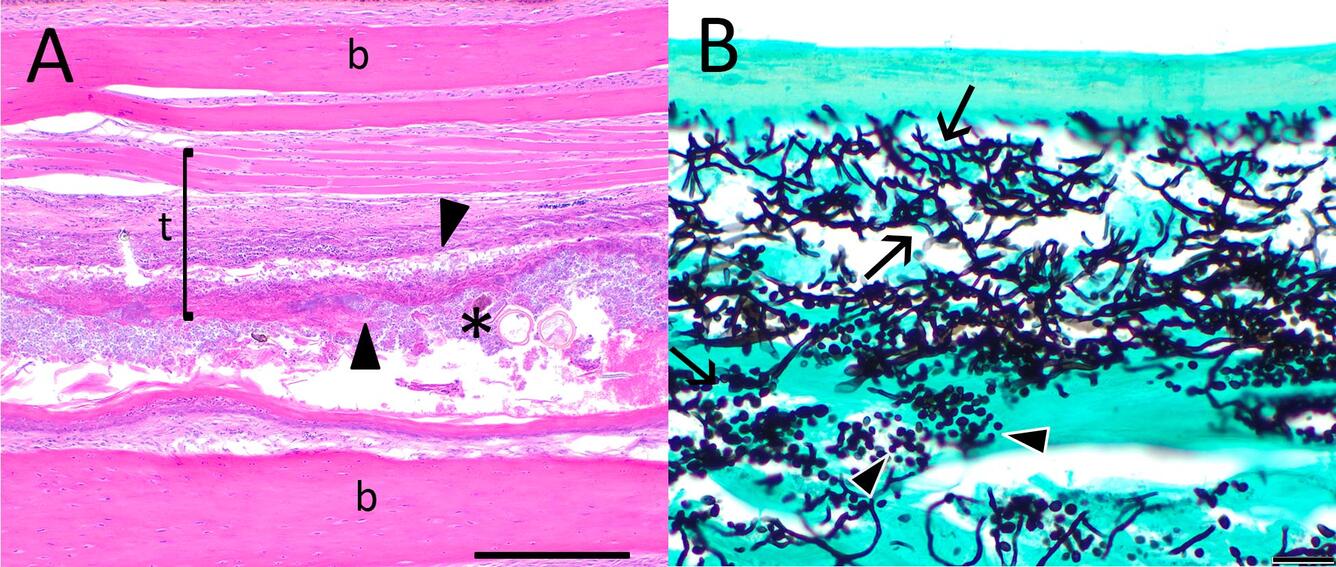
Figure 1. Photomicrographs from a Broad-Tailed Hummingbird (Selasphorus platycercus) collected from Arizona, USA. (A) Longitudinal section of beak (b indicates bone of beak) and tongue epithelium and muscle (t) showing epidermal sloughing, erosion and ulceration (arrowheads) with numerous yeast organisms admixed with bacteria (asterisk) invading epithelium and submucosa. Scale bar 200 µm. Hematoxylin & eosin (H&E). (B) Higher magnification showing oval yeast forms (arrowheads) and hyphal forms (arrows). Scale bar 20 µm. Grocott-Gomori methenamine silver.
Gross and Morphologic Diagnosis: Fungal (biphasic yeast) stomatitis, diffuse, severe, acute.
Disease: Yeast (presumptive Candida spp.) stomatitis.
Etiology: Yeast stomatitis in hummingbirds is widely attributed to contaminated sugar water feeders, or artificial nectar made using honey rather than granulated sugar. It is associated with immune suppression or poor sanitation, and Candida albicans is the most commonly cultured agent (Godoy et al. 2014, Ketz-Riley and Sanchez 2015), however, Aspergillus spp. has also been observed (Harvey-Clark 1993).
Distribution: Worldwide.
Seasonality: No known seasonality, but both nectar feeders and temperatures promoting fungal growth are more prevalent in the summer. Breeding season likely influences prevalence because young birds may not yet be immunocompetent (Friend and Franson 1999).
Host range: Both wild and domestic birds (Haroun et al. 2026), as well as mammals.
Transmission: Yeasts are ubiquitous and usually invade the host opportunistically. Transmission occurs through poor hygiene and ingestion of contaminated food or water, with immunocompromised individuals more susceptible to infection (Friend and Franson 1999, Ketz-Riley and Sanchez 2015).
Clinical signs: White, pseudomembranous plaques in the mouth or crop are frequently observed, and in hummingbirds, a protruding tongue is often reported. Affected birds may be unable to feed and may regurgitate (Ketz-Riley and Sanchez 2015).
Pathology: Candida in birds colonizes the skin and mucosa of the oral cavity or crop. It may be commensal in healthy individuals, but the balance can shift to pathogenic in stressed, young, or otherwise immunosuppressed individuals, or with the introduction of an overwhelming infectious dose. The yeast may then express surface adhesion factors, form a biofilm and produce hyphae or pseudohyphae that invade deeper into tissues causing epithelial damage. Some species and strains express virulence factors promoting invasion. Pollution, heat, habitat loss, vitamin A deficiency and parasitism can synergistically predispose birds to infection (Haroun et al. 2026).
Diagnosis: Direct microscopy of swabs or impression smear of lesions, or histopathology revealing yeast bodies. Culture and biochemical screening or PCR are required for speciation.
Public health concerns: Humans may also contract infections involving mucous membranes or rarely systemic disease, especially if immunocompromised. Poultry or feral pigeons can act as carriers (Friend and Franson 1999, Haroun et al. 2026).
Wildlife population impacts: Infrequent in wild birds.
Management: There are no official management recommendations in wildlife (Friend and Franson 1999), however, since hygiene is a significant risk factor scrupulous cleaning and refreshing of hummingbird feeders may be preventative (Haroun et al. 2026).
References:
Friend, M., and J. C. Franson. 1999. Field manual of wildlife diseases: General field procedures and diseases of birds. Information and Technology Report, Washington, D.C. 438 pp.
Godoy, L. A., L. A. Tell, and H. B. Ernest. 2014. Hummingbird health: pathogens and disease conditions in the family Trochilidae. Journal of ornithology 155: 1–12.
Haroun, M., C. Tratrat, R. T. Mathew, M. Munir, M. N. Sattar, M. Shawky, H. Kochkar, O. N. Aldakhilallah, A. Ghafoor, K. G. B. Turk, A. Geronikaki, and H. S. Ghazzawy. 2026. Avian Candidiasis: A Comprehensive Review of Pathogenesis, Diagnosis, and Control. Veterinary Sciences 13: 171.
Harvey-Clark, C. 1993. Diagnostic exercise: sudden death in colony-housed rufous hummingbirds (Selasphorus rufus)[Aspergillus fumigatus].
Ketz-Riley, C. J., and C. R. Sanchez. 2015. Trochiliformes (Hummingbirds).In Fowler's Zoo and Wild Animal Medicine, E. R. Miller, and M. E. Fowler, (eds.). Elsevier, St. Louis, MS. pp. 209–213.
Related

WHISPers

Pathology Case of the Month

Diagnostic Services
Related
WHISPers
Pathology Case of the Month