



Tracking Chronic Wasting Disease Strains to Understand Transmission and Detect Emerging Threats
At least ten distinct chronic wasting disease (CWD) prion strains with unique biochemical properties affect disease transmission and host range, prompting development and validation of biochemical assays to surveil and track these strains in endemic regions like Wisconsin, with ongoing efforts to standardize these methods for epidemiological tracking and management of CWD variants .
What is the issue

At least ten known variants of CWD prions have been identified. These variants (prion strains) have distinct biochemical properties that alter the transmission of CWD by influencing agent replication, environmental persistence, neuropathology, shedding, and host range. Unlike traditional pathogens, which can be readily characterized by nucleic acid sequencing, prion strain discrimination relies on inferences drawn from an array of biochemical and biological assays.
What's at stake
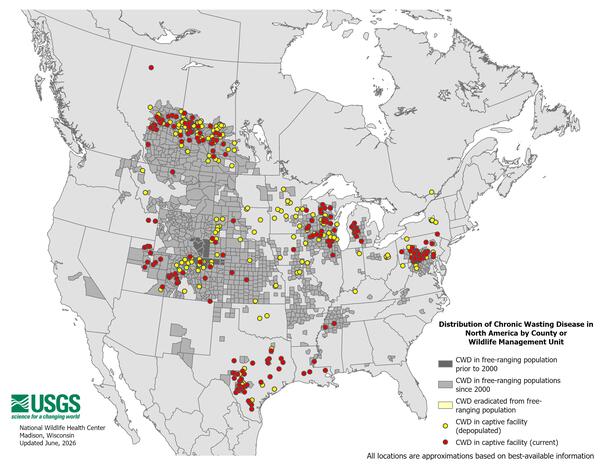
While prion strains are well defined in the laboratory, there is limited information on how CWD strains manifest across the nation, over time, or within endemic regions. Concerningly, CWD strains can change the zoonotic potential of the disease.
What is our approach
Our objectives are to develop and validate biochemical assays that enable surveillance for novel CWD strains, and to use these assays to track disease transmission and identify transmission mechanisms.
To achieve this, we are using an array of biochemical and immunological methods to distinguish laboratory strains of CWD, rigorously validating these assays, and surveying CWD in endemic areas to better understand its natural variation in deer and detect emergent strains.
What are the benefits
Standardizing these assays may enable CWD-positive isolates to be screened for known variants and variant mixtures and allow for the identification of novel emergent strains. Deploying these assays may help managers link new detection events to the existing epidemic, detect new variant emergence, and tailor management actions based on the pathogenic characteristics of the specific variant detected.
Recent accomplishments
Three assays have been validated on reference samples and deployed on a cohort of blinded samples to assess performance with real-world deer samples.
In FY25, we initiated a survey to measure the biochemical properties of CWD prion isolates. These assays probe the structure of each isolate's infectious prions, generating a biochemical "fingerprint" for clustering, comparison, and assessment of strain identity.
In FY26, we increased the number of isolates assayed and produced a detailed description of the biochemical phenotypes in the region under survey, which will serve as a reference for comparison with CWD isolates collected historically and in the future. The biochemical properties of CWD Isolates are also being compared between different states.
Next steps
We are seeking additional support to test the accuracy and reliability of the biomechanical screen methods.
At least ten distinct chronic wasting disease (CWD) prion strains with unique biochemical properties affect disease transmission and host range, prompting development and validation of biochemical assays to surveil and track these strains in endemic regions like Wisconsin, with ongoing efforts to standardize these methods for epidemiological tracking and management of CWD variants .
What is the issue
At least ten known variants of CWD prions have been identified. These variants (prion strains) have distinct biochemical properties that alter the transmission of CWD by influencing agent replication, environmental persistence, neuropathology, shedding, and host range. Unlike traditional pathogens, which can be readily characterized by nucleic acid sequencing, prion strain discrimination relies on inferences drawn from an array of biochemical and biological assays.
What's at stake
While prion strains are well defined in the laboratory, there is limited information on how CWD strains manifest across the nation, over time, or within endemic regions. Concerningly, CWD strains can change the zoonotic potential of the disease.
What is our approach
Our objectives are to develop and validate biochemical assays that enable surveillance for novel CWD strains, and to use these assays to track disease transmission and identify transmission mechanisms.
To achieve this, we are using an array of biochemical and immunological methods to distinguish laboratory strains of CWD, rigorously validating these assays, and surveying CWD in endemic areas to better understand its natural variation in deer and detect emergent strains.
What are the benefits
Standardizing these assays may enable CWD-positive isolates to be screened for known variants and variant mixtures and allow for the identification of novel emergent strains. Deploying these assays may help managers link new detection events to the existing epidemic, detect new variant emergence, and tailor management actions based on the pathogenic characteristics of the specific variant detected.
Recent accomplishments
Three assays have been validated on reference samples and deployed on a cohort of blinded samples to assess performance with real-world deer samples.
In FY25, we initiated a survey to measure the biochemical properties of CWD prion isolates. These assays probe the structure of each isolate's infectious prions, generating a biochemical "fingerprint" for clustering, comparison, and assessment of strain identity.
In FY26, we increased the number of isolates assayed and produced a detailed description of the biochemical phenotypes in the region under survey, which will serve as a reference for comparison with CWD isolates collected historically and in the future. The biochemical properties of CWD Isolates are also being compared between different states.
Next steps
We are seeking additional support to test the accuracy and reliability of the biomechanical screen methods.